
This article is written by Conrad Kraft, Apolitical Insider Fellow, full-time student and former Deputy Director for Municipal Finance at the KZN Provincial Treasury, South Africa. This article is edited by Laelie Greenwood, Apolitical Fellow and Research Officer on the Better Governance and Policy initiative at Monash University, Melbourne.
In 1976, students protested against a decree by the Apartheid Government to use Afrikaans as a medium of instruction in South African schools. A few months earlier, the then Deputy Minister of Education infamously stated, “I have not consulted the African people on the language issue and I’m not going to”.
Want to write for us? Take a look at Apolitical's guide for contributors
The protest led to the massacre of 176 people. Mostly children. It was a harsh lesson on the importance of citizen participation. The massacre ignited a wave of protests across South Africa that lasted over a decade and attracted the attention of the international community. These events ultimately led to the fall of Apartheid and a new normal for South Africa.
Whilst the effects of poor public participation are not always so immediately disastrous, the gradual erosion of public trust and the insidious estrangement of citizen and state it creates, can lead to the dismantling of hard-fought civil liberties and ultimately, social discontent.
What is public participation and why is it important?
Public participation or citizen engagement can be thought of as the processes that ensure the sentiments of citizens are reflected in the way a country operates. More formally, the United Nations Department of Economic and Social Affairs defines public participation as “the involvement of citizens in the decision-making process of the State – through measures and/or institutional arrangements - to increase their influence on public policies and programs, ensuring a more positive impact on their social and economic lives.”
While public participation has many forms and takes place at many levels, governments should explore and institute a broad spectrum of methods and tools to achieve meaningful public participation.
The International Association for Public Participation outlines multiple processes towards achieving meaningful participation outlined in the below graphic.
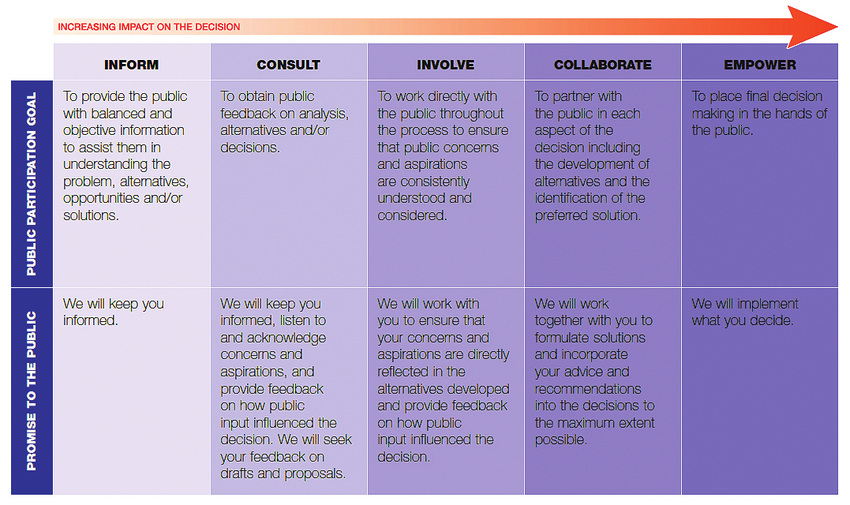
Source: International Association for Public Participation
Public participation is the cornerstone of sound, democratic decision-making, improved policy development, increased government responsiveness, and strengthening citizen trust in public institutions.
For governments, successful public participation has several benefits, including:
accessing and leveraging local information and expertise;
empowering and liberating marginalised groups of society;
creating legitimacy of decision-making;
early identification and resolution of conflict; and
fostering good citizenship skills amongst the public.
Public Participation during Covid-19
In response to the Covid-19 pandemic, many governments across the world have imposed national lockdowns and prohibited gatherings of more than 15 to 50 people at a time. This has impeded traditional public participation initiatives that rely on in-person interactions such as public meetings and face-to-face surveys.
The challenges presented by the lockdowns should not result in the suspension of meaningful public participation. Instead, countries should utilise the lockdown period as an opportunity to modernise and future-proof their public participation tools and processes.
Digital participation
Digitising the public participation process (e-participation) holds great promise to enhance citizen engagement. In comparison to legacy engagement methods, digital engagement offers significant advantages such as greater citizen reach, costs savings, immediacy of information, and increased communication symmetry. To realise these advantages, governments must not only create digital versions of existing participation tools, but also develop new participation channels, mechanisms, and metrics.
When developing engagement tools, governments should consider the tools that are commonly used by citizens. While it might be tempting to make use of emerging technologies, the focus must be placed on the inclusivity of citizens
Moreover, incorporating technology in public participation processes enhances digital governance, and prepares both governments and citizens for the inevitable shift towards smart cities and digital societies.
To increase the effectiveness of modernising engagement efforts, governments should consider the following measures:
Develop “user-centred” digital government processes
With the growing use of popular internet services, citizens have become accustomed to intuitive and seamless digital engagement experiences. Adopting similar user-centric design philosophies employed by popular online platforms will help to align public engagement experiences with citizen expectations.
This could be best achieved by directly employing public servants with skills in emerging technologies like data science, machine learning, digital design, and computer science rather than outsourcing these high-tech skills. Not only would this assist governments in innovating service delivery, but it would also enable better deliberation of key future digital policy decisions.
Create inclusion
When developing engagement tools, governments should consider the tools that are commonly used by citizens. While it might be tempting to make use of emerging technologies, the focus must be placed on the inclusivity of citizens. This requires a keen understanding of citizen behaviour and their level of technological adoption.
Governments play an important role in achieving inclusive engagement with citizens. This role not only includes designing and utilising tools with the greatest level of inclusivity but also establishing infrastructure that supports widespread access to ICT and cultivating digital competence among its citizens.
Overlooking the importance of inclusive engagement risks amplifying existing biases in public participation data, and may result in ineffective policy development and decision-making.
Clearly link participation and decision-making
A common concern amongst citizens is that their input in public participation processes will ultimately lead to nothing. This discourages many citizens from engaging in public participation initiatives and leaves citizens disenchanted with government responsiveness. To safeguard against these risks, governments must develop and promulgate a formal process of incorporating citizen input into decision-making.
Firstly, related to service delivery, this means governments will respond to citizen feedback by requiring service providers change their approach to service delivery. Second, governments should publicise their clearly defined, step by step process of integrating citizen feedback into real policies.
Covid-19 has devastated and disrupted our world. It has forced us to rethink our definition of “normal”. The pandemic, however, also offers an opportunity to mend the often-adversarial citizen-state relationship. What better time than now to include all voices in creating a “new normal”. One in which we all have a say. — Conrad Kraft
(Picture credit: Unsplash)
Make sure to share your own thoughts with the author by leaving a comment below

Log in or sign up to continue the conversation