
This article was written by Shruti Kapoor, founder of Sayfty, an NGO focussed on preventing gender based violence. For more like this, see our gender equality newsfeed.
Governor Kay Ivey (R) of Alabama State last week passed the most stringent abortion law in the nation, making performing abortion (unless necessary for the mother’s health) a felony in nearly all cases with no exception for cases of rape or incest. Anyone performing abortion could be punished with up to 99 years or face life imprisonment.
• Want to write for us? Take a look at Apolitical’s guide for contributors
In 1973, in the landmark Roe v. Wade case, the Supreme Court legalised abortion nationwide. Alabama is not the only state to have gone against this ruling; Kentucky, Mississippi, Ohio and Georgia have approved bans on abortion once a fetal heartbeat is detected (as early as six weeks of pregnancy). And while none of the laws have taken effect, thousands of protestors marched to the Alabama capital on Sunday chanting “my body, my choice”.
Social media was abuzz with angry reactions, women sharing stories of how abortion saved their life and witty memes. President Donald Trump, while not mentioning Alabama's law, wrote in a tweet that he is strongly "pro-life" but favours exceptions.
"As most people know, and for those who would like to know, I am strongly Pro-Life, with the three exceptions - Rape, Incest and protecting the Life of the mother - the same position taken by Ronald Reagan,” he wrote on twitter.
What are the long-term consequences?
So, what might be in store for the women of Alabama?
Between 1966 and 1990, the communist regime in Romania banned all forms of contraception and abortion. Drawing from this Real Life Test case, here are the repercussions of when a country bans abortion.
While initially, as in the case of Romania, the country will see a spike in the birth rates, in the long run that won’t be sustainable. Women will eventually find a way around the ban. They might travel to other states that allow an abortion. Those rich enough might even bribe doctors to perform one in their hometown.
The ones who really bore the brunt of the ban in Romania were the low-income women and disadvantaged groups. According to Staci Fox, CEO and president of Planned Parenthood Southeast, “Banning abortion does not stop abortion. It stops safe abortion”.
Abortion-rights advocated in the United States fear that women might eventually turn to home and back-alley routes for abortion, putting their lives in danger due to the unsafe procedures. In Romania, by 1989, more than 10,000 women had died from unsafe procedures.
In Alabama's legislature, women hold only 22 seats out of the 140
Also, think about all the unwanted children who might be abandoned because say, for example, the mother, a rape victim, didn’t have a choice but to give birth but in no way wanted to raise her rapist’s child. Charles Nelson, a professor of pediatrics at Harvard Medical School asks in an interview with Foreign Policy “Does the state have the bandwidth to take care of those kids and support the families?”
More women needed
The photograph of 25 white men deciding the fate of women’s bodies is what led us here.
We need more women in the conversation, in positions of power so that they can influence policy decisions, allocate gender-specific budgets and not let a bunch of men decide the fate of millions of women!
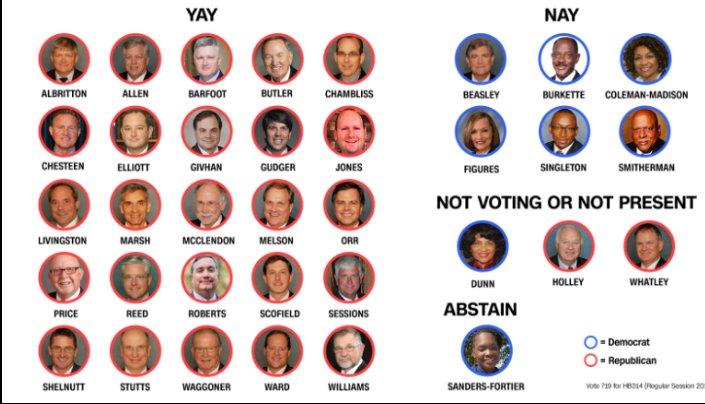
(Image via twitter).
In Alabama's legislature, women hold only 22 seats out of the 140. Across Alabama, in as many as 67 counties, a culture of silence persists when it comes to women’s health. The states’ approximately 2 million women have very few options for specialised care, especially in rural areas.
In almost half of Alabama’s counties, there are no doctors who specialise in women’s health. Alabama has some of the nation’s worst figures when it comes to infant and maternal mortality.
In this sense Alabama’s health problems run deeper than just an abortion issue. — Shruti Kapoor
(Photo credit: Death to the stock photo)
Make sure to share your own thoughts with the author by leaving a comment below

Log in or sign up to continue the conversation