
This piece was written by Lea Simpson, co-founder of Brink and leader of the Frontier Technologies Hub funded by DFID. For more like this, see our government innovation newsfeed.
Picture this: you are a farmer in rural Mozambique. You have a cough. You walk five miles to your nearest health clinic to have a tuberculosis test. Two weeks later you go back to find out the results, only to be told the sample didn’t make it to the laboratory.
Could drones make this last mile dependable and efficient?
Here’s another example: You are an adolescent woman in a slum in Malawi, vulnerable to sexual violence. Emergency contraception might just provide you with a lifeline, but the only access point free from stigma is a contraceptive vending machine that is out of stock.
Could Internet of Things-enabled vending machines prompt for stock fulfilment when they run out to make this resource more reliable?
New tech, old problems
These are just two examples of how emerging technologies are giving us new ways of tackling some of humanity's oldest and trickiest problems. But easy fixes are hard to find — even with the smartest new technology.
• Want to write for us? Take a look at Apolitical’s guide for contributors
The Frontier Technologies Hub, funded by UKAid, is designed to explore the application of frontier technologies like drones and Internet of Things (IoT) to solve humanity’s biggest, global development challenges
The Frontier Technologies Hub works with the UK Department for International Development (DFID) Advisors around the world to rapidly test whether a technology might solve a development challenge. We do this by providing:
- Funding to pilot new ideas
- Matchmaking DFID advisors with technology specialists and innovators
- Support to work in new, agile ways with the Frontier Tech Hub
The programme launched in November 2016 and boasts a current portfolio of 22 pilots, in 12 countries around the world.
The non-tech challenge
These years of experience have taught us that technology’s potential to unlock positive progress is often hampered by things that have nothing to do with technology at all.
Regulatory constraints, business model sustainability, supply chain logistics and other intangible cross-cutting challenges are some of the most common obstacles faced by our pioneering teams across the world. Our teams are usually cross-organisational and geographically diverse, consisting in a mix of local players, domain experts and technologists coming together for a shared purpose.
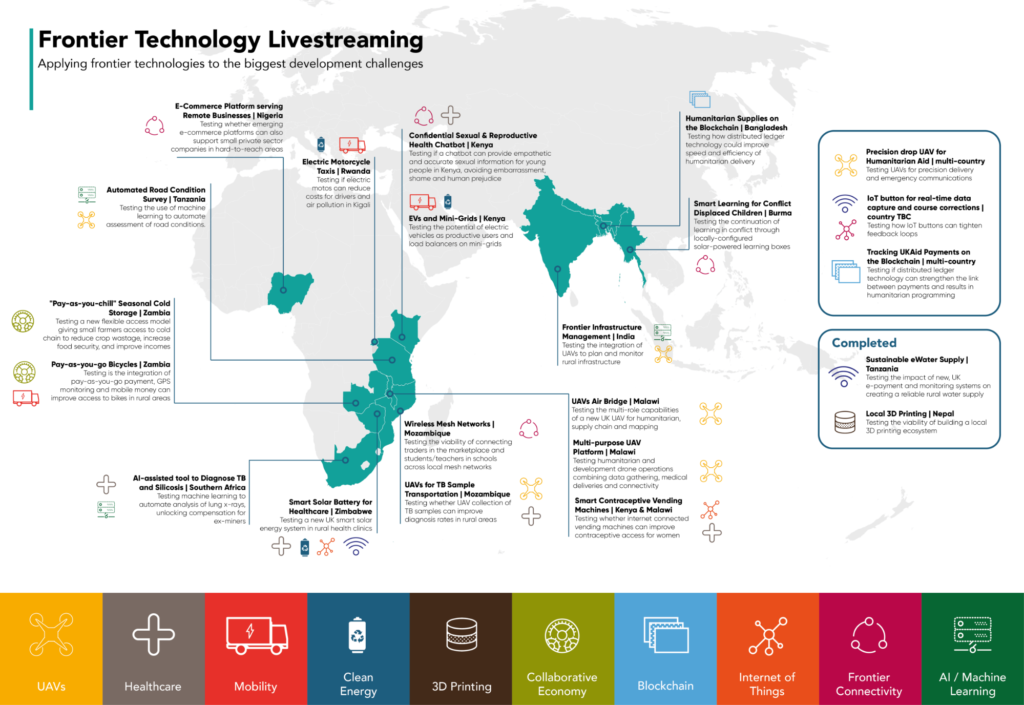
Different technologies all come with different technical challenges. That’s a given.
But often, the non-technical challenges that need to be overcome for technologies like 3D printing, drones, internet of things, blockchain and electric vehicles to operate at scale and create impact can be just as complicated and intractable as the most advanced technology.
We recently conducted an analysis of these key non-technical challenges facing our portfolio of tech use cases. From a long-list of 20+ challenges, six were identified as “key”: these are the challenges that are encountered most frequently and with the greatest intensity.
This analysis of challenges and the various strategies or “plays” used by the teams to overcome them have fed into the first edition of our Frontier Tech Playbook.
The 6 key challenges
- Regulatory barriers: this is defined as a non-favourable regulatory environment i.e. one that is non-existent, not keeping pace with technological change, difficult and costly to engage with, and so on.
One such example can be found in Zambia, where We’re piloting pay-as-you-go bikes with the team at Onyx, a Zambian tech startup.
The bicycles are paid for in monthly instalments using mobile money and equipped with solar lamps and GPS. Tracking the bikes is how we intend to find them if payments aren’t made or bikes are stolen.
However, the regulation related to tracking in Zambia means that it takes ages for approvals to go through, and the whole process is very expensive.
So instead of waiting for this paperwork, we began in the pre-scale phase by distributing eight bikes and told users of the service that the GPS tracker was switched on, even though it actually wasn’t.
This allowed us to begin testing other things like logistics, perception of lease-to-own as a business model, and bike use. While not directly solving the regulatory hurdles, this workaround mitigated one their most negative consequences — a loss of time and momentum to test whether the concept works.
- Supply chain infrastructure: in many countries, the supply chain infrastructure is not good enough to support tech operating at scale. This means that moving physical hardware from A to B, or procuring necessary parts and equipment locally, either isn’t an option or is very difficult and costly.
In Zimbabwe internet of things (IoT) connected solar energy systems are being installed in rural health clinics. The remote locations rely on elaborate and different supply chain partners to deliver and install the solar kit.
To ensure quality standards, we ran a couple of installation processes end-to-end and co-created an easy to understand guide to getting the job done to help with this recurring challenge.
This meant that any scaled up operation would have a much more robust, tighter understanding of what needs to be built, shipped and procured for a successful installation. Focusing on creating and iterating this end-to-end guide pre-scale up has enabled us plan installation and procurement in a much more rigorous way.
- Skills infrastructure and ecosystem: there is a shortage of technical skills for local installation and maintenance of tech, or a lack of local ecosystem to develop and sustain the technology.
In Nepal, we worked with Field Ready to explore manufacturing-on-demand using 3D printers. Nepal has the beginnings of a 3D printing sector, with several start-ups already working in this field.
Beyond incubating the technology, this work required the team to incubate the sector itself, which it did by establishing the Forum for Digital Manufacturing, a membership body for 3D printing organisations in Nepal.
Giving local organisations prominence and a combined voice (instead of bringing tech in from outside Nepal) gave us local insight into critical leverage points, such as import costs and filament production.
It has created a buzz around 3D printing, helping to attract Nepal’s abundant engineering talent to the sector. It has also created a focal point for a network and ecosystem that can sustain the technology.
- Fitting into existing systems: often, new technologies don’t fit existing planning, decision making, execution or local implementation systems.
To address this challenge, we’re working with blockchain service provider Datarella to explore the potential of Blockchain to increase trust and cost effectiveness in the humanitarian supply chain.
This pilot, like many others in our portfolio, exists within the context of a complex stakeholder network and system — and in each case, a wrong guess or a faulty assumption about the repercussions or impact of our work in one place can have a massive ripple effect.
We work to limit our reliance on guesses by regularly checking in with quick “if this, then that” questions via a survey. This survey was delivered to both donors funding humanitarian aid, and implementers delivering it on the ground.
We asked questions around the user interface, what benefits were most important, and what we needed to consider for this new blockchain tool to actually be used in humanitarian response. These surveys were a quick and easy way for us to sense and respond how best to make progress.
- Sustainability post-pilot stage: this problem arises when the tech use case is not sustainable after the pilot stage, either through donor funding, private investment, government take up or commercial revenue.
Financial security is, unsurprisingly, a significant non-technical challenge for almost all of the pilot teams we work with.
Often work done by grantees in the public sector struggle to attract long-term investments. It’s not unusual for teams to work through the grant finance stage, generate evidence and then take that evidence to organisations that might fund them to maturity, only to be disappointed by the result.
We work to get ahead of these challenges by connecting early with potential future funders, and asking them “If we manage to deliver X, would you be interested in funding us?”
In Rwanda, we’re working with Ampersand — a local manufacturer of electric motorcycles — to switch the moto market to electric bikes in order to decrease costs for customers, improve livelihoods for drivers, and reduce emissions.
The team in Rwanda spoke to five local donors/investors active in cleantech, asking what it would take for them to invest, pushing for metrics and clear answers: for example, when they said they wanted to see “bikes on the road,” we asked “how many?” We looked for the most frequent topics and comments to help guide us on what to focus on going forward.
- Awareness building: finally, one of the biggest challenges we face is that our end users (person or organisation) is often not aware of the tech or its benefits.
We could build the most compelling product or solution to a previously intractable problem, but if people don’t know it’s there, or we haven’t taken the time to make our offering attractive to the end user, it won’t make a difference.
Along with testing the tech, every pilot project has to be strength-tested to make sure that it’s being built in line with end user needs. Still, in Rwanda, the team at Ampersand worked with early motorbike prototypes to test and learn what design of bike was most attractive to taxi drivers.
Through workshops with the prototype bikes, followed by customer interviews, we discovered that moto drivers rejected any feature that made the bike feel "futuristic" or "special" — instead wanting to keep to the design and feel they were familiar with.
Just as importantly, our workshop participants created a “buzz” around these new electric motos, and emphasised as trusted sources to their colleagues and friends that the bikes rode just as well as their petrol counterparts.
Without appreciating and responding to the non-technical, cross-cutting challenges described above, any tech solution will find it difficult — if not impossible — to endure and scale.
Today, our most successful pilot projects are “hacking” their way through and around these non-technical challenges. For governments, appreciating and responding to the non-technical and cross-cutting barriers is essential to realising the exponential impact we believe frontier technologies promise. — Lea Simpson
(Picture credit: Unsplash//Frontiers Hub)
Make sure to share your own thoughts with the author by leaving a comment below

Log in or sign up to continue the conversation