
This article is written by Scott Edwards, Innovation Facilitator and Business Analyst, Government of Manitoba.
What you're about to read might sound familiar. You are going about your daily work—perhaps analysing statistics, writing policy documents or responding to email after email—when you are suddenly pulled into a meeting and asked to come up with the next big idea or a solution to a burning problem.
I know this happens to me all the time. And switching from analytical to creative thinking in these situations can be tough. Like any muscle, your brain needs to warm up before you put it to work. But, it can also be necessary to switch between modes, especially as urgent problems arise.
To help you get those creative juices going, I have compiled a list of games and group exercises that I have found helpful, and that I think you and your team will benefit from. They allow everyone to have a little fun, loosen things up, and get into an innovative mindset before diving into the real problem solving.
1. Unfinished artwork (5 to 10 minutes)
Take a few pieces of paper—one for each member in your team—and draw a random shape on each. Something like a letter of the alphabet or an odd squiggle. Just keep it simple.
Take those sheets and hand one to each team member. Give everyone a few minutes and see what they come up with based on that starting shape. Speed is key. Don’t think, just draw. When the time is up, each team member should share their artwork with the group.
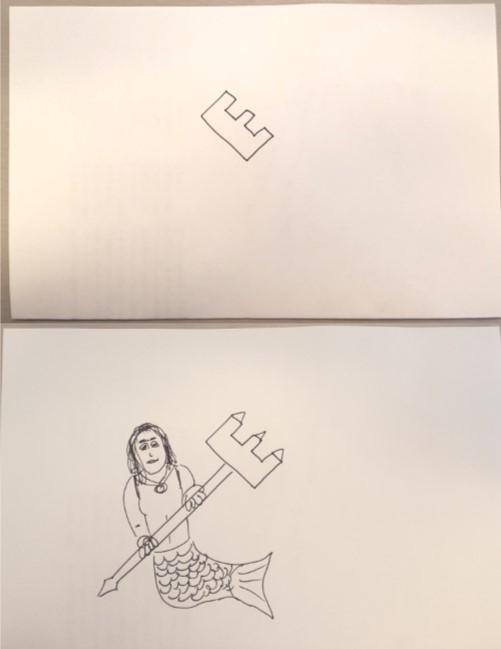
(Artistic talent is not a requirement, as you can see from my merman example.)
This is perfect for building comfort with constraints, which helps to focus ideas. When dealing with real problems, our starting point and acceptable boundaries for creative ideas is often limited. By using a given object to start from, the team learns to create something around what exists.
You can add another level to the exercise by identifying a theme for the drawings.
2. “Yes, and” pictures (5 to 10 minutes)
Give each person in the group a pen and a blank sheet of paper.
Once everyone is ready, give them 10-20 seconds to start drawing a picture. Once the time is up, each person then passes their paper to the person on their right (or left if you want to go crazy with it!) to continue the drawing. Repeat the process until each new masterpiece comes back to the original owner. Share what the group came up with with everyone.
Human creativity usually peaks when we are five years old.
This tool supports the concept of building on others’ ideas rather than tearing them down. Having the pictures on paper, it is not easy to undo something done by another. You can only add to it. Creative and divergent thinking thrives on having a safe space to share ideas.
3. Play like a preschooler (10 to 20 minutes)
The concept of 'loose parts' is often used as a creativity and learning tool for preschoolers in many childcare settings. Well, it works for adults too.
Gather a bunch of objects and use them to create something. It can help if you identify a theme for the creation. Items like pens, paper clips, note pads, plastic cutlery, staples, erasers, and whatever else you can find in the drawer at your desk, office lunch room, or supply closet. Allow about 10 to 15 minutes to create something individually or as a group, then share the result.
This exercise is grounded in a fact that may sound a little scary, but I have read it in many places: Human creativity usually peaks when we are five years old. Our creativity goes downhill as a result of learning the “rules” of the world, which artificially limits what is possible. So if this 'loose parts' activity gets you acting like a preschooler, that is a good thing, as it breaks you out of your routine way of thinking.
4. Alternate use pitches (10 to 15 minutes)
Take any object and come up with a quick sales pitch about how it is used. The catch is, it cannot be for its actual real life use.
For example, I pick up a stapler: “Check this out. This is a Staplograph (pronounced Stah-plo-graf). It is the latest craze in the hand-held instrument market. You hold it in one hand and squeeze it to make a 'ka-chunk' sound. It takes some time to develop serious skill, but once mastered, it is a perfect compliment to any band’s sound.”
It sounds silly, but that is the point. Bad idea or good, it is the breaking of the real life “rules” of the object which provides the creative value here. We often need to find alternative ways to accomplish something using the resources we have. This is a great way to get people looking at things from different angles.
5. Backronym game (5 to 10 minutes)
Take a few random letters and challenge everyone to create a backronym of it. Each person only gets about 30 seconds or so to write down their version and share them.
For example: N.W.F.Q.—New Walls Fall Quickly, Nine Wanderers Find Quicksand, Next World Fun Quota.
Repeat this a few times, with a new set of letters each round.
I like this one because it is so simple and fast-paced. You really only have time to get the first words that pop into your mind out and there is no time for filtering. The worst thing for ideation is when people are converging on their ideas before they even get them out. This teaches (and forces) people to get their thoughts out quickly. Quantity breeds quality and every idea can spark an even better one.
These are but a few of the many games and tools you can use to get people into a creative space where ideas can start to flow freely by injecting a sense of fun into the session, which I find is a huge booster. I love to use them as the icebreaker for creative sessions, or to kick off a meeting. You can also use these on your own to engage the right brain and relax the left.
Feel free to take these tools and add your own spin (innovation!).
👋 You can create a post like this one! Share your thoughts with a community of public servants. Learn more
(Image Credit: Unsplash)
Make sure to share your own thoughts with the author by leaving a comment below

Log in or sign up to continue the conversation