
This article is written by Debbie Rosen, science and policy manager for the CONSTRAIN project
Both climate change and Covid-19 are threat multipliers, meaning they exacerbate existing problems and hit the most vulnerable the hardest.
At the time of writing, several countries are battling a second wave of coronavirus, whilst 2020 has just been declared the joint warmest year on record. With this in mind, you could be forgiven for thinking the future looks rather bleak. However, we still have a chance to change this outlook.
- Want to write for us? Take a look at Apolitical’s guide for contributors
As part of our work for CONSTRAIN (a consortium of 14 European universities and climate institutes), we recently developed a report that highlights how the economic recovery from Covid-19 could slow down global warming compared to recent trends by up to half, as well as limit the total amount of warming we experience — if we make the right choices. By taking action that tackles both crises, we can ensure that a more resilient world emerges on the other side.
With global temperatures now almost 1.2°C above pre-industrial levels, limiting warming to 1.5°C, in line with Paris Agreement ambitions, means taking urgent and decisive global action.
Without it, we look set to exceed 1.5°C before mid-century, risking more frequent and more extreme climate impacts.
The climate debate often focuses on how global temperatures might change by the end of the century, depending on the greenhouse gas emissions pathway we follow, but policy decisions are made on much shorter timescales
As part of the second ‘Zero In’ report, CONSTRAIN explored what the latest climate science tells us about avoiding dangerous climate change in light of Covid-19. We show that a strong green economic recovery could cut the rate of temperature rise by up to half, giving us more time and space in the coming decades to plan for and adjust to whatever climate impacts do come our way.
Our approach, developed by CONSTRAIN researcher Christine McKenna, combines climate modelling results with real-world measurements to show how a strong green recovery could both halve global emissions by 2030, and slow down global warming by up to half its current rate. Doing so means cutting emissions hard and fast, investing 1.2% of GDP in green technologies and industries, whilst refusing to bail out fossil fuel companies.
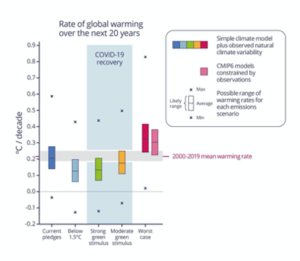
Near-term (20 year) warming trends for pathways exploring two Covid-19 recovery options (following moderate and strong green stimulus pathways) compared to current emission reduction pledges (following Nationally Determined Contributions or NDCs), a pathway limiting warming to below 1.5°C by the end of the century and a worst case, no-mitigation fossil-fuelled scenario. Moderate green stimulus (orange bar) reflects an 0.8% increase in investment in low-carbon technologies whilst that for fossil fuels falls by 0.3%, a 35% decrease in greenhouse gas emissions by 2030, and global net-zero CO2 by 2060. Strong green stimulus (green bar) reflects a 1.2% increase in investment in low-carbon technologies, and a fall of 0.4% in fossil fuels investment, a 50% fall in greenhouse gas emissions by 2030, and global net-zero CO2 by 2050. All pathways account for current natural climate variability effects. The mean warming rate over the last twenty years is shown with a red line (range shown in grey).
This level of action would also get us on track for net-zero by mid-century, and give us a good chance of keeping temperature rise below 1.5°C.
We must do all we can to ensure that the political decisions made this year give us the best chance to cope with unavoidable climate impacts, stay within 1.5°C warming, and avert a full-blown global climate catastrophe
The climate debate often focuses on how global temperatures might change by the end of the century, depending on the greenhouse gas emissions pathway we follow, but policy decisions are made on much shorter timescales. Alternatively, by highlighting the opportunity to cut warming rates in the near future through investments made now, we hope to inspire action at a critical time for both climate and wider economic, societal, and humanitarian issues.
Slowing down warming, and avoiding the most dangerous repercussions of climate change, is therefore still very much on the table — but only just. With the US now re-entering the Paris Agreement, and countries and corporations increasingly setting net-zero emissions timelines, things are looking more hopeful. However, the current state of global ambition is still not enough.
Instead, climate targets and action need to be joined-up with the vast sums being invested in Covid-19 economic recovery packages. Otherwise, recovery-related emissions that rise above levels projected before the pandemic cannot be ruled out, depleting the remaining carbon budget and pushing 1.5°C further out of reach.
With thoughts now turning to June’s G7 summit, a major milestone on the road to the COP26 climate conference now scheduled for November 2021, we have a real opportunity to drive these issues home on the global stage. We must do all we can to ensure that the political decisions made this year give us the best chance to cope with unavoidable climate impacts, stay within 1.5°C warming, and avert a full-blown global climate catastrophe. – Debbie Rosen
We want to hear what you think about this article. Pitch an article to us or send your comments to hello@apolitical.co
(Picture credit: Unsplash)
Make sure to share your own thoughts with the author by leaving a comment below

Log in or sign up to continue the conversation