
This article is written by Tero Väänänen. NHS Digital’s Head of Design
Strategy is how we get from where we are now, to where we want to be. It’s as much about saying what we’re not going to do, as it is about deciding what we will do.
Strategy focuses the organisation’s efforts towards a common goal. User-centred design is one of your best tools to define that.
What is user-centred design?
The term “design” is often incorrectly used to describe the form of the end result. What it looks like or how it feels. But design is actually a creative process to solve complex problems.
- Want to write for us? Take a look at Apolitical’s guide for contributors
Using design methods to solve complex problems is sometimes called “design thinking,” but design is as much about delivery as it is about thinking about how to solve the problem. The American writer Jared M. Spool describes design as:
“…the rendering of intent. The designer imagines an outcome and puts forth activities to make that outcome real.”
This is what we advocate in NHS Digital, the national information and technology partner to the UK’s health and care system. Only by creating something of what we have envisioned can we find out whether our design will actually work as intended and how we should develop it further.
Whether you’re a programme director, policymaker or service owner tasked with delivering “a thing”, you can’t go wrong by working closely with a multidisciplinary user-centred design team
The design process involves many more specialists than just designers. We cannot define a problem without insight from user researchers. We can’t understand whether something is clinically safe without expertise from our clinical leads. Nor do we know how best to technically architect the underlying systems. The design of whole services requires the involvement of technical colleagues, operations specialists and more.
User-centred design is a well-established discipline; the ISO 9241-210 “Human-centred design for interactive systems” international standard was initiated over 20 years ago, and the six principles in it are the foundation to our own NHS design principles in our NHS digital service manual. The six principles for user-centred design the ISO 9241-210 provides are:
The design is based upon an explicit understanding of users, tasks and environments
Users are involved throughout design and development
The design is driven and refined by user-centred evaluation
The process is iterative
The design addresses the whole user experience
The design team includes multidisciplinary skills and perspectives
These six principles are valid whether you are designing a product, a service or a strategy.
Can you design a strategy?
In his book “Good strategy/Bad strategy,” Professor Richard Rumelt describes good strategy as having “coherence, coordinating actions, policies, and resources so as to accomplish an important end.__” He goes on to describe how many organisations don’t have this, but instead have _“_multiple goals and initiatives that symbolise progress”.
To achieve real progress you need a strategy, and to achieve this, ruthlessly prioritising your activities is key. The best way to do this is to focus on our users, their needs and figure out how we can help them achieve their goals.
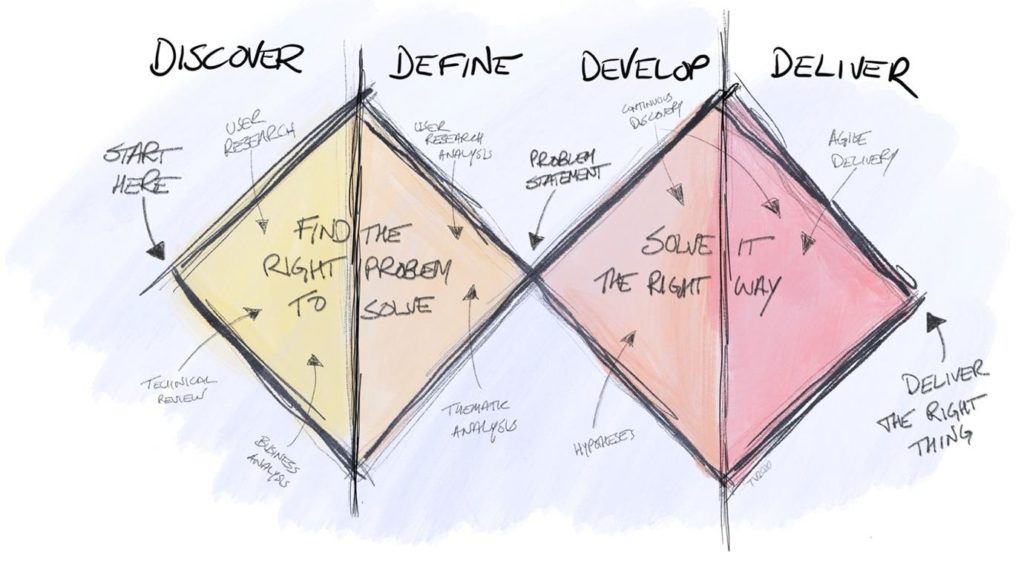 The double diamond design process adapted from the UK Design Council’s original model, describing a design process from the early discovery to delivery.
At NHS Digital, when we discuss our approach to user-centred design, we often refer to the “double diamond” model created by the UK Design Council. This model starts by asking what the right problem is to be solved and then continues by helping you to solve it the right way.
The strategy is delivery, but user-centred design is the strategy to deliver the right things
This is exactly where a good strategy starts from; by understanding what the problem is to be solved and what the future looks like when we have solved it.
What follows is an iterative process which allows us to explore the different opportunities, validate our decisions quickly and inexpensively, discard choices that will not work and keep those that do.
Designing under pressure
An iterative design process reduces the risk of delivering the wrong thing.
At no other time has this been more important than during the on-going coronavirus pandemic. During a crisis, existing complexities increase exponentially. We have less time, more pressure and everybody working on delivering the solutions is more stressed, tired and emotionally drained. Everyone working at the NHS wants to do the right thing to help the public take care of themselves and their loved ones.
At NHS Digital, we quickly adapted the way we do user research to be able to conduct interviews and prototype testing sessions remotely — to feed the users’ needs into the process and help to drive the strategic decisions.
At times, although not as often as we would’ve wanted, we worked directly with policymakers to create a more user-centred policy with a greater chance of achieving the policy’s desired outcome.
In some of our early coronavirus projects, our user research participants were not diverse enough. As a result, we changed the way we do user research and made sure we included users who are seldom heard but disproportionally more severely impacted by the coronavirus, such as black and Asian communities, and people with physical, emotional and cognitive barriers to accessing services.
We listened to the impact that the coronavirus pandemic is having on these communities and fed this back into our strategies of how we design our services going forward – making sure we’re not excluding these users.
Design as strategy
In 2001 the Danish Design Centre published the Design Maturity Ladder consisting of four steps; from the first step where design in an organisation is non-existent to the highest step where design is seen as a key strategic element in running the business.
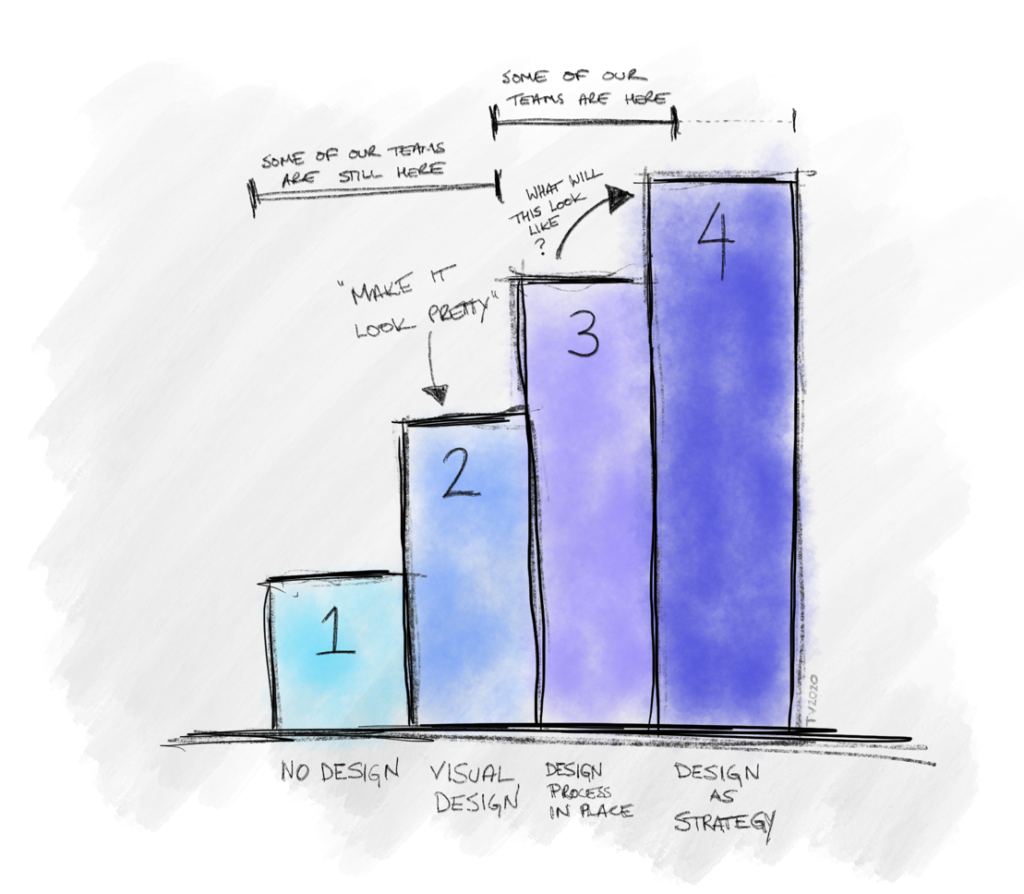 The design maturity ladder adapted from the Danish Design Centre’s original model, describing the four steps of design in an organisation.
This model is useful in identifying how mature design is in an organisation, but different teams and departments may not all be at the same level. At NHS Digital, some departments and teams are definitely on the third step — “Design as process”. They have an established multidisciplinary team with a user-centred design process and they conduct regular and frequent user research to evaluate the design iteratively. Some of these teams are even working closely with our commissioners to define the future roadmap and strategy based on our service design thinking and service catalogue.
However, other parts of the organisation are still on the first two steps of the ladder. We are spending time with these departments to understand their barriers to adopting a user-centred design process and demonstrating how design can help them to create a believable and solid strategy going forward.
So, here’s the thing... Whether you’re a programme director, policymaker or service owner tasked with delivering “a thing”, you can’t go wrong by working closely with a multidisciplinary user-centred design team. They will help you to identify your users’ needs and ensure you follow an iterative process — navigating through the forest of right and wrong assumptions. This is about delivering the right thing to get the adoption, realising the benefits you have set in your business case and creating value for the service user and thus to the service provider itself.
Mike Bracken’s “the strategy is delivery” mantra is more important than ever before, as we seek to fail fast and then rapidly iterate to fix issues on services. But as Richard Rumelt put it in his book Good Strategy/Bad Strategy: “The master strategist is a designer.”
The strategy is delivery, but user-centred design is the strategy to deliver the right things. — Tero Väänänen
We want to hear what you think about this article. Pitch an article to us or send your comments to hello@apolitical.co
(Picture credit: Unsplash)
Make sure to share your own thoughts with the author by leaving a comment below

Log in or sign up to continue the conversation