
This article is written by Signe Hanson, senior policy analyst at Manitoba Justice.
As public servants, time is our most precious and finite resource. It is the thread that intricately weaves the fabric of our work days together. And while time is a constant, it always seems to be in short supply. Have you ever caught yourself picturing what you could accomplish, the problems you could help solve, the connections to community you could make, if you just had a little more time?
Virgil said it best when he wrote: “Time is flying, never to return”. While we cannot get back time spent or lost just yet (Stephen Hawking never completely ruled out time travel, so I am hopeful), we can choose to be conscious of how we manage our time going forward. Here are three tips to help you do just that.
Want to write for us? Take a look at Apolitical's guide for contributors
Set a daily priority
Start each day by identifying one priority. This is a major task that, come hell or high water, you will make sure gets done.
To select your priority strategically based on urgency, value and time, ask yourself a few quick questions: Do I have any upcoming deadlines? What will best support my project and team? What can I realistically accomplish today based on my calendar?
Time management is as much about finding time to do everything as it is about finding time to do nothing (work related)
Reflect on when you work best and schedule uninterrupted time to get it done. By the end of the week, you will have completed at least five strategic priorities to advance your work.
Working in the public service, some days it can feel like everything is a priority. For a long time, I struggled with lengthy to-do lists that never seemed to end. When one task was crossed off, three more were added. This approach left me feeling unaccomplished, disjointed and overwhelmed. I was drowning in a priority paradox of my own making - turns out the more priorities you have, the less valuable and attainable each individual priority becomes. Unsurprisingly, this approach did not make the best use of my time. So I changed my system, and never looked back.
Design a task board
Using a physical or digital whiteboard, create a task board to help you stay organised and on top of your work responsibilities. Challenge yourself to move beyond a traditional checklist to a space that inspires you into completing your work effectively.
Finding the right format for your board will take trial and error; it is important to give yourself permission to explore what works and what does not. This is the beauty of whiteboards—they are non-committal and can always revert to a blank slate.
Designing my first task board helped me free myself from the never-ending to-do list. Borrowing from agile methodology, I created a simplified Kanban board with three categories: To Do, In Progress, Done. I use sticky notes to capture important information about each task, such as the task name, due date, who it was due to, and who I needed to collaborate with to get it done.
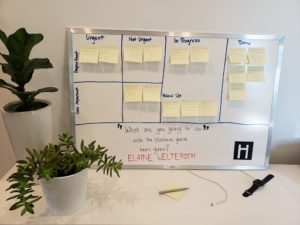
My Kanban Board at the beginning of June 2020
I work on a task, I physically move the sticky note across the board. For me, this physical movement feels like a symbolic representation of moving pieces of complex projects forward. At the end of each week, I take a few minutes to review all the tasks in the done category before I clear them off to set up the board for next week. I also use this time to find a new quote or image for the bottom of my board that will ground me the following week.
I used this model for a couple of years but found that the "To Do" column was slowly sliding back into never-ending to-do list territory. I swapped out this column for a modified version of an Eisenhower Matrix. The approach allows me to capture more information about the task than just the name itself and keeps tasks organised in a way that helps me stay mindful of what is really important. My board is now more dynamic and makes it even easier to identify my daily priority.
Find time for stillness
Time management is as much about finding time to do everything as it is about finding time to do nothing (work related). Carve out dedicated time during the day to stop working, find stillness and recharge.
This will look different for each person and is likely to vary day to day and with the seasons. Maybe it is a puzzle in the break room, adult colouring books, mindfulness meditation, a walk around the block or a cup of coffee with a friend. The idea is to find balance with deliberate actions that offset intense periods of productivity.
In the summer of 2019, I took three weeks off work and travelled through Asia and Oceania. In Singapore, I stumbled on this small gift shop that specialised in everything Swedish. I picked up a book called "Lagom: (Not Too Little, Not Too Much) The Swedish Art of Living a Balanced, Happy Life" by Niki Brantmark. Aside from explaining the idiosyncrasies of my Scandinavian-Canadian family and upbringing, I finished the book with a revelation: I needed to find balance during my workday.
Before my trip, I was working on a fast-paced and time-bound project. Breaks felt like a luxury I could not afford. I rarely stopped for lunch and often worked late. Upon my return, I was on the same project but I consciously built in time throughout my day to press pause and find stillness. I have “Lagom” scheduled in my calendar for 15 minutes twice per day, I stop for lunch and I end my day at a reasonable time. Finding time to be still has had the same, if not greater, impact on improving my productivity, as has setting a daily priority and designing a task board.
Yes, time is flying, never to return. But, we can make sure our flight runs smoothly by consciously choosing how we manage our time. - Signe Hanson
(Picture credit: Unsplash)
Make sure to share your own thoughts with the author by leaving a comment below

Log in or sign up to continue the conversation