
This piece was written by Amanda Bernardo. For more like this, see our future of government newsfeed.
This article is part of the 'Career development skills in the UK Civil Service' boot camp. Sign up here.
Public servants around the world are leveraging digital platforms to share their work, collaborate with others and engage with citizens.
In doing so, they’re able to take a once shielded and closed environment and transform it into one that is open and transparent. This environment invites public servants to connect; citizens to participate; and governments to change the way we communicate. In other words, welcome to the age of Open Government.
While countries around the world are developing their open #OpenGov policies and tools to enhance the way in which data is shared, there are platforms that already exist and are being used worldwide to achieve a similar outcome.
• Want to write for us? Take a look at Apolitical’s guide for contributors
Open Government is about making government more accessible to everyone, including those working in the public service.
Regardless of what area public servants are working in, social media platforms such as Twitter have become a new avenue for open data. Public servants are sharing their days through daily and weekly notes; engaging in open dialogue with colleagues, stakeholders, and citizens; and sharing progress and updates in real-time.
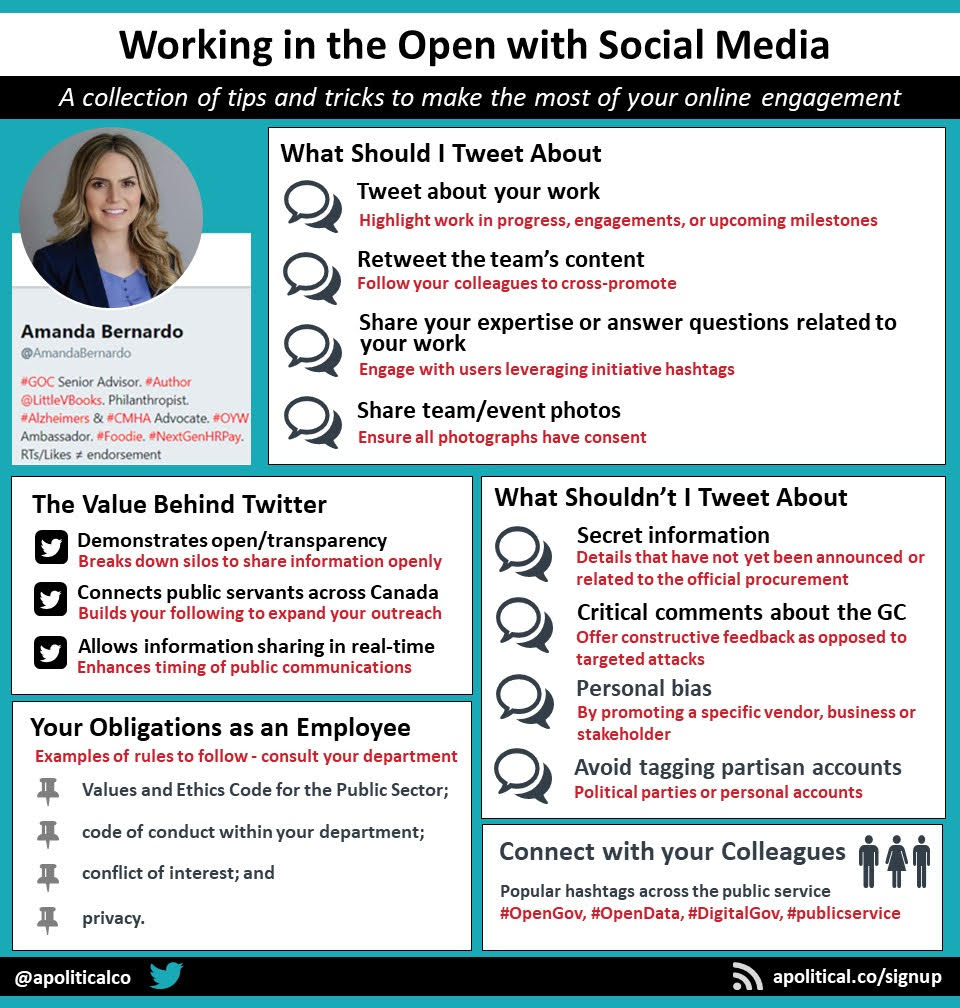 Image credit: Amanda Bernardo
While working openly may be easy for some, it can also be extremely daunting for others. We’re hearing public servants charged with sharing their work online, talking about their progress, and demonstrating how they’re achieving results.
But many are looking for guidance on how this can be done.
Here are a few tips and tricks for those leveraging social media to work in the open:
What is the value of online engagement?
- Demonstrates openness/transparency
Breaks down silos to share information openly - Connects public servants across the world
Allows you to build a multi-disciplinary network to expand your outreach - Allows information sharing in real-time
Enhances timing of pubic communications
What should I write about?
- Write about your work
Highlight work in progress, engagements, or upcoming milestones - Share your team’s content
Follow your colleagues and those working in similar areas to cross-promote - Share your expertise or answer questions related to your work
Engage with users leveraging your team’s hashtag(s) - Share team/event photos
Ensure all photographs have consent
What shouldn’t I write about?
- Secret information
Details that have not yet been announced or related to an official announcement - Critical comments about your government
Offer constructive feedback as opposed to attacks - Personal bias
By promoting a specific vendors, business, or stakeholders - Avoid tagging partisan accounts
Political parties or personal accounts
Where should I write?
There are many social media platforms that can be used to work openly in the public service. Twitter, however, is quickly becoming a fan favourite, enabling public servants to act in real-time; connect across borders and waters; and, grow an influential network that allows for true reflection, feedback, and collaboration.
As a Canadian public servant, I’d be wrong if I also didn’t give a shout out to the amazing tools being created internally to work more openly — GCCollab, GCConnex, GCPedia and GCIntranet (#GCTools).
As public servants, we must also remember our obligations as an employee
In Canada, public servant employees are expected to follow the rules for:
- Values and Ethics Code for the Public Sector
- Code of conduct within your department
- Conflict of interest
- Privacy
In addition to why we use online platforms and how we use them, we must also consider the efficient use of government electronic networks and devices to support this enhanced communication and collaboration.
However you choose to engage online and whatever platform is your preference, these tips and tricks are a great way to start an open dialogue.
Let’s not forget communities such as this one that continue to empower us to share our voices, our thoughts and our work in a common place for us all to read. — Amanda Bernardo
(Picture credit: Unsplash)
Make sure to share your own thoughts with the author by leaving a comment below

Log in or sign up to continue the conversation