
**This article is written by Pedro Conceicao, Director of the Human Development Report Office at UNDP
**
Levels of inequality in many countries are such that some may never recover.
This was the stark warning issued in The United Nations Development Programme’s (UNDP) 2019 Human Development’s report entitled Beyond income, beyond averages, beyond today: Inequalities in human development in 21st Century.
The report was released in December 2019, but as the fallout from Covid-19 continues to paralyse lives and economies, the stakes have clearly risen.
- Want to write for us? Take a look at Apolitical’s guide for contributors
Inequalities tend to weaken social cohesion and undermine people’s trust in government, institutions and each other. And they are wasteful, for the simple fact that they prevent people from reaching their full potential at work and in civic life.
When taken to the extreme, they can push people over the edge, filling the streets with violent protests. I will focus here on two important points from the report. The first is that a new generation of inequalities are being germinated and added to those that the development community has been focused on for some time. The second is the part of the report that urges us to recognise that tackling inequality requires going beyond income inequality and understanding the ways in which inequalities evolve and interact over a person’s lifetime.
Where are we now?
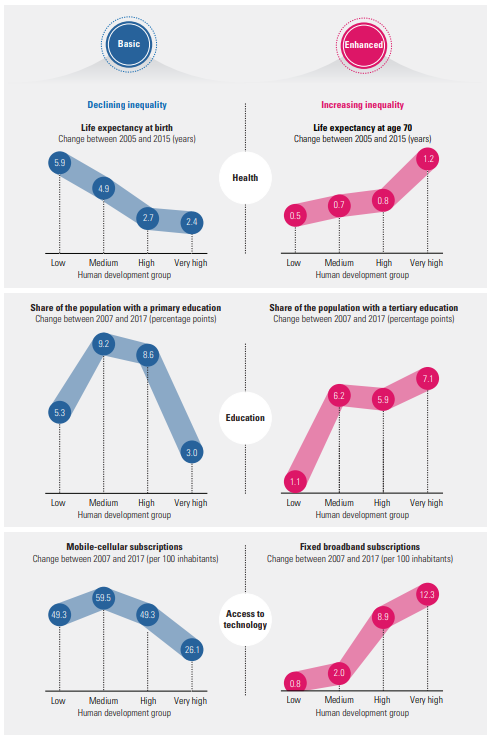
Some basic inequalities are slowly narrowing in many countries, even if much remains to be done. The indicators of basic achievements in the figure below all show narrowing inequalities between countries in different human development groups, though the gaps remain wide. Changes in life expectancy at birth (defined mainly as survival to age 5) is one, as well as access to primary education and mobile phones. All such changes show that countries with lower human development are catching up with more developed countries.
In contrast, and much less well known, are the inequalities in more advanced regions that are widening. Countries with higher human development have longer life expectancy, higher tertiary education enrolment, and more access to broadband — and are increasingly unequal. Some of these inequalities have had a spotlight thrown on them during the current public health crisis. In education for instance, when schools close, it is often only those children with access to the internet who continue their education. These effects are so important that there is a real chance that the global 2020 Human Development Index will, for the first time since we began calculating it in 1990, decline.
Slow convergence in basic, rapid divergence in enhanced capabilities
(Photo credit source: UNDP)
Inequalities in human development can accumulate through life, frequently heightened by power imbalances.
Understanding inequality — even income inequality — means looking well beyond income. Different inequalities interact, while their size and impact shifts over a person’s lifetime.
Inequalities start before birth, and the gaps can increase over a person’s life if they are not counteracted, creating self-perpetuating engines of privilege and disadvantage. This can happen in many ways, and the report looks in detail at one set of linkages: the nexus between health, education and parental income.
Parental incomes and circumstances affect the health, education and incomes of children. Health gradients — disparities in health across socioeconomic groups — can start before birth and may accumulate.
When that happens, inequalities compound and spiral. Children born to low income families are more prone to poor health and lower education. Those with lower education are less likely to earn as much as others, while children in poorer health are more likely to miss school. And when children grow up, they typically partner with someone of similar socio-economic status, reinforcing those inequalities across generations.
It is a cycle that is often difficult to break, not least because of the way in which inequalities in income and political power co-evolve. When the wealthy shape policies that favour them and their children — as they often do — income and opportunity further accumulate at the top. Unsurprising, then, that mobility tends to be lower in more unequal societies.
Where to next?
Tackling inequalities means addressing the drivers, not just the symptoms, of inequality. Two arguments are central to this.
The first is that inequalities do not always damage a society, nor do they always reflect an unfair world. Some inequality is productive in rewarding talent and effort, and some is probably inevitable. But some inequalities — especially in opportunities — are unjust and damaging. They have deep roots, and we focus on these inequalities and their drivers.
The second argument is that the sorts of inequalities that concern us most are a consequence of an underlying unfairness more deeply embedded in our economies, societies, and politics. That sense of unfairness can lead to alienation and become a wellspring of anger.
The human development lens — placing people at the heart of the problem of inequality — is central to approaching inequalities and asking why they matter, how they manifest themselves and how best to tackle them.
This is a conversation that every society must have for itself, and that should begin today as we seek to recover from the Covid-19 crisis. — Pedro Conceicao
We want to hear what you think about this article. Pitch an article to us or send your comments to hello@apolitical.co.
(Photo credit: UnSplash)
Make sure to share your own thoughts with the author by leaving a comment below

Log in or sign up to continue the conversation