
This article is written by Toru Hashimoto, director-general of development cooperation, International Affairs Bureau, City of Yokohama
Yokohama is a bustling port city close to Japan’s capital, Tokyo, and was the first port to open to foreign traders in the 19th century. It continues to be one of the main hubs for Japan’s trade with the outside world.
Its history makes us appreciate the value of collaborating with cities around the world — looking beyond our own shores to find innovations, ideas, and insights that make life better for our own citizens.
• Want to write for us? Take a look at Apolitical’s guide for contributors
Since the 1960s, Japan has experienced a high rate of population growth. Insufficient growth in infrastructure and city service provisions, however, means that the country’s urban centres face challenges similar to those cities in emerging economies face today.
The Sustainable Development Goals (SDGs) now provide a common basis for all governments to advance a shared set of interconnected challenges reflected in the fight against climate change, inequality, and the Covid-19 pandemic.
In short, we only stand a fighting chance of achieving the SDGs if we work together and learn from each other. To do this, Yokohama has developed a model of city-to-city development cooperation. As one of the fastest growing cities in Japan, we have experience in solving our own infrastructure, pollution, and service provisions challenges, and are now seeking to help other cities in emerging economies do the same.
Public-private partnership and city development cooperation
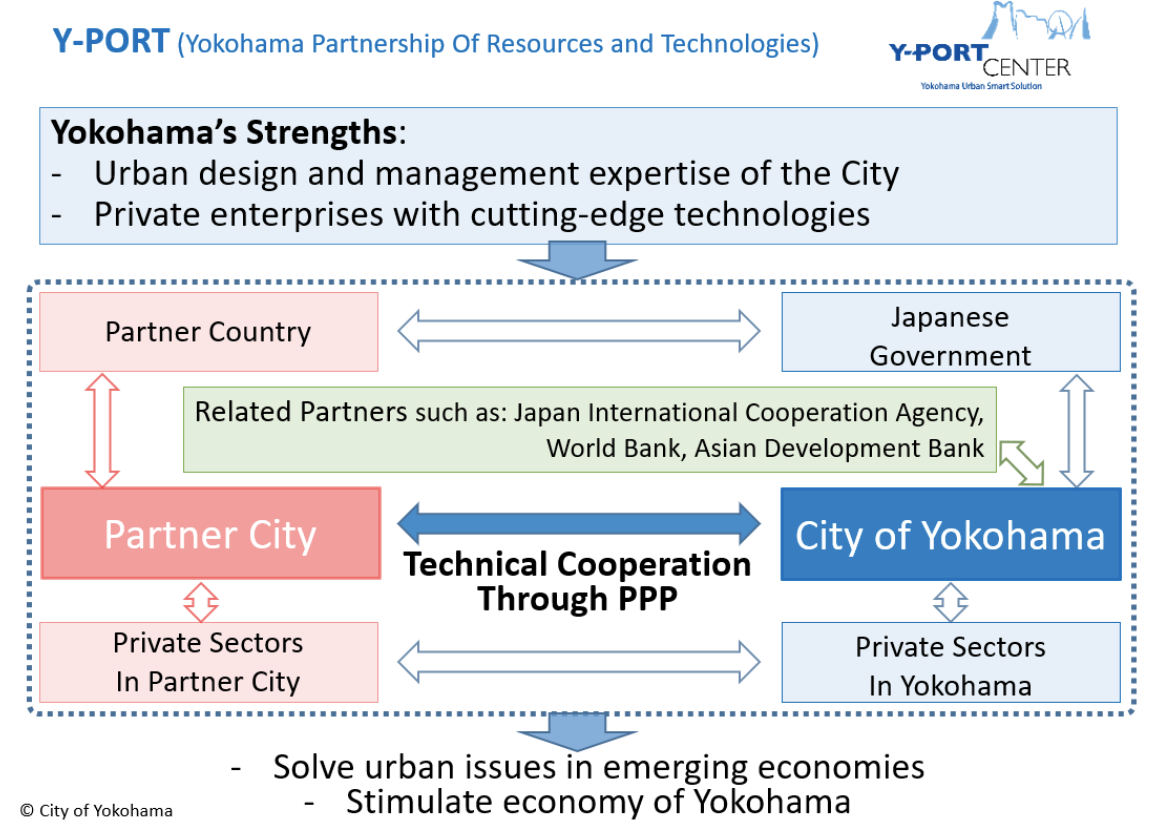
In 2011, we initiated a programme called the Yokohama Partnership of Resources and Technologies (Y-Port). Y-Port is a public-private partnership and international cooperation programme. Its explicit goal is to export Yokohama’s expertise on sustainable urban development to other cities. A lot of our know-how and technological capacities come from Yokohama-based private companies, so Y-Port brings on local firms as key partners in the programme.
We only stand a fighting chance of achieving the SDGs if we work together and learn from each other.
Through the programme, Yokohama takes several steps that enable its partner cities to adopt solutions that will advance the SDGs. These include:
- Involve the private sector from the outset: Compared to more traditional technical aid, which might focus exclusively on government-to-government assistance, Y-Port’s activities heavily involve private firms. They are invited from the outset to offer their expertise and solutions to specific challenges based on their experiences.
- Co-create solutions: Y-PORT seeks to present solutions to other cities that will enable them to leapfrog to ready-made green innovations, based on Yokohama’s decades of experience. However, we also need to translate these solutions into the partner city's unique context and community structure. That’s why mutual dialogue with partner cities is central to Y-Port’s model. Yokohama and its partner cities regularly host joint workshops, called “urban solution forums.” This is where we jointly formulate urban master plans, policy guidelines and private sector-led pilot projects with partner city counterparts. Aid agencies such as Japan International Cooperation Agency (JICA), the World Bank, and the Asian Development Bank join to provide policy and technical advice, while private firms offer insights to their solution concepts.
- Provide tailored technical assistance: Yokohama also provides other cities and city developers with know-how, particularly City Management as a Service (CMaaS), where our public and private actors have developed expertise. For instance, Yokohama helped the City of Cebu in the Philippines, the City of Da Nang in Vietnam, and the Bangkok Metropolitan Administration in Thailand, revise their city plans to improve urban public services. Japan’s national development agency, the Japan International Cooperation Agency (JICA), supports these partnerships with technical and financial support. Through these technical advisory engagements, we facilitate, introduce, and co-create private sector-led projects that deliver urban solutions and technologies. Some of the main sectors include solid waste management and recycling, wastewater treatment, water supply, climate change mitigation and energy savings. For instance, we helped introduce a policy framework for recycling in the metro area of Cebu, Philippines, and one Yokohama-based firm has set up a solid-waste management project.
- Expand networking and knowledge sharing: Y-Port also acts as a knowledge hub for sustainable cities solutions and smart city management available to its partner cities. When the Y-port programme expanded into a Y-PORT centre in 2015, city and business staff came together in the same space to facilitate collaboration and house their joint expertise under one roof. To further disseminate this know-how and introduce cities to urban solutions, we also host the annual Asia Smart City Conference.
The benefits to Yokohama
To justify this international development to our taxpayers, we needed a clear value proposition. Part of it is intangible, as it will involve the projection of our global city identity and brand. Our global engagements bring more awareness, visitors, and even conventions to Yokohama.
Business involvement also brings visible returns to Yokohama. Some of the knowledge partners from the private sector have eventually entered into business arrangements through these cooperative activities, which, in turn, brought jobs and growth to the city. This link to the SDGs also increases the visibility of our business community towards Environment, Social and Governance (ESG)-focused investors.
Cities: work together to achieve the SDGs
Cities have a unique opportunity to drive action on the SDGs, but we need to learn how to collaborate better together and, crucially, leverage the expertise of the private sector. As ESG-focused investment has become more common in capital markets, innovations that foster better connections between businesses and advancing the SDGs can help cities accelerate their progress. Yokohama’s Y-Port offers one model that brings value to all parties by promoting SDGs globally through city-to-city development cooperation with wide participation of private sector firms. — Toru Hashimoto
Curated by Brookings and edited in collaboration with Apolitical, these how-to briefs authored by experienced city government leaders aim to disseminate their innovations to counterparts to accelerate the local delivery of the Sustainable Development Goals. This compendium is part of the SDG Leadership Cities project, a community of practice of vanguard cities promoting a global movement of city leadership on sustainable development.
We want to hear what you think about this article. Pitch an article to us or send your comments to hello@apolitical.co
(Picture Credit: Unsplash)
Make sure to share your own thoughts with the author by leaving a comment below

Log in or sign up to continue the conversation