
This article is written by Sheila Bennett**, head of libraries strategy and delivery for the UK’s** Department for Digital, Culture, Media and Sport, and former policy lead for the Libraries Taskforce
When you’re next asked to present your strategy for achieving a specific aim in government, remember this: nothing is more important than having a strong action plan coordinated around clear responsibilities within your team.
In this article, I’m going to explain how my team and I went about bringing together stakeholders from a fragmented sector to agree on a strategy that was ultimately endorsed by both central and local government. Our approach and the resulting strategy inspired, and supported, those involved to increase advocacy, boost the profile of libraries, and develop good practice.
• Want to write for us? Take a look at Apolitical’s guide for contributors
My hope is that you’ll find reading about our experience useful, and take with you some insights that may help you in your own work as a public servant.
Be clear about the purpose of your strategy
When the Libraries Taskforce was set up by the UK’s Department for Digital, Culture, Media and Sport (DCMS) and the Local Government Association in 2015, one of the tasks was developing a strategy for the future of libraries which all stakeholders could subscribe to.
The challenge lay in finding common ground. There are 151 library authorities in England alone. Although there are sector organisations that represent public libraries, they’d never been asked to come together, nor had they ever worked with important partners outside their core, such as those in public health, to develop a strategy.
However good you think your strategy document is, think again.
Early on, it was challenging to explain what the public libraries sector does. We needed to cultivate a collective understanding of the positive outcomes it contributes to from the perspective of central and local government, as well as its non-core partners.
We decided that our strategy needed to build on existing good practice. The public library sector was already doing impressive things. This was not about starting from scratch, but drawing best practice principles together in a more coherent way.
We also recognised this needed to be done with appreciation of local democratic accountability. Councils make decisions about local library services based on their knowledge of local needs. The strategy couldn’t be imposed on those running library services — its ideas had to be persuasive enough for people to voluntarily choose to adopt them.
Understand what all parties want
The taskforce recognised that getting core stakeholders around the table wasn’t enough to create lasting change. We set out to engage a wide range of people and organisations with an identifiable interest in helping public libraries thrive. The taskforce travelled the country, learning about different approaches. This gave us the opportunity to hear a wide range of different perspectives, from that of library staff to citizens and partners.
Setting out our stall
After we finished gathering information, we drafted a framework intended to be discussed with the libraries sector and those with a vested interest in its success. Using our experience working as editors for the UK government’s website, GOV.UK, we drafted the framework in plain language, meaning we were concise and avoided jargon.
To gather feedback, we published a draft online and included a structured response form. We gave people the option of responding by post or email. We also used a Trello board to record and organise the comments so they corresponded to the relevant section of the draft.
By the end of a 10 week consultation period, we’d held workshops in 12 libraries across the country, travelled over 2,200 miles, and involved around 300 people directly. We changed our approach to workshops as we went. Initially, we presented on the proposed outcomes and how we’d measure them. However, these discussions felt limited, and led to generic responses. We decided to make our workshops more interactive, inviting people to put suggestions on flip chart sheets around the room, and then to comment on the suggestions made by other participants.
At each discussion, each member of the team hosted a table. Here, we worked through the proposals and, yet again, made sure to log every comment on our Trello board. We blogged about our interim findings to keep everyone engaged with the process. The result was far richer and more collaborative.
Based on the feedback we received, we made changes to the original proposal. We identified consensus areas as well as divergences, reflecting on what the problem areas were and why they were an obstacle.
This gave the taskforce more to work with, while also emphasising the knottier issues that demanded in-depth discussion. After a couple intensive group sessions reflecting on everything we learned, we worked up our final draft. Not everyone agreed on every detail, but we eventually came up with a document that every organisation was prepared to endorse.
Presentation and follow-up
So, finally, we had a polished text. However, it would count for nothing if we did not figure out how to communicate about it effectively.
The lesson here is: don’t assume that it’s all about the words, important though they are.
We were fortunate to have a great communications lead, who had the foresight to source a designer. Together, they developed a powerful infographic showing the seven strategic outcomes libraries supported:
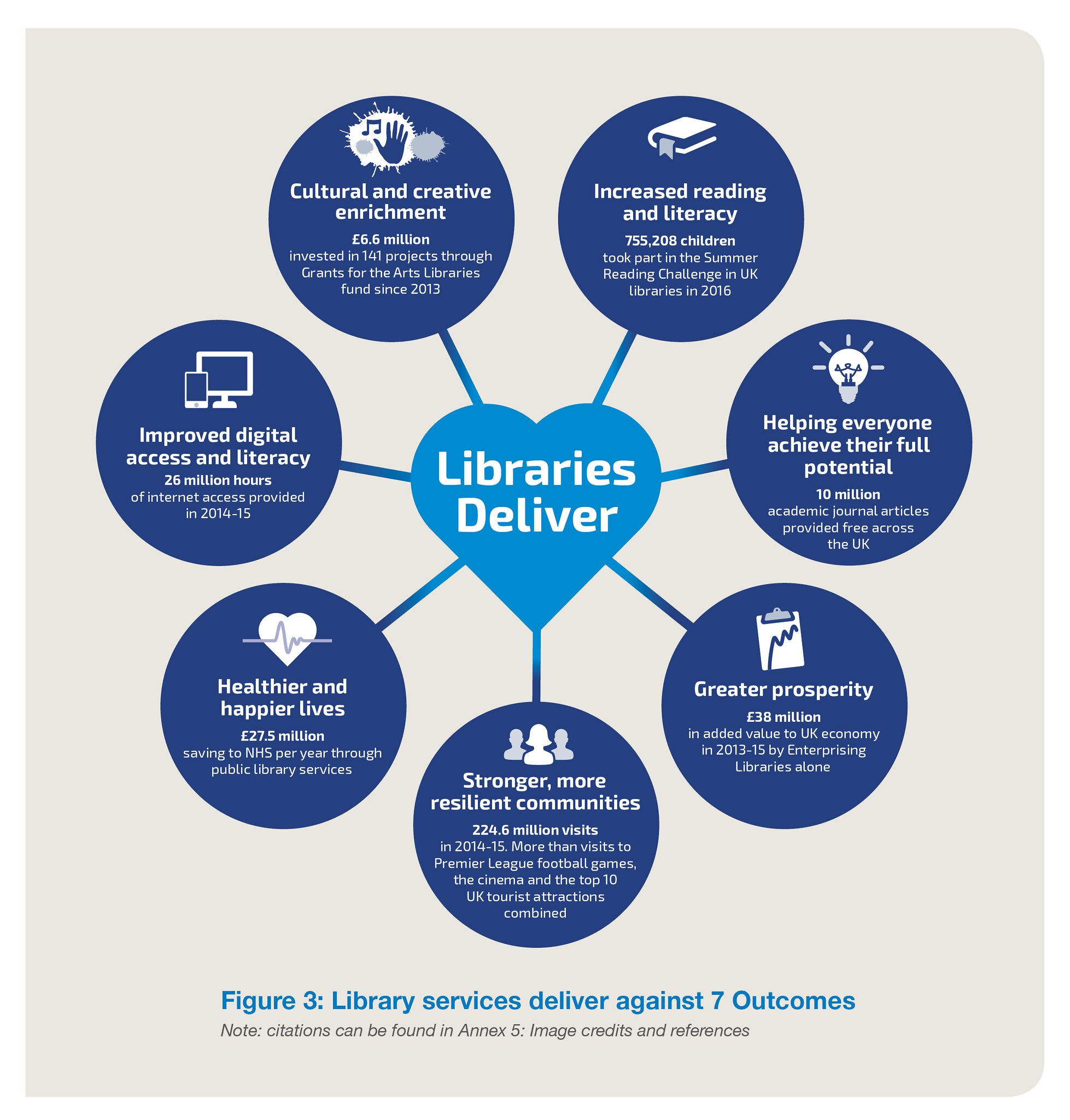 The infographic used by Sheila Bennett and her team
We’ve used this infographic to advocate for funding and inclusion. It inspired further publications, and has been (most gratifyingly) reproduced in many local library strategies.
This picture is worth thousands of words.
After the strategy was published, we went back on the road, holding free and open forums and running workshops explaining what we were planning to do. We continued to ask for feedback.
The strategy is delivery
We boiled the five-year strategy down to a 25 action point plan grouped into themes. This became the basis for the taskforce's work over the following years, and was adapted regularly to reflect changes. Deciding on specific actions early on meant it was easier to measure progress.
We continued to be open about what we were doing, reporting on our progress every six months and publishing about it on GOV.UK.
To sum up, we learned that it is invaluable to get as many perspectives as possible. We tried hard to strike a balance between them, and were responsive to each. Writing everything in plain language forced us to clarify our thinking, and using graphics helped get across some of the major points to stakeholders.
However good you think your strategy document is, think again. Unless it sits alongside a cohesive, clearly defined and rigorously tested action plan that can be referenced throughout the process, and that can be adapted to changing situations, the strategy won’t come to life and will not be actionable. Make sure you are open about what you are doing and what you have achieved (and the barriers you’ve hit) so that you keep the dialogue going. — Sheila Bennett
We want to hear what you think about this article. Pitch an article to us or send your comments to hello@apolitical.co
(Picture Credit: Pexels)
Make sure to share your own thoughts with the author by leaving a comment below

Log in or sign up to continue the conversation