
This article is written by Salman Samad, Manager, Enterprise Architecture at Ontario’s Workplace Safety and Insurance Board (WSIB) and Apolitical Insider Fellow. This article has been edited by Leslie Gray, Apolitical Insider Fellow and Scientist at Environment and Climate Change Canada.
There’s an internet meme circulating right now of a survey that asks, “Who led the digital transformation of your company? A) CEO B) CTO C) Covid-19” — and Covid-19 is circled.
- Want to write for us? Take a look at Apolitical's guide for contributors
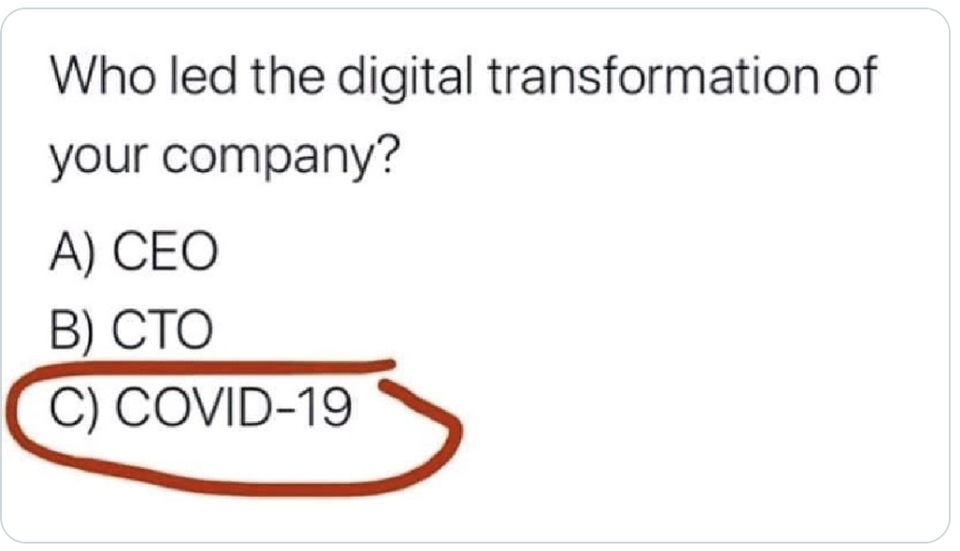
As funny as it is, there is certainly an element of truth in this, and it is something that I have experienced firsthand in my job at Ontario’s Workplace Safety and Insurance Board. Here are a few of the initiatives within my organization that accelerated digital transformation by breaking down long-standing workplace cultures and silos.
From 1% to 99% in two weeks
It has been just over three months since I started working from home. This is the case for almost all the public servants in Ontario, Canada, since the province declared a state of emergency on Mar 17, 2020.
Pre-Covid-19, about 1% of our staff was capable of working from home; now (and the change happened in a span of less than 2 weeks), more than 99% of our staff is working from home
With the province in a state of emergency, only essential staff were allowed to be at our offices and the rest were asked to work from home. The challenge, however, was that the majority of the staff (with the exception of IT) had desktop computers and were not equipped with laptops to facilitate working from home.
It took a monumental effort from the IT staff over a period of ten days to coordinate the provision of equipment (desktop computers, laptops, VPN tokens, and other required peripherals) to enable all staff to work from home. To gain a true appreciation of the effort, let me share some numbers: pre-Covid-19, about 1% of our staff was capable of working from home; now (and the change happened in a span of less than 2 weeks), more than 99% of our staff is working from home!
By the end of March, all of the offices were closed to employees and customers in order to prevent the spread of Covid-19. Customers in our case are employers in the province of Ontario, injured workers who rely on our services to be able to quickly return to work after a workplace injury and the various health care providers.
Digital transformation is not only about technology; the workplace plays an important role in that transformation as well in order to attract and retain top talent
The office closure meant our staff were not able to get to the mail and faxes that are a primary means of communication for a lot of our customers. As a result, we started promoting our existing online services for customers to get in touch with us while the offices remained closed. Fax and snail mail were replaced by phone, secure email and online access as the primary means of communicating with our organization. In essence, we became more digital and transformed the way we communicate with and provide service to our customers.
The tides are changing
Digital transformation is not only about technology; the workplace plays an important role in that transformation as well in order to attract and retain top talent. As such, we have started to conduct surveys and focus groups to understand work personas and mobility requirements that would help create safer, more collaborative and productive workspaces. Realizing that the office will not look the same once the pandemic is over, this is a step in the right direction to ensure that the office real estate is managed appropriately and effectively.
I am glad to see conversations moving towards “Let’s figure out how to do this” instead of “Should we do this?”
Would these changes have been possible at such a pace before the pandemic? Probably not! It would have taken months of deliberation, documentation and working through the bureaucratic processes to make noticeable progress on any one of the initiatives above. The pandemic has certainly created a shift in the culture within my organization to rethink our business processes and the way we offer services to our customers. It is a boon for employees as it helps us stay motivated and engaged; I am glad to see conversations moving towards “Let’s figure out how to do this” instead of “Should we do this?” The change in culture and dialogue is also positive for the customers as we create better and more efficient interaction mechanisms and improved services for them.
I am certain these stories are not confined to where I work and similar stories would surface within the public sector across the globe. Some of us (especially the ones with a long history of public service) may have baulked at the idea of large and rapid changes in the past. But the tides are changing and public servants are embracing change wholeheartedly in the hopes of providing a safe and enjoyable future for all of us. The pandemic has served as a catalyst for change and I urge all my fellow public servants to not lose this momentum and continue being the enablers and champions of change. — Salman Samad
The views expressed here are mine alone and do not reflect those of my employer.
(Picture credit: Unsplash)
Make sure to share your own thoughts with the author by leaving a comment below

Log in or sign up to continue the conversation