
This opinion article was written by Maram Ahmed, Fellow, School of Oriental and African Studies (SOAS), University of London, and was originally published by WEF. For more like this, see our migration and integration newsfeed.
Climate-related displacement and migration is set to be the greatest challenge of our era.
While there is a general consensus that global warming impacts us all, the role it will play in future human migration is often underestimated. Climate change disproportionately impacts developing countries, and more specifically fragile states.
• Want to write for us? Take a look at Apolitical’s guide for contributors
Communities in arid and semi-arid lands are particularly vulnerable to the effects of climate change. Exposure to extreme temperature irregularity and rapid rainfall fluctuations makes these communities more prone to recurring drought or flooding.
Why should we care?
Climate-induced displacement is on the rise.
Last year, climate-related factors resulted in the displacement of around 16.1 million people. It is estimated that, by 2050, between 150 to 200 million people are at risk of being forced to leave their homes as a result of desertification, rising sea levels and extreme weather conditions.
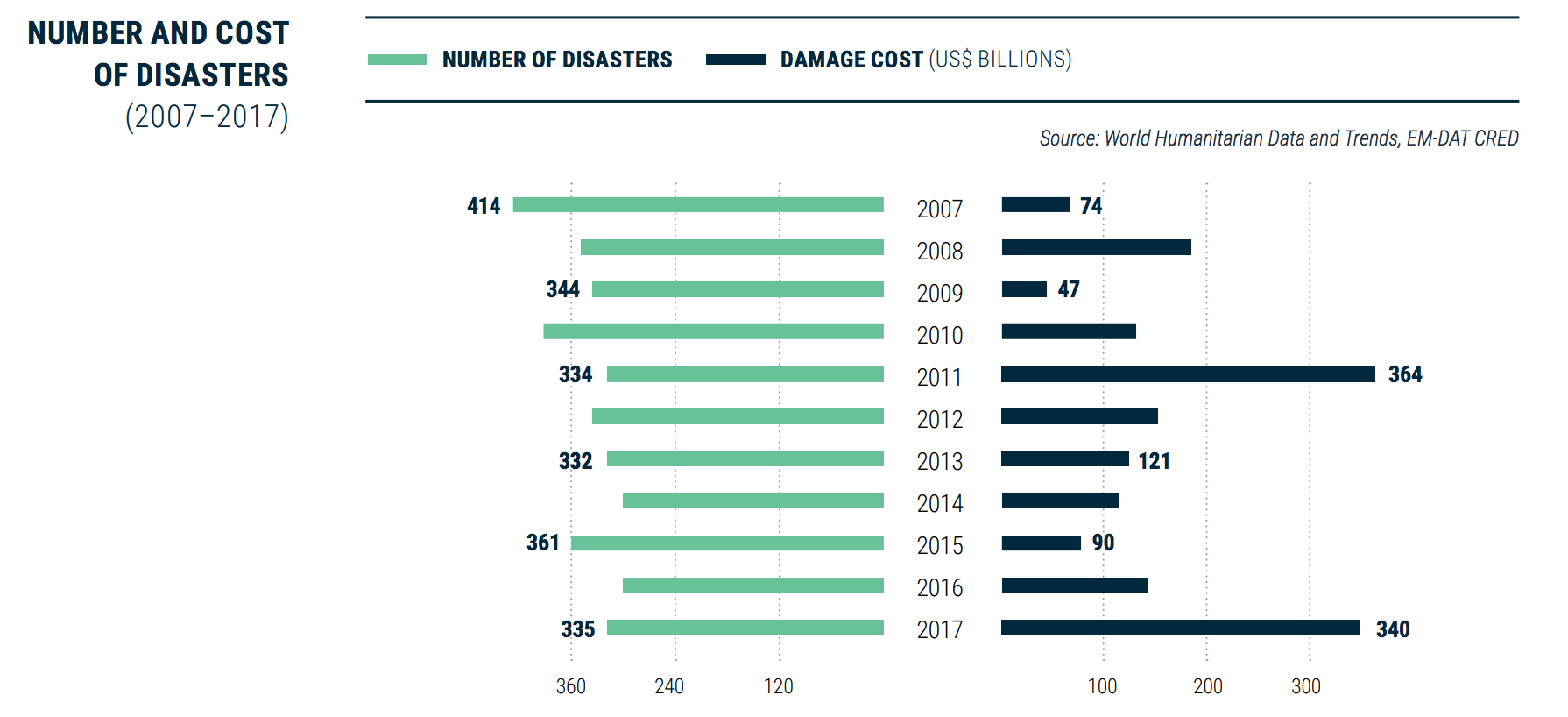
Natural disasters are impacting millions of people each year. (Image credit: Global Humanitarian Overview 2019)
This is not just an issue for fragile states, as the changing patterns of human migration mean that more people are forced to flee their communities in search of safe havens.
It is the world’s most vulnerable people who are made to bear the brunt of climate change, though they are the least responsible for causing it, and are ill-equipped to deal with the consequences.
With climate change intensifying humanitarian needs, international humanitarian agencies are overwhelmed, increasingly stretched, and lack the funding required to address these issues.
We can see that the United Nations Sustainable Development Goals commitment to “leave no one behind” is failing. The time has come to prioritise climate-induced humanitarian problems and assemble a full range of resources to tackle it.
Creating innovative finance mechanisms
The current humanitarian finance system is reactive and in desperate need of reform. As humanitarian crises become more complex, the demand for funding is struggling to keeping up with the supply available.
The global humanitarian funding requirement for 2019 was a record $21.9 billion and is expected to increase further. By 2030, humanitarian assistance costs are estimated to almost double in one decade by rising to an annual rate of $50 billion, if current trends continue.
The time has come to integrate a gender perspective into the climate change agenda
The issue is that, as crises become more protracted, the coordinated response rate also rises. According to the United Nations Office for the Coordination of Humanitarian Affairs (OCHA), the average UN coordinated humanitarian response rate is currently nine years — this is up from the average length of 5.2 years recorded in 2014.
With the continuation of crises, multi-year funding is needed to help close the gap. The scope for non-traditional innovative sources of finance is enormous. Creating financial solutions to reach more of those at the bottom of the pyramid would be a major contribution to addressing this pressing issue and helping build local resilience.
In the past couple of years, we have had green bonds that have been issued globally to fund climate-friendly projects and, more recently, a humanitarian impact bond that helped fund the building and operation of physical rehabilitation centres in Nigeria, Mali and the Democratic Republic of Congo. Why can’t we have a financial instrument, embedded with humanitarian principles, that addresses climate-induced humanitarian problems?
Prioritising gender
Climate change induced migration is adding a new layer of complexity to the area of gender, as women and girls are more vulnerable to the effects of climate change impacting education, maternal health and gender-based violence.
In cases of climate change disasters, such as droughts, girls are more likely to be withdrawn from school, as women and girls are often in charge of water collection. In Africa alone, it is estimated that 17 million women and girls collect water every day.
With climate change disrupting their education, young girls are reportedly being taken out of school to marry early, creating a worryingly higher number of “child brides”. The repercussions have a profoundly negative impact on a young girl’s mental, physical and overall wellbeing.
As for health, 60% of all preventable maternal deaths take place in settings of conflict, displacement or natural disasters, because women and adolescent girls cannot access critical health care.
Furthermore, in situations of climate change disasters, there is clear evidence that shows an increase in sexual and gender-based violence against women and girls both during and after disasters.
The time has come to integrate a gender perspective into the climate change agenda by putting women and girls at the centre of design and decision-making. Gender-sensitive policies must be identified and prioritised to help build resilience to climate-induced disasters. — Maram Ahmed
This article was originally published by WEF. To read the article, click here.
(Photo credit: Unsplash)
Make sure to share your own thoughts with the author by leaving a comment below

Log in or sign up to continue the conversation