
This article is written by Honey Dacanay, Director, Digital Academy at Canada School of Public Service
This article is part of the 'How to be digital in government' boot camp. Sign up here.
I often liken the global digital transformation mission to the Theseus paradox: If you change all the planks on a ship, is it really the same ship when it reaches its destination? In other words, if the end-game of digital government is just . . . well, government . . . would we be able to recognise it? We are, after all, as Harvard lecturer David Eaves describes, in the midst of the hardest part yet of this movement’s journey — that “long, slow battle over what the structure and shape of government will look like.”
- Want to write for us? Take a look at Apolitical's guide for contributors
As planks go, all-digital government offices begin with digital service standards. These principles represent a new set of defaults for working better in a digital era. The standards are important because they constitute an organisation’s change mission, codified. They are what every activity going forward will be measured against.
You must have a clear understanding and appreciation of the complexity of the institution you’re changing
The standards are often accompanied by the change-wash approach that bogs down most public sector transformation initiatives. It’s a play in three acts:
- Act One — Issue an executive memo usually from the top of the org signalling the initiative’s official status.
- Act Two — Have a figurehead executive and her/his team conduct roadshows with slick communications materials and a gold-plated pilot project that is exempt from all organisational constraints.
- Act Three — Starting a month later, ask various departments to complete some form of tracking document outlining how they have complied with said initiative.
But therein lies the problem. Each new digital organisation, whether created as an agency or unit within or outside of government, has a tendency to undervalue government and the bureaucracy writ large, and view its role as a “government saviour.”
Bureaucracy is a system feature, not a bug
If digital transformation is to have any hope of lasting beyond the coveted temporary special project of the day, the digital team needs a very clear understanding of what the people who create them think their mission is.
If there is a mismatch between the team’s perceived mission and others’ expectations, there is nothing but a long slow battle (requiring lots of antacids) ahead. This is not to say it’s impossible. But it means that you must have a clear understanding and appreciation of the complexity of the institution you’re changing. It means having people on-staff who understand government, the difference between laws and lore, and the nuances of decision-making. We need honest conversations about governance at the highest levels and we need to consider these dimensions:
- Leadership: Is a single Chief Digital Officer with an office and mandate really sufficient?
- Funding: What is the right way to invest in technology? How do we continue to meet our policy goals without introducing new risks?
- Direction/expectation: How specific or prescriptive does a government digital service need to be? What policy levers do we need?
- Capacity-building: How do we support public sector organisations in applying the standard?
- Interventions: How should we ensure that public sector organisations and vendors meet minimum expectations?
- Measurement and evaluation: How do we assess services objectively? How do we measure digital transformation?
- Reporting: How can reporting be used to influence future actions and decisions?
Let’s think about this another way, at the scale of institution-wide reform.
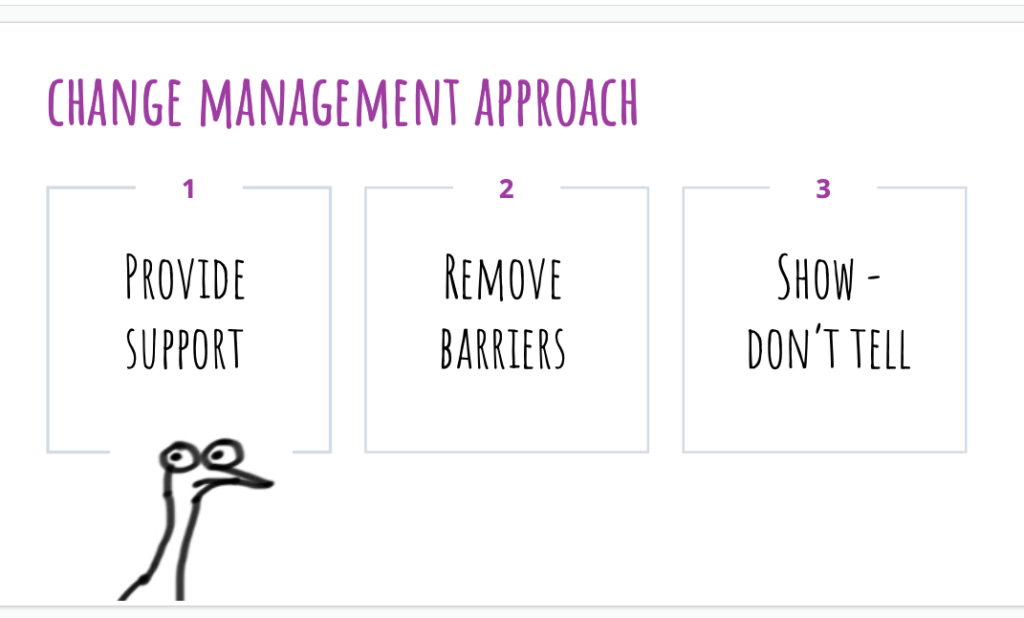
Institutional supports are a continuum
Most people immediately assume that institutional supports are training exercises and that training is really just about sharing a boilerplate presentation far and wide or having executives and marquee speakers talk about “new ways” of working.
Whether training is about introducing a new mindset, knowledge, or skill, it needs to be part of a larger set of incentives to work differently. These include:
- Self-help tools and resources
- Communities of practice
- Learning and development — from general to hands-on
- Talent strategy and career paths, and
- A rethink of how the public service is organised around its mission.
Institutional barriers tend to be removed, but only in crisis situations
Institutional barriers come in many forms, but the most recognisable and reviled ones are the ways people work (siloed, hierarchical, micro-managed teams) and pre-Internet era rules and tools that have outlived their original policy intention. Often there are few incentives for public servants to revisit these structures, and digital organisations are either forced to set up parallel structures outside existing government departments or find a patchwork of loopholes (or hacks) around the existing structure.
It is just as important, if not more so, to talk about the services that become better, the changes that make a big difference to people’s lives
Most public servants have two windows of opportunity for removing institutional barriers: the start of a new government mandate; and, in a time of crisis, an urgent government priority.
For digital government teams, this means these barriers must be catalogued and ready to be addressed en masse at the right opportunity, but also prioritised based on public impact.
Showing, not telling, works
Digital government offices follow the tradition of working in the open, so that others can build on their successes and understand just how difficult this journey can be. However, it is easy to fall prey to the temptation of talking exclusively about a digital team’s accomplishments — which are important, and shouldn’t be diminished — but not about the team’s impact.
It is just as important, if not more so, to talk about the services that become better, the changes that make a big difference to people’s lives. Did applying for a program become less cumbersome? Did the government become less confusing, its decision-making less opaque? These stories matter more than the workplace culture of the digital team, which doesn’t often reflect the realities most public service departments face.
In talking about workplace culture or impact, it also helps to tell the story from a different point of view — the person whose life is made better. — Honey Dacanay
Postscript — Nerd out with me
I’m more than a decade into my career, and I continue to be obsessed with this topic. If issues of governance and government in a digital era are of interest to you as well, I’d love to chat with you — connect with me on Twitter
(Picture credit: Unsplash)
Make sure to share your own thoughts with the author by leaving a comment below

Log in or sign up to continue the conversation