
Hua Wang is the founder and chief executive of SmartBridge Health, a global cancer telemedicine startup, and former FUSE executive adviser in the Office of the Mayor and City Administrator in Washington, DC. The opinions expressed in this commentary are her own.
Cities have long been centres of new ideas, especially in Washington, DC, a world-class capital city with brilliant and passionate residents. Supporting DC is one of the most important things I can do to help spur progress in the face of federal inaction.
Despite what some see as a gridlocked political system, I believe we can usher in a new renaissance in the public sector – led by residents, inspired by common goals, driven by data and science, and propelled by creativity and innovation.
That’s why, in 2019, I decided to devote a year of my life towards championing customer experience and innovation in local government. I wanted to test my hypothesis that I can leverage the networks and lessons learned from my career in investment banking, strategy consulting and private equity law, and apply it towards making life better (and more delightful) for DC residents.
- Want to write for us? Take a look at Apolitical’s guide for contributors
I decided to embark on a one-year engagement with DC government as a FUSE executive adviser to the Mayor. FUSE is a national nonprofit that enables local government to more effectively address the most pressing challenges facing urban communities.
In pursuit of this mission, FUSE runs an executive-level fellowship program in civic innovation that is focused on accelerating cross-sector collaboration and community-based problem-solving.
Here are the key lessons I learned from my year in public service. I am proud of the results we were able to achieve for customer experience and innovation, which culminated in the DC government being nominated as a finalist for Apolitical’s Workforce of the Future Award.
1. Encourage stakeholder feedback at the outset
To really understand the needs of the stakeholders, you have to reach out and engage early with a diverse group of people. As a former strategy consultant at Accenture and a startup founder, I am well versed in customer discovery and asking open-ended questions designed to surface multiple, and often hidden, perspectives.
“A listening tour is the best way to prepare for a successful project or strategy. It helps define the scope and overall structure of the problem, craft a shared vision of success and prioritise focus areas for further diagnostic”
A listening tour is the best way to prepare for a successful project or strategy. It helps define the scope and overall structure of the problem, craft a shared vision of success and prioritise focus areas for further diagnostic.
I launched a listening tour comprised of deputy mayors, directors, chiefs of staff, managers, analysts and frontline staff, as well as the private sector (McKinsey, Yelp and IDEO), and encouraged everyone to share their perspectives on how government can be more delightful.
The purpose of the listening tour was to build trust and form cross-agency relationships, understand organisational pain points around customer experience and gather information on current initiatives and ideas for future initiatives.
From these conversations, we brainstormed big ideas, observed overlapping areas of agreement and, in the process, made people feel included from the outset. I shared the listening tour findings with the participants and provided a roadmap for what I plan to accomplish in the year ahead.
2. Set clear goals
The second lesson was to develop a full strategy early and be prepared to modify as things progressed.
Based on the insights gained from the listening tour, I distilled a set of prescriptive initiatives (e.g. a comprehensive set of distinct levers for creating change, “quick-win” actions and long-term priorities, and a ranking of DC government’s KPIs relative to other local governments) to help agencies make incremental changes in customer experience and encourage the mindsets, processes and culture to support that goal.
Improving customer experience requires a common vision and new levels of coordination across historically strong organisational silos. To overcome barriers and deliver exceptional customer experience, I found that a key step is to align on what type of experience we want to deliver, whether it is to have a best-in-class customer experience, improve the baseline or invest in a full transformation.
Given that I only had one year and no budget or team, I decided to focus on making incremental change in customer experience across agencies. My goal was to plant as many seeds as possible, and gain political and financial support for a true customer experience transformation.
3. Don’t be afraid to ask for help
I learned early on that you can’t be afraid to fail.
The truth is that the challenges facing DC government are simply too complex for any one person to make progress alone. In this role, I was committed to a goal and I was resourceful about finding ways to achieve it, even if it meant putting my own reputation on the line and asking my networks to volunteer their time and resources, and join me in my mission to make government more delightful.
I convened and engaged strong partners from across fields and industries, who can help us break down complicated issues, innovate and create solutions that work.
As a former Halcyon fellow and Nantucket Project scholar, I have built a strong network of leaders who share my passion for finding solutions to some of the world’s greatest challenges. General Assembly, for example, led the user experience research and helped redesign my startup’s website.
Based on my prior engagement with General Assembly, I knew they were exceptional in infusing innovation efforts with design thinking. They were the ideal partner to help us unlock the positive potential of government and create better outcomes for DC residents. I convinced the organisation to provide $250,000+ in pro bono consulting to bring DC government employees and residents together, share best practices and build human-centred design into new initiatives.
To establish a baseline understanding of current performance on the things that matter most to DC residents, General Assembly surveyed a statistically significant sample of 1,500 residents, structured insights around the customer journeys where residents interact with government, and launched the following activities:
- Conducted 150-deep structured interviews and usability tests across all eight wards in DC on current resident experience to develop initial hypotheses around strengths and opportunities;
- Identified the top three to four pain points by each ward and mapped “signature moments”’ that shape the resident experience; and
- Created customer journey maps and resident personas to bring the findings to life.
The chart below illustrates how we organised the insights from the surveys and interviews around residents’ experience with DC government:
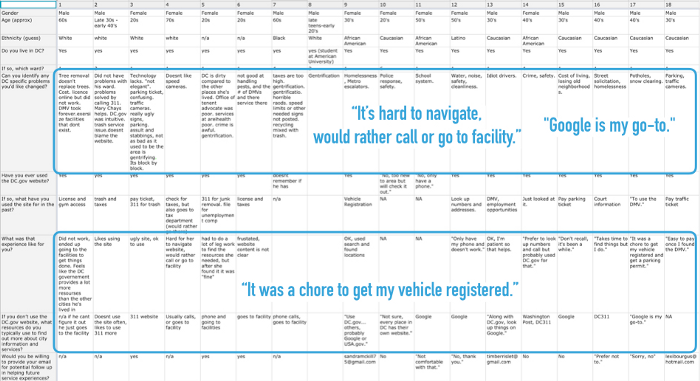
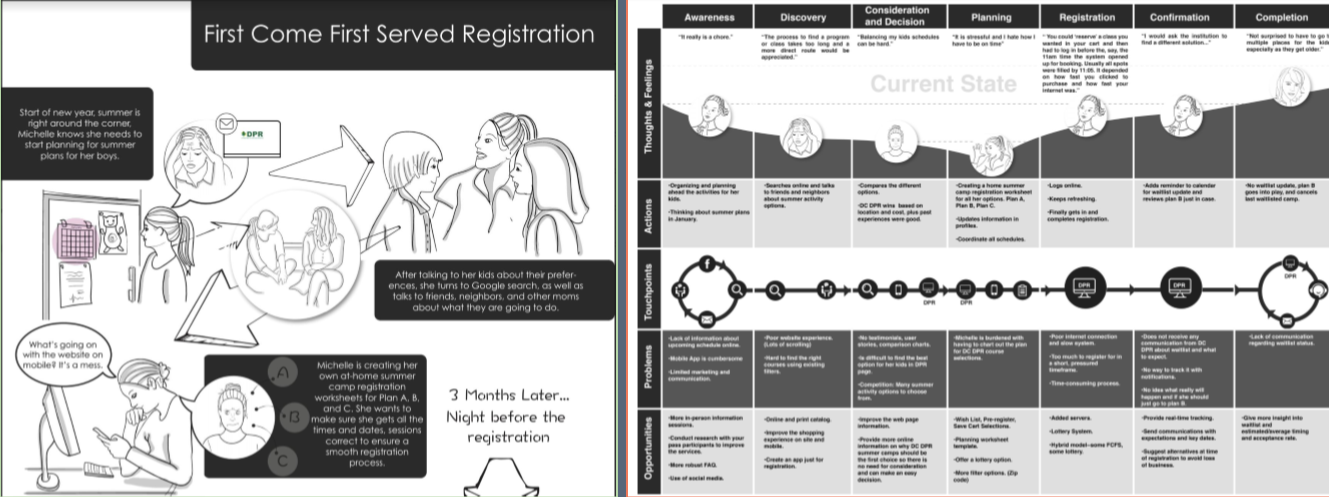
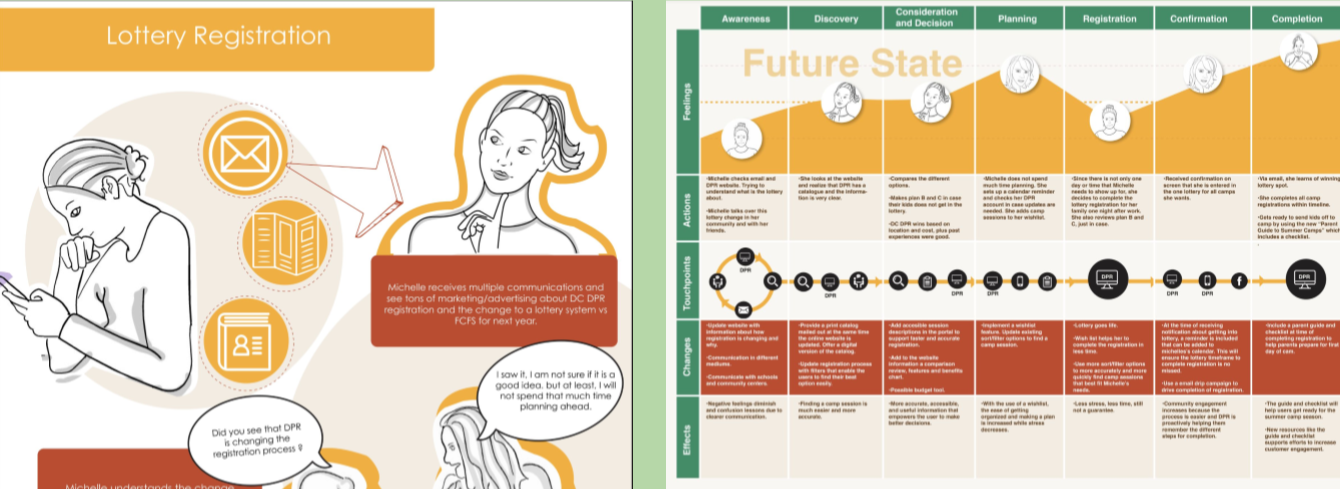
Based on the resident interviews, we saw an opportunity to explore whether DC summer camps should be on a lottery system (as opposed to first-come, first-served online registration).
Many DC parents rely on the subsidised summer camps to keep their kids engaged with a fun and affordable summer, but, like most government services, the demand far exceeds the supply. Under the current model, parents who needed to go to the local library to access computers or have slow internet access at home were at a disadvantage, as some of the camps fill up in seconds.
General Assembly collaborated with the Department of Parks and Recreation to create a future-state customer journey map, prototypes of the future state concept and recommendations to achieve the future-state journey design.
Based on the insights from the resident interviews, we decided to apply a similar approach towards improving employee engagement. General Assembly interviewed 90 government employees across 17 agencies to help us to identify pain points and prioritise areas of improvement, as well as establish a baseline understanding of current performance on the things that matter most to employees district-wide.
The overall insights can be seen in the well-designed and analytically informed Miro chart. The chart illustrates the strengths, challenges and opportunities for seven DC government agencies.
4. Foster a culture of innovation
According to Harvard Business Review, a large body of research on organisational behaviour shows that most people want some form of choice and voice in what they do at work, and that this can spark greater commitment and improve performance.
Fostering a culture change among agency leadership and staff, demonstrating the value of improved customer experience and creating government-wide support will help ensure consistent and sustained improvements in customer experience across agencies.
“We tapped into the creativity of DC government employees by giving them the autonomy to do whatever they can to improve the customer experience and fix problems themselves”
We partnered with FUSE and Smallify to train government employees on rapid prototyping. We offered government employees the tools and resources needed to create minimal viable products of their ideas.
We tapped into the creativity of DC government employees by giving them the autonomy to do whatever they can to improve the customer experience and fix problems themselves.
5. Prove your case
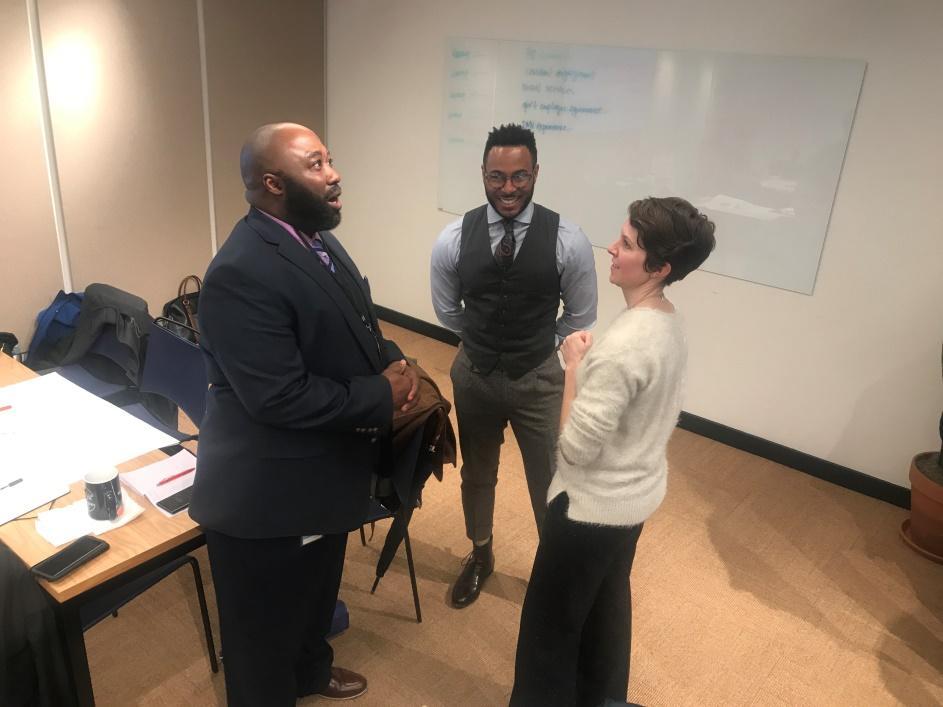
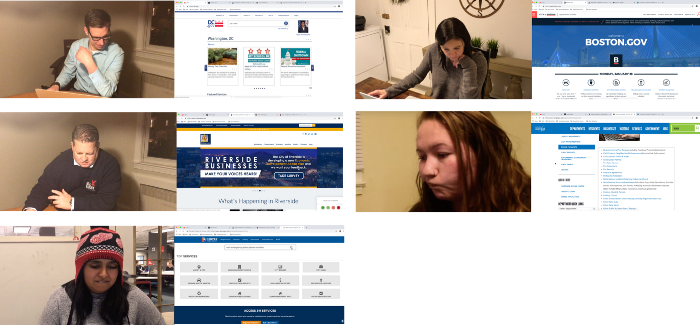
We partnered with General Assembly to present a business case for why DC government needs to invest in a website redesign. We conducted usability tests with DC residents and recorded the mouse clicks and times it took to complete a task on the DC website (versus Boston, Riverside, Tampa and Denver government websites).
The images below illustrate how we engaged residents in usability tests and gathered data to prove that DC.gov lags in functionality and design compared to other cities’ websites:
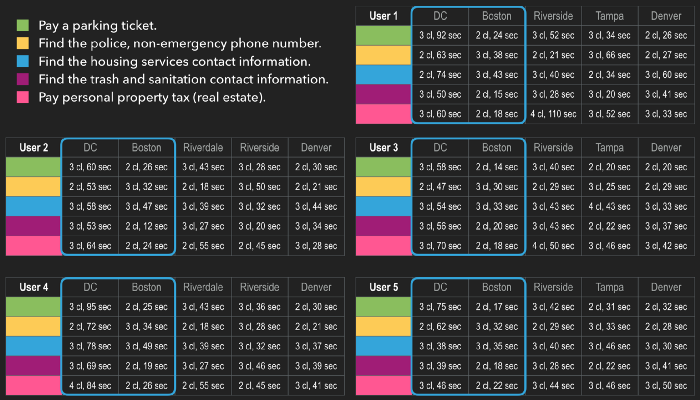
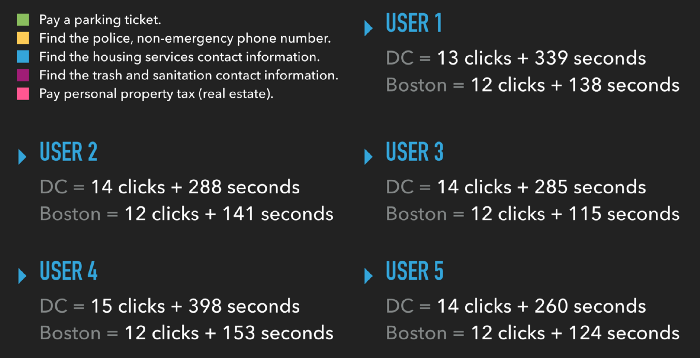
The insights helped us secure the buy-in for a $1.5m budget towards a more beautiful, welcoming and useful DC.gov website. When launched next year, the redesigned website will take into account what residents need and offer simple, intuitive navigation, with much cleaner search possibilities. The goal is to reduce the time it takes for residents to get something done.
6. Stay optimistic
In government, tangible rewards are hard to identify. It’s about solving challenges because you believe in the mission and want your city to succeed. You must be sober about the challenges, but accepting them as fixed reality is often self-defeating.
The silos that make up many agencies are at odds with the need for achieving truly cross-functional collaboration. That’s why it’s important to continue engaging with a variety of stakeholders to understand their unique perspectives and insights, and to showcase existing efforts to improve customer experience.
We partnered with Boston Consulting Group’s Centre for Public Impact to host a cross-agency “failure foundry” workshop to foster a culture of experimentation and innovation in DC government.
A fear of failure often inhibits innovation because government agencies typically view failure as an end-state, often to be forgotten or hidden, instead of what it really is – a critical component of learning and growth.
7. Believe in outsize impact
It’s always a good reminder to understand why you are in government and whom you are serving. While I had much more freedom to pursue what I wanted in the private sector, once I made the switch to my new government role, I understood that there is no bigger platform for impacting people’s lives than local government.
“It’s always a good reminder to understand why you are in government and whom you are serving. There is no bigger platform for impacting people’s lives than local government”
This is especially true in Washington, DC, where the annual government budget at $15.5bn is a lot bigger than in many other local governments.
The challenges are hard and the variables to accomplish anything are vast. But on my tough days, I think about the people we are fighting to help and all of the change that will come to individuals, families and Washington, DC, if we are successful – and that makes it all worth it. — Hua Wang
Photo by Jorge Alcala on Unsplash
Make sure to share your own thoughts with the author by leaving a comment below

Log in or sign up to continue the conversation