
This article is written by Joshua Kirchner, who was previously a Business Expertise Senior Consultant at Service Canada, and is now an Analyst at the Canada School of Public Service.
There are times in a public service career when you come across a policy and service delivery issue that seems easy to solve. You wonder to yourself, “This seems so easy to fix, why hasn’t this been done already?”
- Want to write for us? Take a look at Apolitical's guide for contributors
However, I have learned that even seemingly easy problems require perseverance, as you’re bound to run into unforeseen hurdles to help citizens who need it most. I also learned that even if it means taking the long way towards your goal, you can still make meaningful smaller improvements to client service along the way.
Here’s my story.
Falling through the cracks
In Canada, the federal government (Service Canada) administers public retirement pensions whereas provinces and territories administer social assistance (previously known as welfare). Since 2013, Service Canada has been making it easier for Canadians to receive their pensions by removing the need to apply by paper application and automatically enrolling them for their pension based on personal information that they had already shared with the federal government, if they met certain criteria .
The problem was simple: Ontarians receiving social assistance had already shared personal information with government, albeit the provincial government, but they did not meet the criteria for auto-enrolment for federal pensions, and were falling through the cracks.
We learned from Ontario’s Ministry of Children, Community and Social Services that many of their clients were experiencing a challenging transition from social assistance to retirement pension benefits. Here is what we knew:
most social assistance clients apply for social assistance online, and this information is held electronically by the provincial government;
the majority of social assistance clients need to transition from social assistance to their pension when they turn 65 years old;
many do not apply for and receive their pensions as soon as they are eligible;
approximately 85% of social assistance clients in Ontario do not meet pensions auto-enrolment criteria and are not auto-enrolled;
resulting income support extensions leave them with large over-payments and in the middle of an administrative process for Service Canada to reimburse the province; and,
many social assistance clients need help accessing programs and services from multiple levels of government and would benefit the most from something like auto-enrolment.
In other words, social assistance clients really needed the money from their pension as soon as they could get it, but they were not being “fast-tracked” and struggled to access programs and services from government. So the question remained: why was the federal government asking clients to go through a paper process to provide personal information to apply for a federal benefit at age 65, when they had already provided most of the same personal information to receive their provincial social assistance?
The solution seemed straightforward: electronically transfer social assistance clients’ information from the provincial government to the federal government to automatically enrol them for their pension. Essentially, this would mean using client information held by the provincial government to fast-track these clients into receiving their pension and prevent them from falling through the cracks.

Previous Client Journey
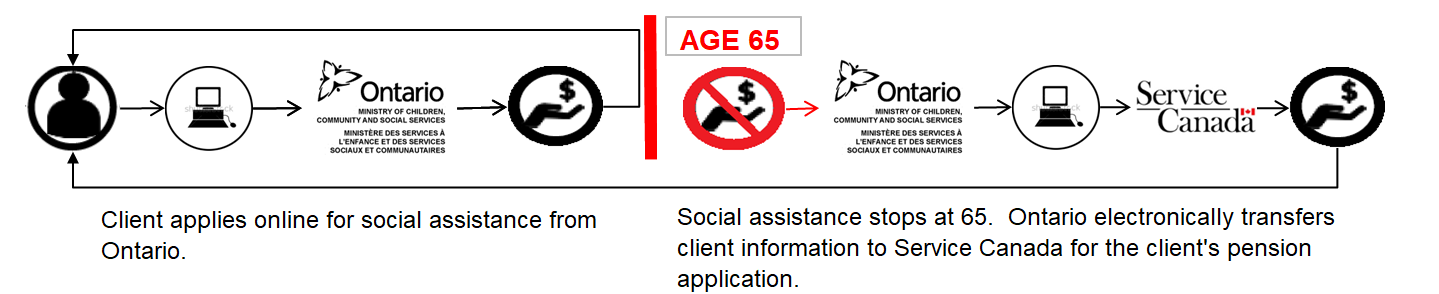
Vision Client Journey
However, implementation was not straightforward. We did not have the legal authority to exchange client information to apply for benefits for them. Amending legislation and information sharing agreements was an option, but did not have a guaranteed outcome or timeline.
Tough calls
We wanted to make an expedient positive impact for social assistance clients, so we shifted course. Our new solution was the best within current information-sharing authorities, but also an innovative federal-provincial project that was truly ground-breaking and the first of its kind in Canada.
Rather than sending client information directly to Service Canada, Ontario made a small but meaningful improvement to the client experience by pre-filling their pension application for them. This meant clients only needed to fill in any missing information, sign, and submit to Service Canada.
When this project was presented to our Seniors Advisory Committee in June 2018, they applauded it as an example of governments doing what they should – working together to eliminate barriers to benefits for citizens
However, at that time, Service Canada was still in the pilot phase of a new integrated pensions application for two separate but related pensions programs. Another fork in the road. Should we prefill separate applications? The separate applications had a history of confusing social assistance clients, and weren't the direction of the future. Should we wait for the public launch of a new integrated pensions application? Timing wasn't certain and social assistance clients would continue to fall through the cracks in the meantime. Additionally, Ontario needed months of lead-time to upgrade its IT system to prefill pensions applications to avoid unintended impacts to client service.
Despite the uncertainty and these constraints, we decided to embrace this opportunity to improve client service with a motivated provincial partner. We accepted the risk of using the pilot version of the integrated pensions application for this project, and it was full steam ahead!
Our work isn't done
The first prefilled pensions applications were sent to social assistance clients on April 17, 2018, and they continue to be sent to this day — over 30,000 of them! Have we received them all back from social assistance clients? No. We knew we wouldn't. We knew these clients faced extra barriers to accessing government benefits, and the requirement to complete, sign and mail a paper application remains one of those barriers.
However, every one of the thousands of applications that we did receive meant those clients received their pension on time and in the right amount. In fact, when this project was presented to our Seniors Advisory Committee in June 2018, they applauded it as an example of governments doing what they should – working together to eliminate barriers to benefits for citizens.
The results point to early success with room for growth – both in Ontario and across Canada. We know that the baby boomer generation is growing the cohort of Canadians transitioning to pensions from provincial/territorial social assistance. When this project reaches full maturity, it will help over 10,000 Ontarians every year to get their pension in the right amount and on time.
Most importantly, we know that our work isn't done. There is still more we can do to help social assistance clients receive their pensions on time. We have not yet fully achieved our original vision of eliminating the paper from this process. We are taking the long way towards that goal and have improved client service along the way.
Staring down the iceberg
I hope that by sharing my experience, it will encourage other public servants faced with a similar situation not to be discouraged and not to lose sight of who we serve. If you find yourself staring down an iceberg of a problem that seemed easy to fix when you could only see the tip, don’t give up! Even if you can’t take on that whole iceberg all at once, you can still help citizens by taking on that iceberg one piece at a time. — Joshua Kirchner
(Picture credit: Unsplash)
Make sure to share your own thoughts with the author by leaving a comment below

Log in or sign up to continue the conversation