
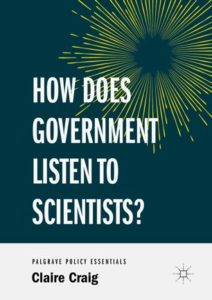
This article was written by Dr. Claire Craig, Chief Science Policy Officer at the Royal Society and former Director of the UK Government Office for Science. The excerpt was taken from her recent book, How does government listen to scientists? For more like this, see our government innovation newsfeed.
What people think about science is often not the same as what scientists or politicians think they think, especially if the people are put in control of the discussion.
Structured public dialogue typically involves selected groups of people with mixed socio-economic and educational backgrounds meeting with scientists, in different localities, and expertly prepared for and facilitated throughout. Done well, it is time-consuming, expensive and invaluable.
Are there genes in food?
There are three principal modes of operation for public dialogue broadly concerned with improving communication, creating new knowledge, and co-creating new ideas.
The first mode gathers social intelligence, usually for the purposes of more effective broadcast communication. It allows scientists better to understand what questions publics might want answered, rather than what knowledge the scientist thinks they ought to have. For example, scientists at the Royal Society working on providing accessible information about genetically modified crops were initially surprised to see that some people wanted to know if there were genes in food.
It typically helps the scientists to respond if they are also aware of the concept of bounded rationality: people are not stupid, but the pattern-spotting human brain will make links between scientific concepts half-heard or half-seen that may initially, to the scientist, seem odd.
People engage with new technology most commonly from a position of cautious optimism
The second mode creates or tests knowledge about what people think now and what they think when given a chance to discuss the science. Surveys can establish superficial findings about the former, but dialogue enables people, scientists and policymakers to explore questions and avenues of thought, potential opportunities and risks.
This is not about influencing those who take part, nor usually about creating scalable findings, but provides proof of concept and illustration as to what people might or might not think, say or do in future debates and circumstances. It helps particularly where public debate risks becoming locked into a particular view such as that, for example, “the public” might always want a human in the loop when an AI system is taking decisions. Dialogue shows that is not the case: given the opportunity to discuss the matter, public judgements are much more context specific.
We’re all cautious optimists
When it comes to public engagement with emerging science and technology, successive dialogues have generated generalisable findings that are still not sufficiently part of mainstream policy or scientific thinking, let alone public debate. They show that people engage with the new technology most commonly from a position of cautious optimism, in which final judgements are highly context specific.
Participants are typically concerned about who is developing the technology and for what purpose; about the distribution of benefits and risks, and about issues such as access and fairness. Overall, they do not take positions for or against broad technologies, but give nuanced responses depending on the application. In the Royal Society’s dialogue on Machine Learning, for example, the discussions operated both at the levels of interest in the potentially very broad impacts on humanity of future uses of AI and simultaneously at the level of highly context-specific perceptions and judgements about risk and value in different potential applications such as those in health, finance or education
In some ways, public dialogue of this structured kind exposes the fact that, when people vote they don’t have the opportunity to engage in technical discussion and that, if they do, they may think differently about the issues. But that knowledge, if developed through dialogue, isn’t sufficient to legitimise a public decision that takes it into account.
It can be very difficult for a scientist fully to internalise the reality that information on its own doesn’t change people’s minds
For example, the use of citizens’ juries for debates in which new scientific knowledge plays a major part has not yet become widespread and it is generally difficult to link insights from dialogue to wider democratic processes. In practice, decision-makers use this kind of dialogue to challenge public and private assumptions about the inevitability of “what people think” about something and, if necessary, to determine how to frame the more formal and widespread consultation. So far the most robust sustained forms of engagement have been through structural mechanisms such as the Human Fertilisation and Embryology Authority.
The third mode of operation is to co-create new possibilities for science and for policy more directly. Researchers who take part often describe how the conversations have prompted new ideas for their future research questions.
This aspect of public dialogue overlaps with futures work and with many examples of national and local innovative policymaking. The creation of the Intergovernmental Panel for Climate Change established a system for developing and distilling evidence on matters of science relevant to policy that evolve over decades. However the timescales for the assessment of the implications of emerging technologies such as new genome editing techniques, or of new forms of data sciences appear to be shorter. They require new forms of expert and public deliberation, policy-making and regulation. Importantly, new ways forward are being crafted painstakingly by mixtures of practice and theory from many disciplines and in many areas of policy (see, for example, Burrall, Jasanoff and Hurlbut and Mulgan).
Opinion-Forming
It can be very difficult for a scientist fully to internalise the reality that information on its own doesn’t change people’s minds.
Increasingly large volumes of practice and theory show it. Even more worryingly for some scientists, there are clear arguments that under many circumstances providing more information increases, rather than decreases, the polarisation between groups.
Two people initially separated by a small difference in views on, say, whether humans are contributing to climate change, grow further and further apart as each preferentially notices and rationalises evidence that supports the direction of their initial view, and reinforces the social networks and other habits that reinforce it.
It is also sometimes hard both for scientists and policymakers to come to terms with what appears to be the irreducible group of people who will not be persuaded of some scientific finding, regardless of the degree of scientific or other consensus about the evidence. Work on conspiracy theorists helps to make this position understandable, by showing how, for example, being part of a small group brings social benefits, or how it may be more comfortable to believe that someone is controlling a situation, rather than there being no guiding agency, even if their purposes are malign.
The links between information, opinions, discussion and decisions are increasingly being studied.
For example, interesting experiments showed that under certain conditions multiple smaller groups were more accurate in estimating the correct answer to a factual question than the same number of people in a larger group. Such experiments can also begin to explore the ways groups negotiate towards a position on issues in which values as well as facts are at stake. — Claire Craig
This excerpt is taken from the new book, “How does government listen to scientists?” by Claire Craig (2018) published by Springer Nature. The excerpt is reproduced here with permission of SNCSC.
(Photo credit: Unsplash)
Make sure to share your own thoughts with the author by leaving a comment below

Log in or sign up to continue the conversation