
This article was co-authored by Ellen Kajura Bajenja, Emma Bell, Fiona Hale, Longret Kwardem, Rebecca Mbewe, Rahayu Rahmat, Martha Tholanah, MariJo Vázquez, Lucy Wanjiku Njenga, Alice Welbourn.
Covid-19 has quickly reversed many of the gains we have painstakingly achieved on gender equality over the last 30 years. As the IMF write in a blog, calling for swift action:
“Well-designed policies to foster recovery can mitigate the negative effects of the crisis on women and prevent further setbacks for gender equality. What is good for women is ultimately good for addressing income inequality, economic growth, and resilience.”
So how can civil servants act on this? Through gender mainstreaming.
Gender mainstreaming in practice
Gender mainstreaming as a public policy concept that assesses the different implications for people of different genders of any planned policy action, including legislation and programmes, in all areas and levels. It is a way of seeking to avoid or reduce the gendered structural violence which can seep in to many institutions, policies and programmes, adversely affecting those whose rights they are supposed to be protecting.
- Want to write for us? Take a look at Apolitical's guide for contributors
It should be underpinned by the intention to achieve gender equality, realise fundamental rights, and create real gains for women and girls and others who are socially excluded. Some advocates of gender equity critique gender mainstreaming, on the basis that without a specific department to prioritise the advancement of gender policy at high level, there is a risk that mainstreaming will just be a nice tick-box idea across an organisation, with no-one really addressing it.
This is a very real potential drawback, and the ideal is to have both policies working in tandem, vertically and horizontally, together with key gender equity performance indicators to be met by each department. What gets measured gets done. There are many frameworks and toolkits, and related measurement tools to support gender mainstreaming, including tools for mainstreaming gender in design, budgeting, implementation and monitoring.
Our work focuses on HIV and violence against women and how they mutually fuel each other. Collectively, we have many years’ worth of examples of public policy that does not take into account the priorities and rights of women in all our diversities living with and affected by HIV and/or violence against women. This impacts negatively on women living with and affected by HIV and contributes to violence against women.
The UNDP Covid-19 Global Gender Response Tracker monitors how "gender sensitive" Covid-19 responses are in terms of addressing violence against women, women’s economic and social security, and unpaid care work (it does not consider SRHR and HIV). As the Gender Tracker shows, When governments were forced to act fast to counter Covid-19, many of their policies didn’t consider the gender lens at all. If they had done their background planning properly and had taken a gender mainstreaming approach to policy-making before the pandemic, we could have prevented these problems. Some examples include:
In Uganda, restrictions on mobility meant pregnant women were not able to leave home to go to a healthcare facility to deliver their babies. The International Community of Women living with HIV successfully advocated for pregnant women to be exempted from the mobility restriction, but if the policy had been decided using gender mainstreaming, this would not have been necessary.
In Latin America, mobility restrictions in some countries allowed men to leave home on some days of the week and women on others. This did not consider trans and non-binary populations and left them exposed to violence and abuse from the police, security guards and the public.
UNFPA figures estimate that globally, six months of lockdown could lead to 31 million additional women experiencing gender-based violence, and an additional 15 million more women for every three months the lockdown continues. The rise in domestic violence has been well documented globally. Gendered Covid-19 responses would include additional funding and support to organisations addressing violence against women, and extra emergency accommodation and places in shelters during and after lockdown.
On a more positive side, there are also some examples of good practice. In many countries, sex workers have been left out of emergency social protection measures during the pandemic, but a [recent Lancet article](https://www.thelancet.com/pdfs/journals/lancet/PIIS0140-6736(20%2931033-3.pdf) reports on government initiatives including supplying food packages to sex workers in Bangladesh, the provision of emergency housing in England and Wales, and the inclusion of sex workers in financial benefits in Thailand, the Netherlands, and Japan. Where this has not happened, many sex workers have been unable to stop in-person services, exposing them to violence from clients, the public and the police.
Using the ALIV[H]E framework to mainstream gender in decision-making
Governments should always be ensuring that women’s rights to health and safety are upheld; and will always need to prepare for crises. As the UN Secretary General recently stated,
“COVID-19 has been likened to an X-ray, revealing fractures in the fragile skeleton of the societies we have built.”
Mainstreaming gender ensures that, when the unexpected happens, the state is better prepared to ensure our policies don’t inadvertently harm people.
So how do you do it in practice? One thing all governments can do is to use a gender mainstreaming framework for all its work.
The ALIV[H]E framework (Actions Linking Initiatives on Violence against Women and HIV Everywhere) was developed for UNAIDS by women in all their diversities from East and Southern Africa and India. It is currently being translated into Spanish for use in Latin America. It promotes a process of change for gender equality and women’s and girls’ rights and requires full support for women’s rights movements, organisations and networks as a key to achieving gender equality.
Civil servants could plan ahead, and reach out now to your local women’s rights groups to check through with them your next lockdown strategy, in advance of the next potential even
The framework is designed to focus on two global intersecting [‘syndemics’](https://www.thelancet.com/pdfs/journals/lancet/PIIS0140-6736(17%2930640-2.pdf): HIV and overcoming violence against women to advance gender equality. The checklist can be expanded to your local context by including related intersectionalities, such as mental health, sexual and reproductive health, poverty, drug use, sex work, LGBTI rights, disability rights, Indigenous rights, migrants’ rights, rights of incarcerated women and so on, all of which affect one another to a greater or lesser extent.
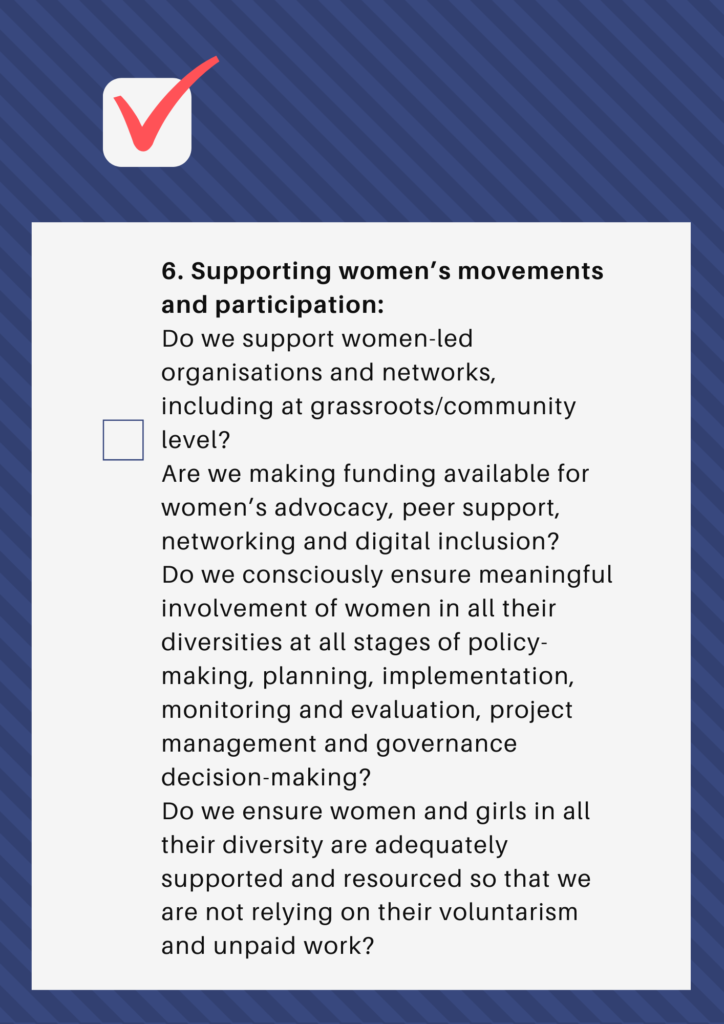
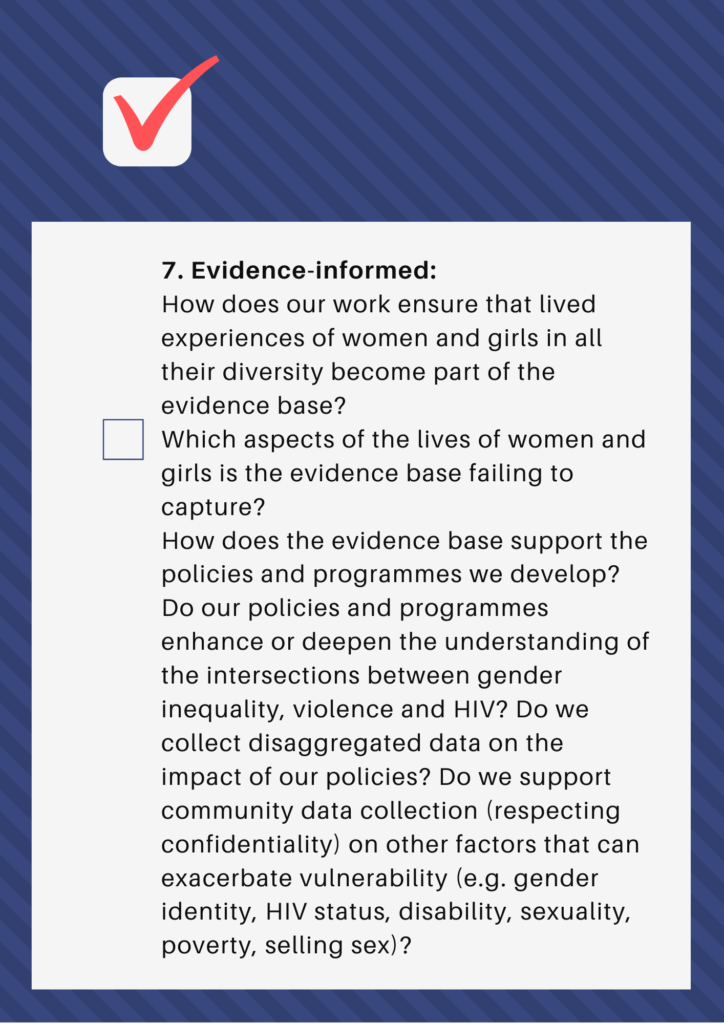
Here we share the ALIV[H]E Values Checklist (see page 41 onwards), which recognises that all rights are indivisible and interdependent. We provide an adapted set of key questions from the checklist to support public servants in their gender mainstreaming efforts to ensure that women’s and girls’ rights are addressed at every stage and level of policy-making and programming, during the Covid-19 response and beyond:
(Download the pdf of the Gender mainstreaming checklist here)


How to use the Values Checklist
Before using the Values Checklist, it is important to: a) know what is already being done to respond to HIV and violence against women in our communities, b) identify the women who are most vulnerable, and c) have considered what could be done differently to strengthen what is already being done. (These steps are all outlined in the ALIV[H]E framework.)
Using the Checklist ensures that the seven core values of the ALIV[H]E framework are central to all our decisions across all departments. Without this, we risk losing the trust of the people we work with and fail to respond meaningfully and safely to abuse and violence against women in our communities.
For example, in planning how to deliver healthcare during the Covid-19 pandemic, maternity care has often been neglected. This is an example of gendered institutional or structural violence against women. The problems with maternity care that have been reported around the world include:
Birth companions banned from hospitals – in some cases even after other lockdown restrictions have been lifted;
Forcible separation from newborns and being prevented from breastfeeding – despite no evidence that breast milk can transmit coronavirus;
Pain medication withheld because hospital resources, including anaesthetists, were diverted to the Covid-19 response;
Procedures performed without their consent, including caesarean sections, induced labour and episiotomies, to speed up labour;
Women in labour and distress reportedly being turned away from health centres or shunned by medical staff, because they appeared to have coronavirus symptoms or didn’t have masks, or because maternity facilities were rededicated to the Covid-19 response.
Working through the checklist while developing Covid-19 emergency healthcare responses would immediately raise the issue of women’s need for ongoing maternity care during the Covid-19 response, and prompt discussion on how to change the structure and policies to avoid such problems. It is important to do this in a way that includes and takes into consideration the priorities of people who will be affected by policies. Participatory forms of engagement with civil society can are transforming government decision making – this is the case in Taiwan, where it has made and making mass demonstrations there a thing of the past. Listening to people and acting on their expertise based on their own lived experiences really makes a difference to a government’s popularity and a country’s prosperity.
Civil servants could plan ahead, and reach out now to your local women’s rights groups to check through with them your next lockdown strategy, in advance of the next potential event. Provide them with funds to host their own internal focus group discussion (through text or on zoom or other platforms). Send them your current strategy and ask them to discuss what worked OK for them, what went wrong for them and ways in which the plans could be improved, which could meet their priorities in future.
These funds should include preparation, hosting and report-back time for the discussion organisers as well as funds to thank those who take part in the discussion and to compensate for their time and data bundle costs. Then you can meet with the organisers so that they can share their findings with you and your colleagues. If you can’t meet in person, you can do so by Zoom or even Whatsapp, (which you can now do with 8 people). You also should feed back to the women how you change the strategy in response to their (and others') feedback, and build in funds for them to monitor and evaluate the positive and negative effects of your revised plans over time.
The Values Checklist is a simple tool with much to offer policy-makers and organisations seeking to improve their gender mainstreaming. The evidence is there, the guidelines are in place. Now all we need is political commitment and implementation of gender transformative approaches in policy, leadership, research, resources allocation and audits
The point here is not the specifics, though if governments had consistently done the above, the issues we describe could have been prevented. The point is that having a checklist forces you to think about all the contingencies that can arise, including the problems you are not used to thinking about.
If you do this you will build women’s trust and confidence in your intentions. You will have them on your side. You can ask them what other challenges they are currently facing, such as lack of funds for their work, lack of income, etc. You can do what you can to channel help their way to address the priorities they identify. The most effective and lasting relationships are always built on trust. By building a relationship with them, you will, in turn, develop a better understanding of their priorities and they will understand better how your structures work. Working together may bring your mayor more of the women’s votes in the next election. Working to address women’s rights can be a win-win for all.
The Values Checklist is a simple tool with much to offer policy-makers and organisations seeking to improve their gender mainstreaming. The evidence is there, the guidelines are in place. Now, all we need is political commitment and implementation of gender transformative approaches in policy, leadership, research, resources allocation and audits. That’s where you as civil servants play such a key role sustaining a vibrant independent women’s rights movement, and making the world a kinder, safer place for us all.
* Ellen Kajura Bajenja (CFAR, Uganda), Emma Bell (independent consultant, Salamander Trust and Making Waves Network, UK), Fiona Hale (independent consultant, Salamander Trust and Making Waves Network, UK), Longret Kwardem (Co-Director, 4M Mentor Mothers Network, UK), Rebecca Mbewe (Co-Director, 4M Mentor Mothers Network, UK), Rahayu Rahmat (Founder, Sinar Sofia, Malaysia), Martha Tholanah (community activist, Making Waves Network, Zimbabwe), MariJo Vázquez (counsellor and facilitator, Making Waves Network, Spain), Lucy Wanjiku Njenga (Founder and Team Leader, Positive Young Women Voices, Kenya), Alice Welbourn (Founding Director, Salamander Trust, UK)
(Picture credit: Unsplash)
Make sure to share your own thoughts with the author by leaving a comment below

Log in or sign up to continue the conversation