
This article is written by Peter Constantinou, Associate Professor, School of Public Policy and Administration, York University.
Over the last 50 years, we have seen great progress towards an ever more highly skilled civil service. In advanced democracies around the world, governments have likewise become more sophisticated and highly functioning organisations. Though some would tell you otherwise, there are today countless examples of governments embodying best practices in policy and program design, management, leadership, and operations and evaluation.
• Want to write for us? Take a look at Apolitical’s guide for contributors
Our civil servants today are better educated and trained than any generation that went before them. But to reach a point where government is working to the best of its ability we have to do more. In particular, we need to refine the relationships between the professional civil service and the elected leaders and their political staff.
Intelligent design
This relationship between civil servants and politicians is at the heart of the structure and function of our government.
Civil servants are professionals who are hired for their skills, experience, knowledge, education and expertise. They are there to provide good information so elected officials can make informed decisions. And when those decisions are taken, the civil service is to passionately and professionally implement them. Elected officials are chosen as representatives of the people and are supposed to make decisions and set the agenda and the budget. They are not supposed to “run” their departments — that is the role of the civil service.
That sounds simple enough.
But in many governments around the world this structure and distinction between roles is the source of much friction. In an increasing number of cases, it is a source of conflict and aggravation, getting in the way of the smooth functioning of government.
The solution to this challenge is to ensure our public servants are equipped to effectively collaborate with elected representatives by building up their political acuity skills.
Political Acuity
Political acuity can be defined as a way of thinking and behaving; putting information and skills together to better guide choices and behaviour to accomplish your goals and objectives.
For a long time, the general thinking was you “either have it or you don’t”. Research has shown that, while there is both an art and science to it as with most things, political acuity is indeed a learned competency.
Political acuity is clearly a competency that is worth developing. As a sensitivity to a way of thinking and behaving, it allows us to understand the motivations of people around us, and of the organisation in which we work.
To help civil servants build their political acuity, public sector institutions should start by focusing on role clarity. As a first step it’s crucial that both politicians and civil servants understand and agree to their proper roles. This, just as with ethics, requires ongoing conversations and resources to guide decisions, along with agreement on a process to follow when both sides cannot agree.
The second part of this is building the knowledge and skills of our civil servants.
In many ways, political acuity is made of a number of layers. Each competency is made up of other competencies and when fully engaged is more than the sum of its parts. So for example, reading people and situations is a key competency needed for political acuity, and an important part of that is active listening and the ability to read and respond to non-verbal cues in body language.
This set of competencies can be divided into four categories:
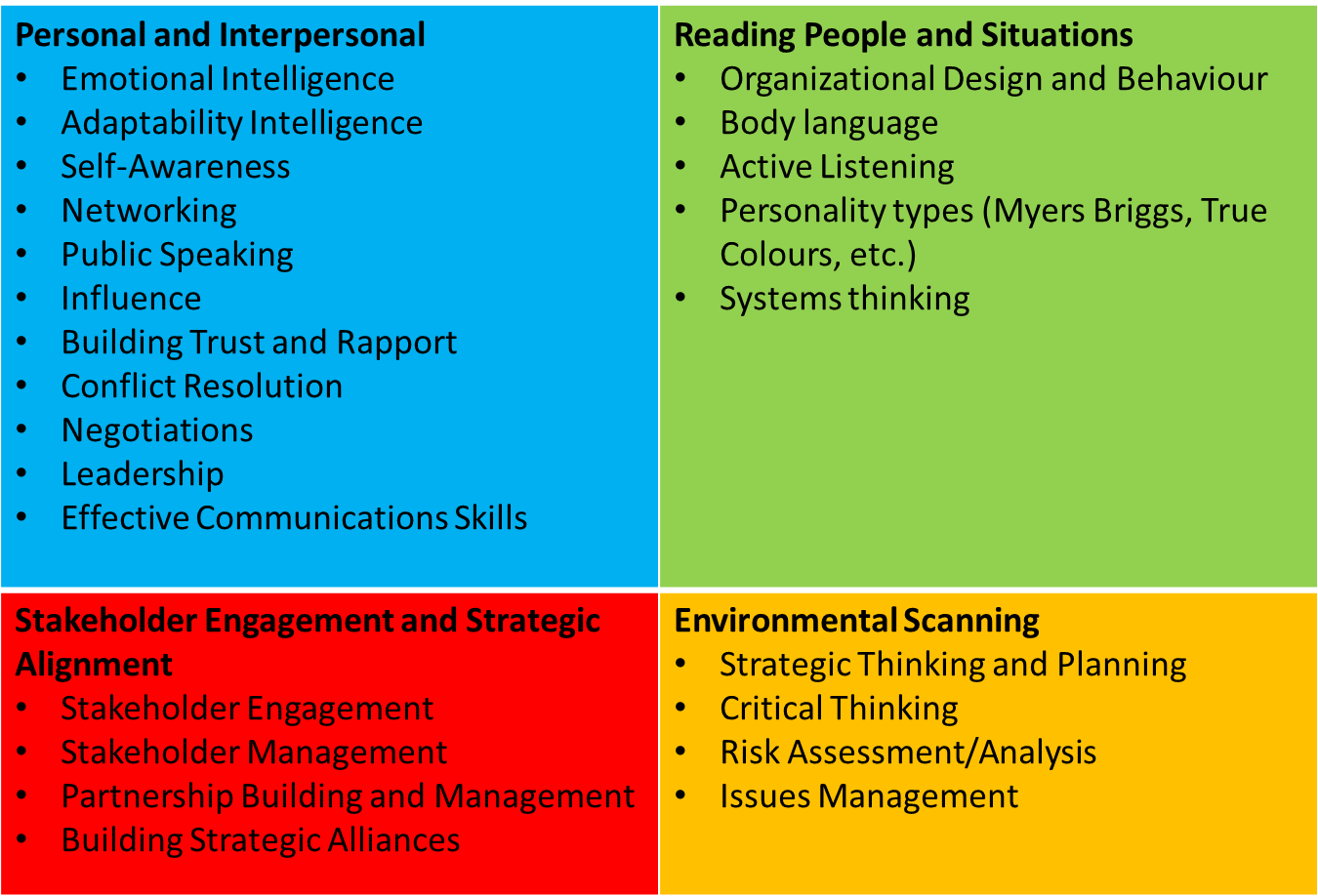
For individual civil servants, building knowledge and skills in all four of these areas is crucial to effectively lead in the civil service. When we combine these together and think and behave proactively and strategically, we are better positioned to effectively perform our roles and more likely to achieve our goals and objectives.
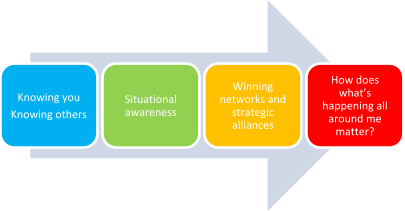
The first phase of this process begins with learning more about you. As you better understand yourself you will be more effective in dealing with others; and the more we can learn about others, the better we can engage with them.
The second phase requires you to be more observant to the people and the dynamics around you. By observing and noting the behaviours of those around you, you can begin to establish base-line data about things like body language and meeting dynamics, which will better allow you to know when to say something and when not to. When the minister asks you “is there anything else you would like to add?” and there is really something else you would like to say, but are not sure if you should, you will likely have a better sense of how to proceed.
The third phase requires you to start thinking very deliberately about networks, alliances and proactive and strategic stakeholder engagement. Building key networks and supportive alliances as part of your formal and informal stakeholder engagement will mean less conflict, less delay, fewer budget overruns and less bad press and reputational damage.
The fourth and final phase requires you to accept that the world around you affects everything you do. What was acceptable yesterday may be a disaster today. By spending some time to assess the context and what it means for us will serve us well.
Summary thoughts
Political acuity is clearly a competency that is worth developing. As a sensitivity to a way of thinking and behaving, it allows us to understand the motivations of people around us, and of the organisation in which we work. It will certainly assist us in achieving our goals and objectives, build a more effective relationship with the political class and will help the government run better. But it is also important as a survival mechanism, as missteps seem to have greater impact in an era of “gotcha politics” and the fast moving and unforgiving world of social media. After all, if we are going to “speak truth to power”, we better think about what we are going to say. — Peter P. Constantinou
We want to hear what you think about this article. Pitch an article to us or send your comments to discussion@apolitical.co
(Picture credit: Unsplash)
Make sure to share your own thoughts with the author by leaving a comment below

Log in or sign up to continue the conversation