
This piece was written by Pablo Hilaire Chaneton, undersecretary, and Pablo Casas, judge, in the judicial branch in the City of Buenos Aires, Argentina
It is crystal clear that in this time of global crisis it is particularly important that justice systems retain public trust.
An effective response to the challenges presented by this crisis is crucial and, as public servants, we have the responsibility to reassure the general population by demonstrating the ability of our vital institutions to do this.
It would be impossible to disregard the negative impact that this crisis is currently having on our social institutions.
As it is rightly pointed out in the recent report about justice in a pandemic published by Pathfinders, a group of UN member states and civil society working to promote the SDG targets for peace, justice and inclusion (SDG16+), “Lockdowns create heightened risks of insecurity, crime, and gender-based and domestic violence and human rights are at stake.”
- Want to write for us? Take a look at Apolitical’s guide for contributors
This is the scenario in the judicial sector and, in order to deal with these conflicts, we have to work in different ways and outside the court rooms that we’re used to. In this process, it is important to be proactive and seek multidisciplinary collaboration to address matters while keeping the necessary legal safeguards.
We need to share successful experiences that can be transferred to other administrations and be relevant for different policy areas
Many others across government — in legislative and executive branches — are struggling with similar issues and, likewise, need to find quick solutions to keep going in these unusual circumstances. So we need to share successful experiences that can be transferred to other administrations and be relevant for different policy areas.
For that reason and because we’re convinced that there are different, more flexible and accountable ways of administering justice and providing an effective service, even throughout this COVID-19 emergency, we believe sharing our tips for how we’ve done this in Argentina’s judicial sector can be useful for public servants of various sectors.
Essential role of digital technologies
In our court, we are always striving to foster collaboration amongst our fellow judiciaries and public servants in order to promote positive innovation. These past weeks, various domestic and gender violence cases have come before us, which we have managed to conclude promptly by working remotely within the confines of our own homes.
With the assistance of the General Direction of Computing and Technology of the City of Buenos Aires Magistrates Council and the support of director Jose Luis Branca, we have rapidly upscaled our audio and video capabilities. As a result, we have held several timely video conference hearings for different gender violence cases that have arisen and that required urgent conclusion. Victims of such violence must not be left unprotected by justice institutions during lockdowns.
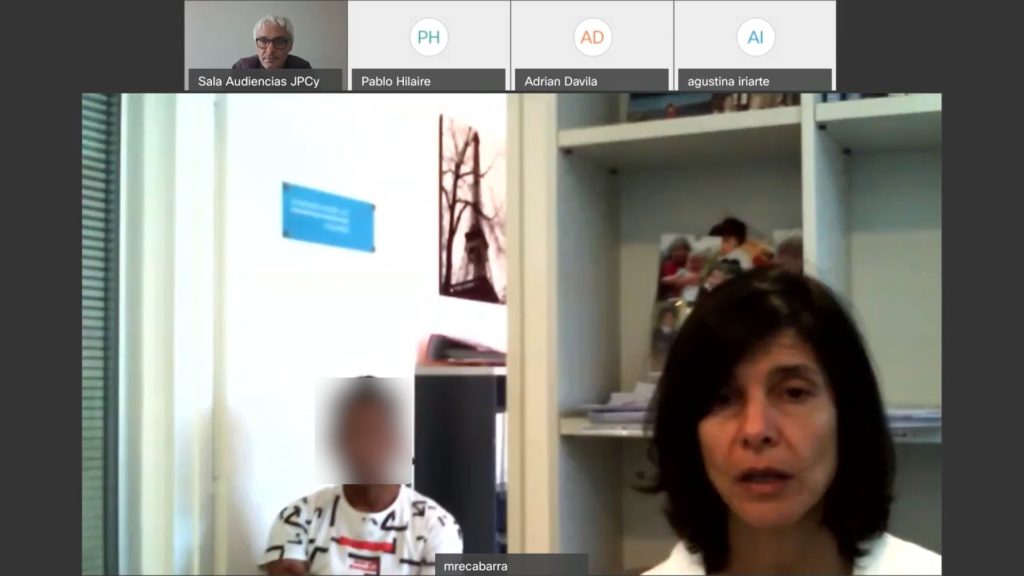 _A juicio abreviado (similar to plea bargaining)hearing on a domestic violence case, the public defender in front, keeping the recommended social distance with her defendant. Above, judge Casas, undersecretary Hilaire, prosecutor Davila and secretary Iriarte are connected._
In countries across the globe, there is a tendency among some judicial actors to resist change, favouring instead the tradition and comfort of the courtroom. Now is the time to put aside comfort and rise to the responsibility afforded with our positions. We need to be creative and get rid of any obstacles to innovation. It's time to persist in demonstrating that the increased use of digital technologies is urgently needed in judicial systems and in any court daily tasks, regardless of the problems presented by COVID-19.
Working through lockdown
This is at the core of the open justice initiative we have been implementing since early 2016, and for which we have received recognition from OECD Observatory on Public Sector Innovation as a case study. Consequently, our way of working has enabled us to keep providing service during Argentina’s mandatory lockdown, without becoming overwhelmed.
Thus, we are still making the best possible use of existing technologies to keep our court running. We decided to use Webex platform, which enables us to conduct hearings virtually and moderate the interaction between participants with acceptable safeguards.
In order to avoid delays and to make sure everything runs smoothly during these virtual hearings, we contacted the various stakeholders in advance with information about what they were required to have in place (basically, with the sole use of their phone/computer/tablet and internet access, they are good to go).
Participants can join the hearing via their web browser and do not need to pay for or install any software
This advance contact is important to ascertain if there are any circumstances that might affect or weaken the participant’s ability to join an audio or video hearing. By doing this, we can make sure to adjust for or anticipate any problem. The effectiveness of the hearing relies on taking these prior steps.
In addition, we have designed a step-by-step guide on how to connect in order to avoid unnecessary delays, sharing it in an open format. Participants can join the hearing via their web browser and do not need to pay for or install any software.
This new normal that we’re all getting used to has not deterred us in our conviction or from promoting open justice principles. On the contrary, we recently held a video conference trial on a contravention case we shared by tweeting ‘TODAY #StayAtHome and enter our Virtual Court Room’. Naturally, the audience was bigger than at any of the public hearings we have been sharing every week previously.
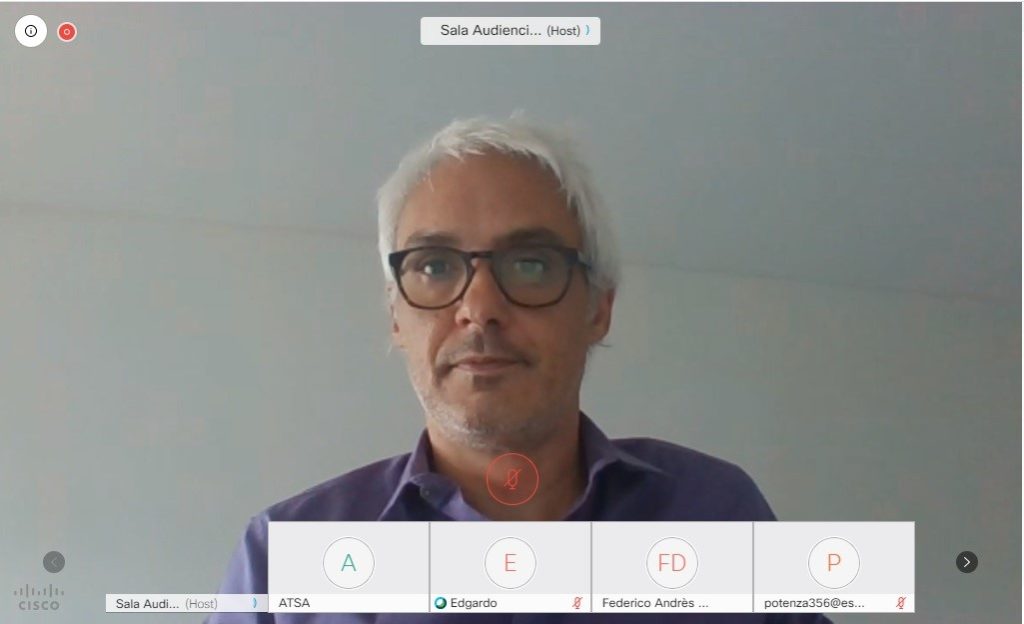 Judge Casas conducting the trial. Below, the defendant, the prosecutor and two persons of the general public appear connected. The hearing took place with the virtual presence of up to fourteen participants.
The crisis has actually presented an opportunity to enhance our accountability and to measure our performance. For instance, it’s allowed us to invite participants to assess our use of plain language during the hearing. Before the trial began, we informed the public that we would be receiving comments and answering questions afterwards. Once the trial came to an end, we received suggestions and ideas from the public, such as putting up a welcome sign, or playing background music until the trial begins so those waiting would know they were properly connected.
Keeping up with the times
The virtual trial was a first experience for court members, the prosecutor and the defendant. We were able to conduct the hearing without any real inconvenience. The participants were satisfied, and the case was not postponed. It was an interesting and unusual experience at a time when public gatherings pose a risk to public health.
While people are rightly following instructions to stay home, they can see that justice matters won’t be delayed unnecessarily. These new procedures, which are proven to work, should encourage others in the justice community to follow suit.
That being said, we care about the consequences of sharing our work and that makes our responsibility not to slip up even bigger. When choosing virtual platforms on which to execute work remotely, and before giving public access to any hearing, judges have an obligation to consider the nature of the matters at stake, any privacy concerns and the protection of personal data.
The speed with which our court was able to adapt to these pressing circumstances is directly linked to our open justice aim and the constant use of technologies to improve our work
Numerous justice institutions are struggling due to their rooted commitments to the procedures of conventional court systems. The speed with which our court was able to adapt to these pressing circumstances is directly linked to our open justice aim and the constant use of technologies to improve our work. It is important to note that many technologies available do not require a costly budget.
Having worked for several years in different areas of the judicial and legal system, we can assure you that many people resist the changes implemented and proposed by early adopters. We believe, however, it is now necessary to identify and share good experiences already in place and scale them up. Justice leaders are essential players in the mission to ease this global crisis.
In the words of legal technologist Richard Susskind, “A court system that is antiquated, detached, unaffordable, slow, or unintelligible, can weaken confidence in the judicial process.” It is time judiciaries across the world hear people like Professor Susskind, take action, and gain society’s confidence by implementing different, more flexible and accountable ways to deliver justice.
A new way of delivering justice?
The challenges presented by the COVID-19 emergency are spreading across diverse sectors and policy areas.
It is important that we do the utmost to keep our court services running. Different justice parties and users must act together in order to make this happen and we are grateful to those who are coming on-board as we adapt our processes.
Although some of the problems need different type of solutions, many of them can be tackled by implementing similar processes and collective ways of working.
 Our team (@jpcyf10)holds virtual meetings to manage the workflow, divide tasks and keep the court services running from our homes.
These are complex and demanding times that present opportunity to be more creative and flexible when it comes to develop innovations. Many changes implemented will improve our performance and are here to stay.
There is much to learn from sectors that turn to existing, secure and affordable technology to find solutions. Let’s share these fruitful experiences. An open, accountable and collaborative approach is necessary to keep providing resilient and sustainable services. — Pablo Hilaire Chaneton and Pablo Casas
(Main Picture Credit: Unsplash)
Make sure to share your own thoughts with the author by leaving a comment below

Log in or sign up to continue the conversation