
This article is written by Liz Lutgendorff. Liz has worked at GDS since 2012, helping launch GOV.UK. She currently works on the GDS International Team which helps other governments with their digital transformation ambitions.
Even though I haven’t been part of the team behind GOV.UK for several years now, it has been on the forefront of my mind since I joined the International Team at GDS in 2019.
Our team helps other governments with their digital transformation ambitions, drawing upon GDS’ transformation journey and continued championing of user-centred design at the heart of government. With very few exceptions, GOV.UK is one of the key areas that other governments are interested in finding out more about.
Want to write for us? Take a look at Apolitical's guide for contributors
Almost 8 years after it was first launched, GOV.UK remains a remarkable achievement. Many governments still struggle with the problem GOV.UK solved: a fragmented online presence for government and expensive online estate. But as we tell other governments, it wasn’t just the technology that made it work, it was putting user needs first and relied upon a vast cross-government collaboration.
At the time It didn’t feel like we were working on something that was potentially revolutionary, mainly because we were just trying to get it done. We were trying to apply a new concept – content design – to the real task of taking millions of words, getting rid of a lot of them, and making the rest more useful.
We could see from the viewing data that most people didn’t engage with videos for longer than a minute. It’s why we don’t recommend using videos for important information as part of our guidance
Before GOV.UK, each government department and agency had their own website (or more than one) and there were two “user facing” websites: Business Link and DirectGov. Depending on the policy, the information about that policy could be spread out across all these sites, with slightly different words and interpretations of what was important. There was overlap, duplication and fragmentation of information and services.
The first task for GOV.UK was to take DirectGov and make it fit for the 21st century, using modern web techniques and approaches to create a user-focussed website and content for the UK. The scope expanded quickly to include Business Link, then every other ministerial, department and agency websites (with some exceptions).
So what did we do?
Understand the government web estate
This is never going to be perfect. If you are embarking on a similar project, you should know that you aren’t going to have beautiful analytics or site maps. We had a lot of spreadsheets that had seemingly endless lists of URLs, fragmented visit data, or search terms. Nothing was complete. Hardly anything was comparable.
The tools we had when analysing Business Link was a Google Form to collect user needs, and a massive spreadsheet that had been generated by a scrape of URLs from the site. We assessed if we thought a webpage had a user need or not, the URL and any related URLs. I’d read hundreds of pages a week, teasing out what was a legal requirement, a service or advice.
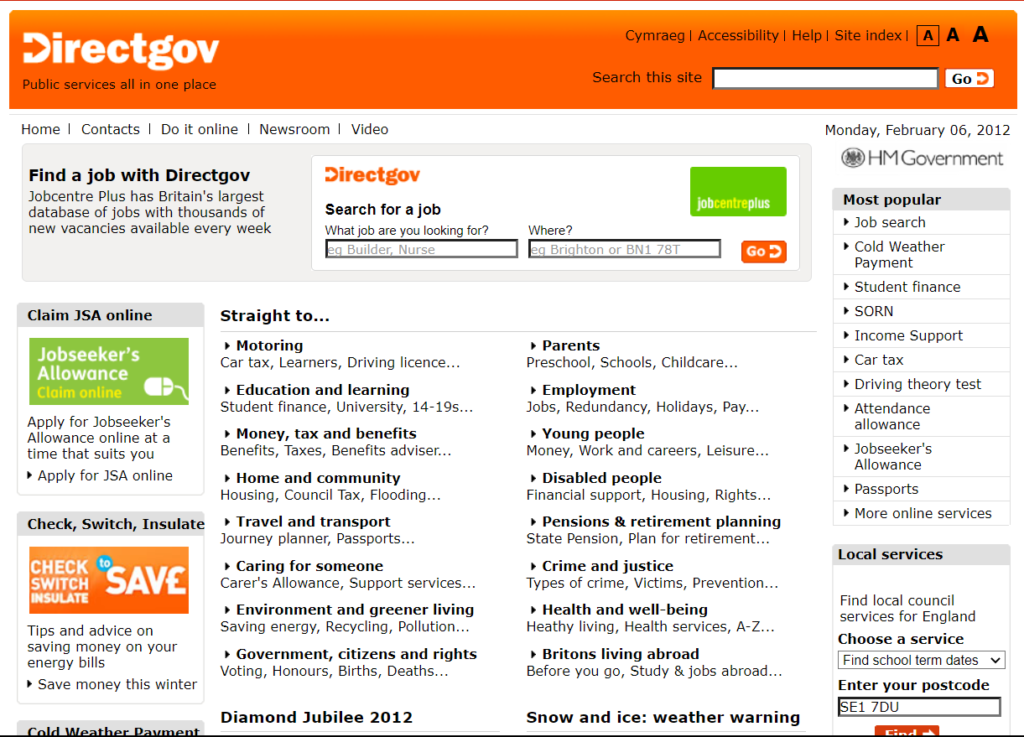 A screenshot from DirectGov, captured in February 2012 (Image credit: The National Archives)
The next step was to take all this information and create a content plan — really just a list of the user needs organised by theme. For example, “what you need to know to start a business” or “what you need to do to import goods into the UK”.
As we migrated hundreds of websites and agencies over, we learned the lesson over and over again that you can’t fragment these journeys without frustrating users
We’d also cross reference this with our imperfect data and analytics, to make sure we didn’t miss anything that existing users felt was important. In general, they indicated that we were on the right track, with much of the advice on Business Link rarely being used.
For example, one reason we didn’t migrate many videos over to the new GOV.UK was because the ones that existed weren’t being watched as they also tended to duplicate existing content. We could see from the viewing data that most people didn’t engage with videos for longer than a minute. It’s why we don’t recommend using videos for important information as part of our guidance.
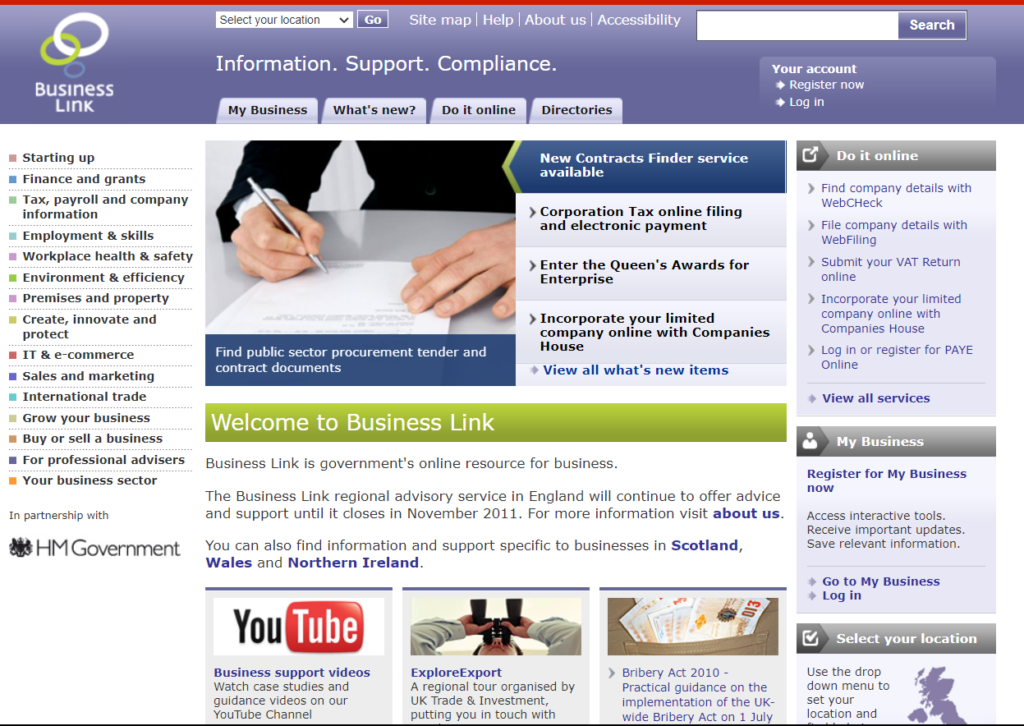 A screenshot of BusinessLink, captured June 2011 (Image credit: The National Archives)
As we migrated more and more websites, you could see how journeys were fragmented across different organisations that had only one part of that entire service journey within their remit. Department A might write the policy, Agency B might deliver the policy and Tribunal C would deal with an issue when everything went wrong. Each party had a different part of a full user journey under their remit and a user had to navigate through several sites and interpretations to get the information they needed.
As we migrated hundreds of websites and agencies over, we learned the lesson over and over again that you can’t fragment these journeys without frustrating users. It’s still why there is a core GOV.UK content team that looks after the most highly used content on GOV.UK.
We made assumptions based on the best data we had at the time. We relied on the principle that we were working in an agile environment and that if we didn’t get it quite right, we’d iterate it over time.
Involve all parts of government
This is what we come back to again and again in the International Team. A single domain is a vast collaboration of content, engagement, policy, legal and senior stakeholders. It requires an enormous amount of dialogue, trust building and leaps of faith to see it through.
There are so many people that I still recall so fondly from across government from my time working on GOV.UK. They were equally as passionate about good content as anyone at GDS. One thing I am so proud of was putting together the first, really scrappy Content Design Conference. They are now the highlight of the content calendar (affectionately known as ConCon) that brings together content minded people to nerd out, but importantly tackle big problems collaboratively to make government content better all the time.
While working on the beta and eventual launch of GOV.UK, We had meetings with government agencies and departments to agree on everything: user needs, content plans, content drafts, publishing and rewrites. There were occasional escalations, but for the most part we collaborated across department lines, learning about each other’s challenges and perspectives along the way. We argued, presented evidence, and reached consensus. Then hit publish.
Experiment and talk things through
One of the moments that I remember quite vividly was bringing together business content with citizen content. The teams transitioning DirectGov (the very orange citizen facing site) with Business Link (the purple-green business site) had been working separately. When we knew that we’d be including Business Link content into GOV.UK, our worlds came crashing together.
It’s an important component of agile working to prioritise individuals and interactions over processes and tools. Discussions let us get to an agreed and shared outcome quickly, so we could deliver at pace
Suddenly we were faced with reconciling guidance with what happens if you’re made redundant with what to do as an employer making someone redundant — but in one place. So what to do? First, look at the data that we had to gain any insights. Then write and experiment with different ways of formatting the content. Test it with users, gain more insights, debate with each other, and repeat. In general, we had the idea of keeping “contested” content separate, so where there could be a conflict it was best to create an employer and a business guide (like with redundancy). But if there was no conflict (like holiday entitlement) we’d keep it in one place.
There were hundreds of discussions about how to present content about individual words and about conventions that we could use to make the site consistent. Many of these ended up in our guidance overtime. Our own practices also emerged, such as the “second pair of eyes” function to review content and to make sure GOV.UK reads consistently.
It’s an important component of agile working to prioritise individuals and interactions over processes and tools. Discussions let us get to an agreed and shared outcome quickly, so we could deliver at pace. It also allowed for wider team learning and reflection, so we were all on the same page, even when we were working in such a dynamic environment.
Final reflections
I used to say that I’d never work on something as momentous as GOV.UK again but with my team it looks like I’ll probably get to watch from the margins as other governments try to break down their own silos and collaborate to provide unified information and services to their own countries. It’s very exciting to watch and I hope at GDS we’ll be able to learn from their journeys too. — Liz Lutgendorff
(Picture credit: Unsplash)
Make sure to share your own thoughts with the author by leaving a comment below

Log in or sign up to continue the conversation