
This article was written by Wim Seghers, play space consultant for the city of Antwerp, Belgium
Aldo Van Eyck, the Dutch architect who died in 1999 having led architecture’s structuralist movement, famously remarked that “a city not meant for children” is “not meant for citizens either”.
On that basis, he added, such a place could not even really be called a city.
There was a time when kids could literally play anywhere. That is the perennial claim older generations make, yet it is one we fondly entertain, because it describes a world we instinctively want to live in: one in which children do not fear the world.
- Want to write for us? Take a look at Apolitical’s guide for contributors
Yet, due to the increase of motorised traffic, territory that might once have belonged to kids has slowly receded. Now, all too often, what we have instead are local playgrounds — compact play islands where children interact under the supervision of adults.
The child-friendly city envisages this differently. Rather than fitting children’s needs around urban infrastructure, it treats kids as the litmus test of a functioning city. The thinking goes that when kids struggle to enjoy their environment, the whole metropolitan area suffers.
Municipalities go to enormous efforts to lure families, often to boast being a ‘family-friendly city’ primed for affluence. Yet, because of the characteristics of today’s urban landscape, child-friendliness has little to do with play and activity, and everything to do with road safety and mobility.
One tool shown to help with this is called the ‘playspaceweb’.
What is a playspaceweb?
A playspaceweb is a network of car-free or low-traffic cycling and walking routes, connecting different playgrounds that feature what are called ‘play impulses’. A play impulse is a walking or climbing apparatus. It can be shaped like a log or a rock, but its underlying purpose is to invite and stimulate spontaneous play. A child who plays inside a playspaceweb is free to meet other children and move freely without being at risk from surrounding traffic flows.
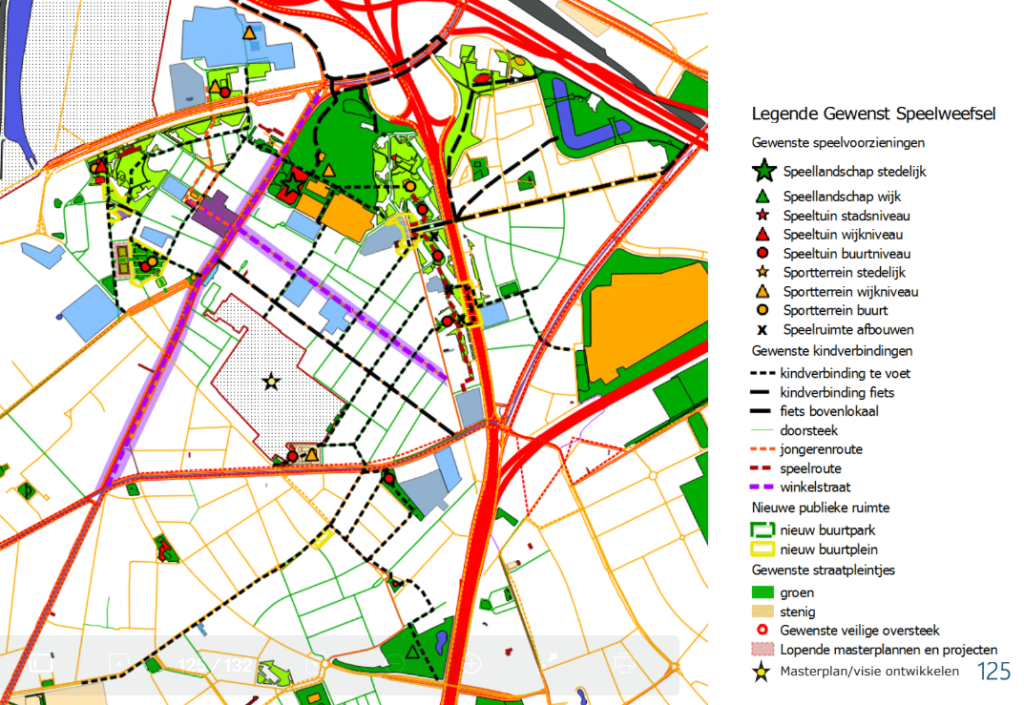 This is a map of a playspaceweb, with a key of various landmarks
The beauty of the playspaceweb is that it breathes new life into city streets. This is good for adults as well. Greater social engagement radiates through all facets of community life. People get to enjoy streets that do not prescribe direction or purpose of travel. This creates greater social cohesion, accountability and trust, as well as the freedom to spend time socially and at leisure. These outcomes also have a positive impact on road safety. Car drivers are more likely to adjust their driving style and speed when they recognise their city to be one in which children play.
Why adopt the playspaceweb?
One of the strengths of the city is that everything is close by. You don't need a car to buy a carton of milk, to drop your kids off at school, go visit the theatre, or go out for a drink. A 'good' city is therefore, by definition, a mobile city. These things benefit adults of course, but the benefits apply to children and young people as well. In the past, this has been seriously overlooked by public servants, who’ve tended to think about a citizen’s mobility in terms such as whether or not they own a car. The result of this way of thinking is that the ability of children to move independently within cities has decreased spectacularly.
Using geographical data, the playspaceweb finds areas where children can go to school, make new friends and enjoy a journey of discovery. Above all, it makes the lines between these activities visible, so that children can move between them without the need for parental oversight. That's the difference between a playspaceweb in which a child can venture, and play islands in which they stay heavily supervised for hours at a time.
Where the playspaceweb starts
In neighbourhoods with many children and few open green spaces, the number of traffic accidents involving children tends to be high. This has little to do with anything other than a lack of playspaces for children. Too many children are forced to play in areas of cities that are either heavily polluted or dominated by motorised traffic.
Antwerp has chosen to prioritise the use of the playspaceweb in its most disadvantaged neighbourhoods. The end goal of this is to create safer roads, and more autonomy for children.
How a playspaceweb is created
Young people are rarely involved in the design of a public space, let alone mobility policy. By contrast, designing a playspaceweb necessitates a young person’s perspective. The design process starts with intensive participation sessions in which children and young people are asked about their experiences of a particular play space.
In that sense then, children and adults are seen as equal partners in the creation of the playspaceweb. Based on both their inputs, the actual play areas are mapped out, after which a list of actions and policy proposals is drawn up to determine how they will be built, regulated and maintained.
Another of Van Eyck’s famous quotes is: “If childhood is a journey, let us see to it the child does not travel by night.”
This points to the higher goal of the playspaceweb: to ensure that a child’s neighborhood remains safe, attractive and open, and allows them to improvise their own unique journey, rather than retrace their footsteps in confined play areas, under the watchful gaze of their grown-up guardians. It is our responsibility, as adults and as public servants, to enable their journey to begin. — Wim Seghers
We want to hear what you think about this article. Pitch an article to us or send your comments to hello@apolitical.co
(Picture credit: Unsplash)
Make sure to share your own thoughts with the author by leaving a comment below

Log in or sign up to continue the conversation