
This article was written by Miki Stricker-Talbot, a featured Apolitical contributor and Intrapreneur at the City of Edmonton, Canada. This is her second article in a series on facilitating change from within the public sector.
Last week I introduced the Personal Progression for Government Innovators framework.
I have created this framework to make sense of the journey civil servants embark upon as they decide to try to innovate and make change from within their organisations. The framework outlines five different “states” that civil servants may embody as they work to innovate within government organisations, the dominant emotions that change agents are likely to experience within each state, and the impact each state has on citizens.
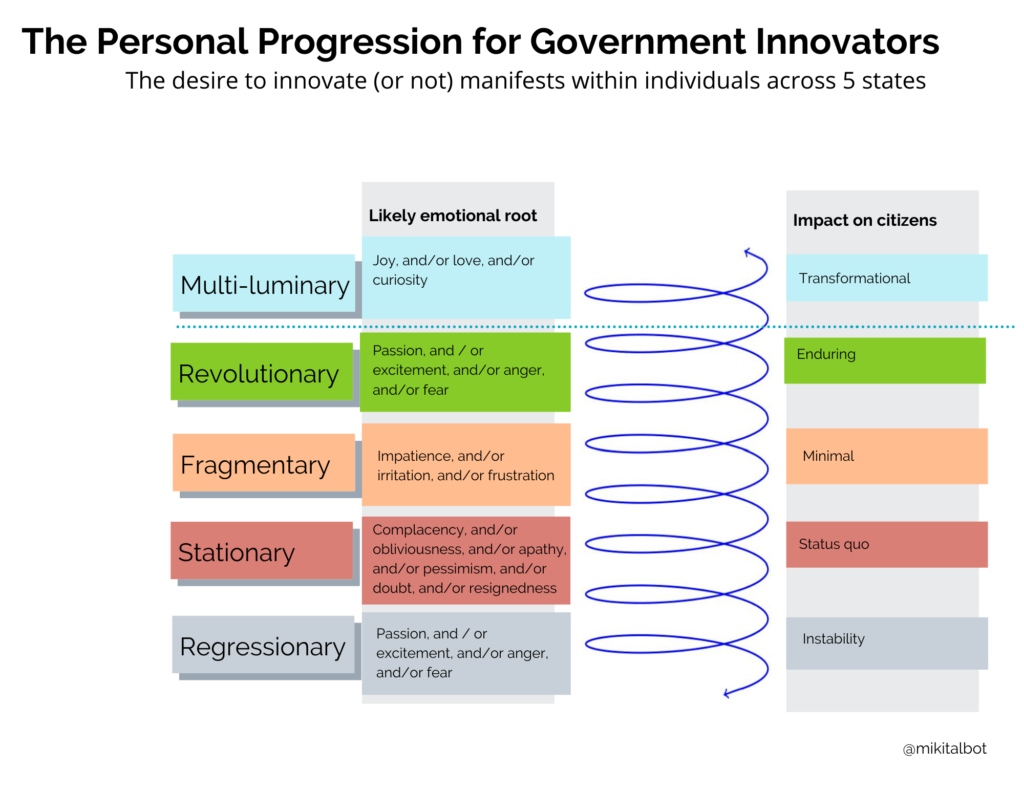
the Personal Progression for Government Innovators
Admittedly, trying to create a framework that encompasses all the diverse experiences felt by public servants from an innovation perspective is not an easy task — nor is it a simple one. So in this article, I hope it’s a helpful exercise to unpack it a little, using a personal story.
- Want to write for us? Take a look at Apolitical’s guide for contributors
Earlier in my career, I worked in a department that coordinated event-related civic services for community organisations. The services we coordinated were not directly delivered by our department, rather they were delivered by a number of other areas within the broader organisation. Our department served as a sort of “air traffic control,” involving a lot of logistical coordination of various civic services. The way we did our work had always been done that way, because it was considered to be “good enough.”
Rewriting a form can be a revolutionary act
The challenge for us was that our office was subject to the ways of operating that the other offices had set up. We didn’t have any control or influence over their processes or policies — even if they served no one’s interest.
A case in point: in order for Office Y to be able to provide a particular service, they needed the community organisations to provide their request and the relevant information through a specific form. The form was the epitome of bureaucracy, filled with jargon and baffling requests. The questions were unclear and caused a great deal of confusion for the people trying to complete it. As a result, the information they provided on the form was almost always incomplete or wrong.
Office Y was constantly frustrated that they were forced to work with inaccurate information. The community organisations that were in need of the service were also frustrated by the lengthy delays and incomplete provision of the service. And our department that served as “air traffic control” and the intermediary between the two took the brunt of angry phone calls and interventions from the community organisations, Office Y, and City Councillors to resolve the issues. No one was happy.
And so, one day, I asked a simple question in a meeting between our office and Office Y: “Can we make a new form?”
I asked the question from a Fragmentary state. I saw a problem and thought that we would “be able to make it better than it is now” by making some adjustments to the form.
in order to really foster change for good within government, public servants need to go to their own personal revolutionary place regardless of how tame, or how radical that act looks to others
One would expect, given the problems resulting from the existing form that the question would have been met by a resounding “YES! Let’s start now!” Alas, my question was instead met by the sound of crickets.
So the problem continued. As it did, each week during our team meetings, I asked the question again: “can we make a new form?” The sound of crickets continued. As the weeks passed, I grew more and more frustrated. But I also grew more determined.
To demonstrate how much better a new form could be, I drew a mock up with a sharpie to help others see the potential. More crickets. And so as the weeks turned into months and the problem continued, my frustration morphed into anger. All I could see was more incomplete information, more angry people, more unnecessary interventions by City Councillors. I began to see my challenge in trying to create a new form to be emblematic for all of the problems the organisation faced. And so over time, given the barriers and walls I kept hitting, I moved from a Fragmentary state into a Revolutionary state. I believed that if we could successfully change the form, then anything was possible.
Fortunately, this story has a happy ending. After asking the question for six months in different ways, I managed to bring a couple of key allies on board. I was no longer alone in my quest! Eventually, nearly a year after asking my initial question, we implemented a new form. After people started to use the new form and comment on how much better it was, I felt such a sense of pride and accomplishment. My anger abated. We had changed the system!
Where do we go from here?
Fast forward several years, and I see things differently.
I am fortunate enough to currently work on a team that embraces social innovation, human centred design, AI, foresight, and other innovative approaches in the co-creation of policies, plans, and approaches for our city. Importantly, we also have the top cover from senior leaders to do our work in this way. Our team culture and the context in which we work provides me with remarkable freedom and privilege to experiment. My context has dramatically shifted over the years.
And context is everything.
In my current context, I now personally define the Fragmentary state by things like Lean methodologies and continuous improvement. I currently define the Revolutionary state by things like incorporating artificial intelligence or systemic design into our work, and I define the Meta-luminary state by things like unlearning methodologies or imagining protopian futures.
This work takes work. It is continuous, ever shifting, and requires us to deeply and intentionally explore our messy inner terrain
And so with my current context, I now define my previously Revolutionary act of changing a form as being a Fragmentary action at best (ironically perhaps, the same state I initially started from when I initially asked: “can we make a new form?).
But in my previous context, with the amount of resistance I faced, changing a form was a revolutionary act. And so I’m beginning to understand that in order to really foster change for good within government, public servants need to go to their own personal revolutionary place regardless of how tame, or how radical that act looks to others.
Perhaps this is an important key to understanding the way that innovation happens in government.
There’s one other important context consideration in all of this: it is not only my external personal context that has shifted. My internal personal context has also shifted over time as a result of inner work. To quote Rumi: “Yesterday I was clever, so I wanted to change the world. Today I am wise, so I am changing myself".
As change agents, we must work to understand our own biases, mindsets, heartsets, and ways of understanding the world. This work takes work. It is continuous, ever shifting, and requires us to deeply and intentionally explore our messy inner terrain.
Questions for consideration
I know my story is not unique. Many people have told me similar stories of similar struggles, and fortunately, many have had happy endings like mine. In order to encourage more public servants to move from Stationary or even Fragmentary states and towards embracing the innovation practices we all know are needed to better serve our publics, I invite you to explore this progression. Either alone or in your team, depending on what makes sense for you. Some of the questions that I think we need to explore my deeply, and which I invite you to ask as well, are:
How might we better understand our own and others emotions as we work to realise positive change in the world?
Since the Revolutionary state and Regressionary state are rooted in the same emotional space, what are the conditions that propel individuals to move towards one state versus the other on the progression?
How might we better support employees who are in the Revolutionary state? How might we help prevent their burnout or disillusionment with the system?
As this progression has been developed from my personal Global North and western worldview, what biases exist within this framework?
Although I’ve done my best to illustrate that the progression is not linear, it still is likely to read that way. What changes could be made to the diagram to help clarify this?
This framework is still very much a work in progress, and will undoubtedly shift and evolve as more things that were once hidden become clearer. Thanks to the lovely people who have already been providing me with additional layers to consider (in particular Honey Golightly, Julio Rosa, and Chris Allison). If you discuss the questions above with your team or colleagues, I warmly welcome your thoughts and insights. What is emerging for you? What have I missed? Where might this go from here? Catch me on email or twitter. — Miki Stricker-Talbot
Miki Stricker-Talbot is a featured Apolitical contributor. She writes a monthly article for Apolitical's readers, and this is the second article in her series about facilitating change from within in the public sector. To find out more about how you can become a featured contributor, please get in touch.
Resources, references, and additional inspirations
- Michel Bachmann, Start with Who
- Mee-Yan Cheung-Judge, The Self as an Instrument — A Cornerstone for the Future of OD
- Marco Daglio. How Do Public Sector Organisations Innovate?
- Frederic Laloux. Reinventing Organizations: An Illustrated Invitation to Join the Conversation on Next-Stage Organizations.
- Donnella H. Meadows, Thinking in Systems: A Primer
- Yoko Ono, Wish Tree
- Margaret Wheatley and Deborah Frieze, Using emergence to take social innovation to scale
- The League of Intrapreneurs
- The Long Now Foundation
- The Presencing Institute
- The Tamarack Institute
(Picture credit: Unsplash)
Make sure to share your own thoughts with the author by leaving a comment below

Log in or sign up to continue the conversation