
This article is written by Lauren Lombardo, a master’s student in Public Policy at Harvard Kennedy School, Beatriz Vasconcellos, a master’s student in Public Administration and International Development at Harvard University, and David Eaves, a lecturer in Public Policy at the Harvard Kennedy School
It took only 10 days for Togo’s Ministry of Digital Economy and Digital Transformation (MENTD) to build and launch NOVISSI, a mobile cash transfer programme designed to mitigate the economic consequences of Covid-19.
50% of Togo’s population live on less than US$1.25 per day and 90% of the population are classified as informal workers. The Ministry knew that, as the economy shut down, workers would be left in financial hardship. The highest concern for many government officials was preventing an increase in the poverty rate.
NOVISSI, which means solidarity in the Ewe language, therefore became a critical component of Togo’s Covid-19 response plan. The system has distributed around US$22 million to 600,000 residents through monthly payments. These were possible because of the high numbers of mobile phone users in Togo, good relationships with telecom providers, and a recently-updated voter registry.
• Want to write for us? Take a look at Apolitical’s guide for contributors
NOVISSI asks applicants to complete a registration process, which includes entering a voter identification number. This voter card also provides certain data points, such as an applicant’s work status and home address, which are used to determine if they qualify for the programme. The registration and verification process is quick and successful applicants receive a cash transfer in minutes.
Here is a brief overview of the application process:
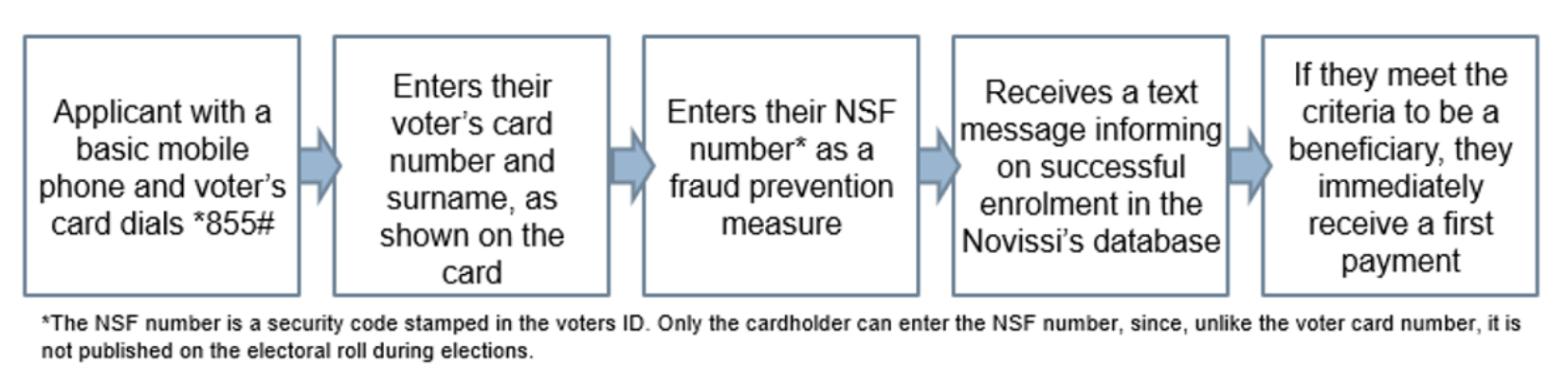 Source: Data from NOVISSI Program Site, Ministry of Digital Economy and Digital Transformation, Republic of Togo
Even though Togo’s policy response — direct cash payments — was similar to other countries, the speed and effectiveness of the NOVISSI programme was unique. It undoubtedly saved lives. And while every government’s response to Covid-19 was constrained by its existing resources, Togo thought creatively about how to draw upon four of its existing capabilities to create NOVISSI.
An existing and reliable biometric database
In Togo, voting in elections is mandatory, and voters were required to update their voter identification information in December 2019. This gave MENTD a reliable data registry for 93% of the adult population. This data registry holds much of the information needed to verify that an applicant qualifies for the programme: name, address, and profession.
The key lesson learned from these sessions was that in today’s world, crisis response is digital response.
Popularity of mobile payments and local familiarity with inclusive design
Mobile phones and mobile payments are used by 82% and 62% of the Togolese population respectively. This popularity allowed MENTD to use mobile payments to deliver cash transfers comfortably. The team also designed an offline process using Unstructured Supplementary Service Data (USSD) technology. USSD was selected because it is easy to use — applicants just need to dial a sequence of numbers on any mobile phone, it doesn’t require an internet connection, and it works with a 2G signal. MENTD also supported offline applicants by working with the post office to help people convert their mobile payment into cash.
An existing team of skilled government technologists
Building NOVISSI in 10 days meant there wasn’t time to rely on external solutions or talent. Everything was built in-house. MENTD also had some experience designing USSD systems: in 2017, the team built a tool to provide subsidies to crop farmers. NOVISSI presented new and different challenges. But the team’s existing technical experience and their desire to serve their communities ensured a speedy development process.
Established relationships with telecom operators
Close collaboration with the country’s two mobile payment operators meant all parties agreed to eliminate transfer tariffs, so applicants received the money without paying fees. MENTD also integrated its systems with the mobile payment operators, which allowed for the automatic creation of a mobile money account for the beneficiary if they did not already have one.
In addition to these four capabilities, MENTD focused on building a transparent and accountable governance system. All NOVISSI payments are reconciled on a daily basis to ensure financial integrity. This helps boost public trust in the programme and reassures donors that all funds are used for the intended purposes. Additionally, MENTD established a product feedback loop. It set up a toll-free contact centre that provides remote assistance and gathers user input. This feedback is sent to the technical teams and incorporated into outreach efforts.
Last summer, the Ash Center for Democratic Governance and Innovation at the Harvard Kennedy School and Public Digital co-hosted a series of coronavirus digital response conversations. The key lesson learned from these sessions was that in today’s world, crisis response is digital response. Because many governments hadn’t invested in digital services, their crisis response was insufficient.
NOVISSI is successful because the team had existing capabilities it could draw on to develop a digital tool. The Covid-19 crisis forced Togo to take a big bet on a digital service solution. It worked, and now the lessons learned from developing and managing NOVISSI can be the building blocks for even more digital government initiatives. — Lauren Lombardo
---------------------------------------------------------------------------------------------------------
This article has been adapted from a section of the 2020 State of Digital Transformation Report published by the Ash Center for Democratic Governance and Innovation at the Harvard Kennedy School.
We want to hear what you think about this article. Pitch an article to us or send your comments to hello@apolitical.co
(Picture Credit: Unsplash)
Make sure to share your own thoughts with the author by leaving a comment below

Log in or sign up to continue the conversation