
When police officers wear body cameras, allegations against them fall by 33%.
If schools text parents about upcoming maths tests, students make progress equivalent to a full month of lessons.
When doctors screen all female patients for domestic violence, abused women are three times more likely to speak up.
These are just a few results of a five-year push for evidence-based policymaking by the UK government through its What Works Network. The idea behind What Works is simple: sector-specific centres test solutions to civic problems then disseminate findings, helping busy policymakers and public servants make better decisions.
On Monday, What Works celebrated its fifth anniversary in London with the launch of a report detailing its work over the last five years. Speakers included ministers from Treasury and the Cabinet Office, as well as David Halpern, the National What Works Advisor and head of the UK’s Behavioural Insights Unit.
The goal of What Works is to reinforce the importance of truth and evidence in an era when some politicians don’t have much regard for facts, and spur a surge of government innovation.
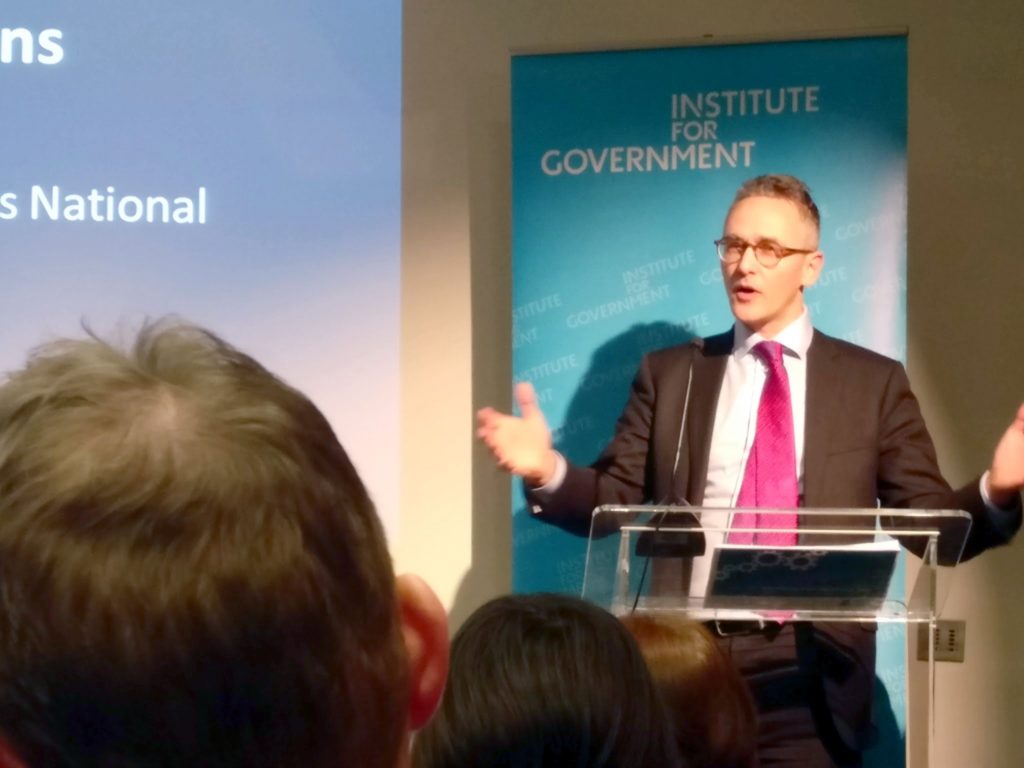 David Halpern speaks at the What Works Network's five-year anniversary event
“I think there’s a real appetite for evidence-based policymaking,” said Mihiri Seneviratne, a senior advisor for the central What Works team, based in the Cabinet Office.
“Getting the right evidence in time has been a perpetual struggle and challenge in policy, but that’s what the network is set up for doing – making it as easy as possible. Ministers are really keen to integrate it into their work.”
Although the What Works Network was formally established in 2013, its roots go back to the late ‘90s. In an effort to strengthen evidence-backed policymaking, the Tony Blair administration established the National Institute for Health Care Excellence (NICE) – now a What Works Centre – in 1999.
NICE showed how an institution could test both the effectiveness and value-for-money of treatments, and disseminate findings across the public service. Its success – and integration into the UK’s National Health Service – was the proof-of-concept needed to create other industry-specific institutions.
There are currently 10 independent What Works Centres across the UK, focusing on sectors such as education, ageing, social care and economic growth. They experiment, conduct studies, and gather the best available evidence, then translate that research into something usable – such as a crime prevention toolkit. Funding comes from the Economic and Social Research Council, Big Lottery Fund, Arup and Centre for Cities, as well as universities like the London School of Economics and Cardiff.
There’s also a focus on testing policies that are already widely used. Sometimes, it turns out that methods we’ve been using for a long time are simply ineffective. For example, a What Works centre established that even though most doctors prescribe antibiotics for ear infections and sinusitis, the ailments are best treated with over-the-counter pain medication.
“We do a lot of things that cause harm – and even when we know what works, sometimes we don’t do it"
“We do a lot of things that cause harm, or we have no evidence of effectiveness – and even when we know what works, sometimes we don’t do it. That’s what we need to change,” said Alex Murray, Assistant Chief Constable for the West Midlands Police. Murray also founded the Society of Evidence-Based Policing.
Some of the most interesting results presented at the launch were in policing and crime reduction. Murray described how, for years, the West Midlands Police struggled to deter people from unsafe driving. The language in the letters they sent to drivers caught speeding was too complex, and as a result, people did not pay their fines and ended up in court.
“You had to read it three times to really understand what you had to do,” said Murray, who worked with What Works to introduce a randomised control trial.
“We started showing a picture of the aftermath of a car accident, where flowers and a teddy had been left on a lamp post, alongside the text: ‘Last year, 700 children were killed in this area because of speeding drivers’. It demonstrated that our motivation is good: it’s not about collecting fines; it’s about saving lives. And that’s when we saw the response.”
Drivers who received the revised letter paid fines 20% more quickly, and as a result, went to court 41% less – which saves the county about £1.5 million ($2.1 million) in court fees per year. It also cut reoffending by 20%.
“Suddenly, all the foundations of everything you think you know are being challenged"
One of the biggest challenges facing the What Works model is convincing public servants on the ground – from experienced police officers to overworked social workers and underpaid teaching assistants – to implement the centres’ findings.
“After a certain amount of service, you think you know what’s best – but you may have learned the old way wrong,” said Murray. “Suddenly, all the foundations of everything you think you know are being challenged.”
His preferred means of changing people’s mind? Hard data. “The power of a bar chart is quite strong,” Murray said.
Another challenge facing evidence-based policymaking is replicability. Even when tried-and-tested research designs are employed, a study’s external validity – whether an intervention would achieve the same results with a different population – can be called into question.
For example, a randomised control trial that examines the effects of smaller class sizes in a school in Leeds may produce different results than one conducted in London, due to different variables which affect outcomes.
David Halpern closed the conference with his ambition for the next five years of the What Works Network: international expansion and exchange.
Australia, Canada, Finland and the US have already set up teams that support experimentation and evaluation – but they don’t currently share evidence between them.
“I think it’s mad that the What Works Centres are only UK-based,” Halpern told the conference. “The best thing we could do is work together on shared evidence infrastructure.”
(Picture credit: Unsplash/Patrick Perkins)
Jennifer Guay
jennifer.guay@apolitical.co
Make sure to share your own thoughts with the author by leaving a comment below

Log in or sign up to continue the conversation