
This article was written by María Mendiluce, CEO of We Mean Business coalition.
The impact of Covid-19 has been catastrophic for our communities, our collective health, wellbeing and our shared prosperity. We are witnessing first-hand the devastation that systemic shocks can create.
- Want to write for us? Take a look at our guide for contributors
As we eventually emerge from a state of lockdown, returning to our daily lives and restarting the economy, we are faced with a choice. We can go back to business as usual, clinging to outdated and polluting systems, or we can listen to the alarm bells that are telling us to tackle the health crisis and the climate crisis as one.
Decarbonization policies are essential if we want a resilient and sustainable labour market
This has to be a wake-up call for us all — businesses, governments and citizens alike. The pandemic has demonstrated our vulnerability to systemic shocks but also our ability to act collectively in our shared best interest. We must now commit ourselves to listen to the science, to protecting health above all else and to doing everything we can to avoid succumbing to further systemic shocks that we can clearly see coming, such as the climate crisis.
When it comes to climate change, the science is clear. Back in 2018, the IPCC’s special report on 1.5ºC underlined the devastating implications for health and the economy with every fraction of a degree greater warming.
In terms of health the warnings are stark. Exposure to outdoor air pollution alone contributes around 4.2 million deaths per year, according to research by the World Health Organization, while the cost of air pollution from fossil fuels ran to an estimated US$2.9 trillion in 2018.
On the other hand, if we embrace the available climate solutions the prospects in terms of the economy and jobs are compelling. A new analysis by Oxford University found that “green projects create more jobs, deliver higher short-term returns per dollar spend and lead to increased long-term cost savings, by comparison with traditional fiscal stimulus.”
In fact, decarbonization policies are essential if we want a resilient and sustainable labour market, as the Corporate Leaders’ Group (CLG) Europe’s new report, Working towards a climate-neutral Europe: Jobs and skills in a changing world, demonstrates.
It’s also an approach that has strong backing from citizens around the world, with two-thirds of respondents to a recent Ipsos MORI poll showing support for a ‘green’ economic recovery from Covid-19.
Never before have governments seen such decisive support from business to ensure we accelerate the transition to a resilient, zero-carbon economy
Business backs bold climate action
Companies around the world, even as they are dealing with the multi-dimensional impacts of Covid-19 recognize that now is a moment to reset the global economy — ensuring a future that protects human health by accelerating the transition to a resilient, zero-carbon economy by 2050 at the latest.
 (Image credit: We Mean Business Coalition)
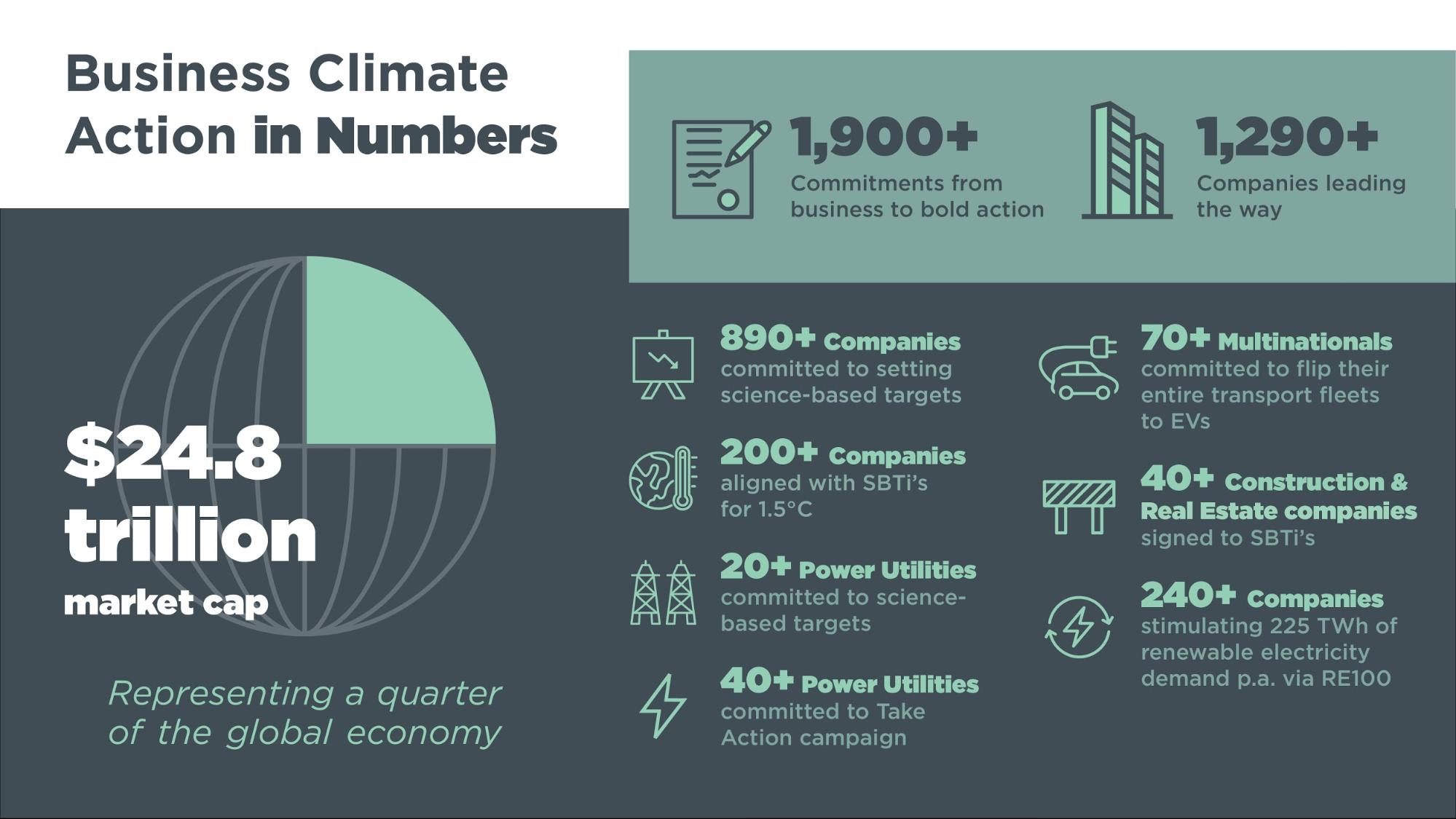
To date hundreds of companies around the world have committed to bold climate commitments, including setting a science-based emission reduction target, switching to 100% renewable electricity with RE100 and accelerating the transition to electric vehicles with EV100.
Now, over 700 leading businesses are calling on government leaders, through a series of open letters, to ensure long-term stimulus spending puts the economy on a positive course to a resilient, zero-carbon future that leaves no-one behind. These include:
- Over 150 global corporations — all part of the Science-Based Targets initiative and with a collective market capitalisation of over $2.4 trillion. This included cement maker LafargeHolcim, power utility EDF, Indian tech giant Wipro and truck maker Scania.
- In the US, CEOs and representatives from more than 330 businesses called on a Congress to prioritize resilience and climate solutions to create jobs and reduce emissions in US economic recovery and stimulus plans as part of Ceres’ LEAD on Climate virtual advocacy day.
- 37 CEOs of Europe’s biggest global companies joined the “European Alliance for Green Recovery” along with Ministers from 11 countries and MEPs. These companies were joined by 50 CEOs from the finance sector including Banco Santander, BNP Paribas Asset Management and PensionDanmark.
- Similar statements and initiatives were published in Germany, France, Spain, the UK, Slovenia and Australia.
- A coalition of 40 global companies, led by the Energy Transitions Commission, called on governments to support “a massive wave of investments in renewable electricity” as part of Covid-19 recovery plans to accelerate the transition to net-zero emissions.
Never before have governments seen such decisive support from business to ensure we accelerate the transition to a resilient, zero-carbon economy and all the benefits that would bring to society.
This moment of crisis can be a turning point in the race to reaching net-zero emissions together, as a healthier, more prosperous society
Companies know that the decisions governments make now will lock in the strategic direction of entire economies for years to come, either helping or hindering the world’s ability to increase climate action at the necessary speed and scale. And Governments are listening — in May the EU took a bold and vital step by placing the Green Deal, climate action and resilience at the heart of Europe's recovery plan.
Policy priorities
To protect health, boost economic growth, drive job creation and increase resilience to future shocks, governments should prioritize policy and spending to:
- Accelerate the transition to an inclusive, just, resilient, zero-carbon economy. Implement policies and incentives and fund projects that accelerate the delivery of a just transition to economy-wide net-zero emissions by 2050 at the latest.
- Advance the delivery of 100% clean power. Invest in deploying renewable energy, storage and grid reliability solutions, and enable corporate procurement of renewables.
- Enable clean mobility. Increase funding for electric public transport and electric vehicle (EV) charging infrastructure, and support fiscal incentives for electric vehicle purchases.
- Deliver zero-carbon infrastructure and buildings. Launch home and building efficiency retrofit programs, and utilize public spending on infrastructure to drive demand for low-carbon materials such as steel and cement.
- Support industry to transition to zero-emissions. Invest in R&D, demonstration and deployment of emerging zero-carbon technologies and use the power of public procurement to drive demand for zero-carbon materials.
- Invest in nature-based climate solutions. Support farmers to invest in climate-smart agriculture, to reduce emissions from land use and restore natural carbon sinks.
- Avoid rollbacks of environmental protections and ensure foreign economic assistance is used to support zero-carbon, resilient recovery and development.
A climate and resilience lens should also apply to public financial support for companies impacted by the virus and economic downturn. Companies receiving funding should disclose climate-related risks in line with the recommendations of the Task Force on Climate-related Financial Disclosures, build science-based approaches to inform company strategy and invest in low-carbon solutions that create new jobs.
This moment of crisis can be a turning point in the race to reaching net-zero emissions together, as a healthier, more prosperous society. One where health is protected from pollution and climate change impacts, such as rising temperatures; one where people have decent jobs with long-term prospects that aren’t tied to outdated, polluting technologies. Together we can build back better to create a future where societies are more resilient and prosperous. — María Mendiluce
(Picture credit: Unsplash)
Make sure to share your own thoughts with the author by leaving a comment below

Log in or sign up to continue the conversation