
This piece is part of Apolitical's spotlight series on scaling social impact, in partnership with the Bernard Van Leer Foundation. It also appear in our government innovation newsfeed.
In wealthy and developing countries alike, service providers are under pressure to reduce costs, improve social outcomes and explain why it has proven so difficult to accelerate the spread of best practices.
In 2003, the MacArthur Foundation gave one of its famous grants to an unusual recipient: a private company called Management Systems International (MSI). Their mission? To develop and test a framework to improve the scaling up process. That grant turned out to be the first of five.
MSI was founded by Larry Cooley, who has worked in more than 50 countries in strategic management, public sector reform and international development. That includes serving as an advisor to cabinet officials in more than a dozen countries, and overseeing a nine-year effort to rebuild Iraqi public administration.
Cooley currently curates a global community of practice on scaling up development outcomes and serves as the scaling advisor for the MacArthur Foundation’s 100&Change grant, which recently awarded $100 million to The Sesame Workshop to bring their early childhood intervention to Syrian refugees.
He spoke to Apolitical about what he’s learned over nearly three decades grappling with the question of scale.
You’ve been applying your framework for over a decade. What’s the most important thing you’ve learned?
You can’t worry about scaling second — you have to worry about it right at the beginning. There’s a model that I used for a long time that talked about three steps: effectiveness, efficiency, expansion. First build something that works, then figure out how to produce it efficiently, and then come up with a plan to spread it. And that made perfectly good sense to me then — but I now think it’s wrong.
"If you don’t worry about how it will spread at the very beginning, you will develop something inherently difficult to scale"
If you don’t worry about how it will spread at the very beginning, you will develop something with features that make it inherently either impossible or difficult to scale. This is a very difficult row to hoe, psychologically, because it means you have to plan for scale and nevertheless remain sceptical about whether the thing you’re working on should be scaled. Because there’s another problem: people fall in love with their pilots. So as soon as they start down the road, they’re not only planning for scale but that’s their success standard. Then they’re too quick on the draw: they’re anxious to scale prior to the time that they should.
"People fall in love with their pilots"
And, if you look at the amount of time it takes for things to go from a good idea, even a great idea, to a scaled up solution, the mode is about 15 years. That’s much longer than the time horizon of most interveners. Figuring out strategies that keep things in motion and commitments in place for as long as it takes to see an innovation all the way through the system is still developing as an art form.
How can people design for scale right from the beginning?
When you’re designing a pilot, you usually try to put in everything you can think of that might make it more effective. But when you design for scale, you need to pull everything out which is not absolutely essential. It’s a game of subtraction, not a game of addition. Think of it like a game of Jenga: if I pull this out, will it still stand up? And now — will it still stand up? That’s not intuitive at all, because you tend to add not subtract when you’re designing something.
"It’s a game of subtraction, not a game of addition"
The second thing is to ask yourself: if this thing were to be delivered at scale, who would be delivering it? Try to have a vision of what that would look like. And then you need to think: what would it take to get those people to want, or at least to agree, to do it? That’s what I call a second theory of change.
A third thing I say is that the pathways to scale are always circuitous. You can have a five-year plan, but if you think you’re going to stick to that plan, you’re going to be sadly mistaken — or unscaled. It’s impossible: there are too many contingencies. Your plan needs to be able to accommodate them.
And I should add that none of these three things are typical in project planning.
Then is keeping it simple the key to delivering at scale?
It’s important, but it’s tempting to see the innovation you want to scale as a technical thing, because that makes it sound more replicable and more easily scalable. In reality very, very few things are like that.
"It’s tempting to see the innovation you want to scale as a technical thing"
Everything has a supply chain and a whole bunch of behavioural changes around it. These often don’t get the attention they need, because the thing that’s being featured is the technical piece of the intervention. It might be a different curriculum, a new emission standard or a new technology. Pick anything, I’ll walk you through it, and it becomes clear in a nanosecond just how many other things are part of the system that needs to change to make whatever the innovation is part of a permanent solution.
Some years ago, I was in Nigeria trying to scale the Non-pneumatic Anti-Shock Garment, a medical device that arrests haemorrhaging related to childbirth for a time sufficient to transport the woman to an emergency obstetric care facility. Honestly, I thought it was a slam dunk. The technology was simple, inexpensive. There was a willing donor. No competing product. No resistance. So what could go wrong? Well, it turns out a lot of things.
Who distributes the product, and who replaces them? How does the woman get from wherever she is to the emergency care facility? Is there an emergency care facility? Who pays who what for this? How does the device get back to where it’s supposed to be afterwards? The people that manufacture the garment had no control over these issues, nor did the women whose lives it saved. The supply side didn’t hold the key cards, the demand side didn’t hold the key cards — the healthcare system did.
In your writing, you emphasise the importance of intermediary organisations. Can you elaborate?
I think there’s a broken part of the business model in scaling — I call it intermediation. Think about it this way: there are three gears, and on the left hand side there’s a medium-sized gear called innovation. Then on the right side you see a large gear: delivery at scale. But in between those two gears, there’s the smallest gear: that’s intermediation.
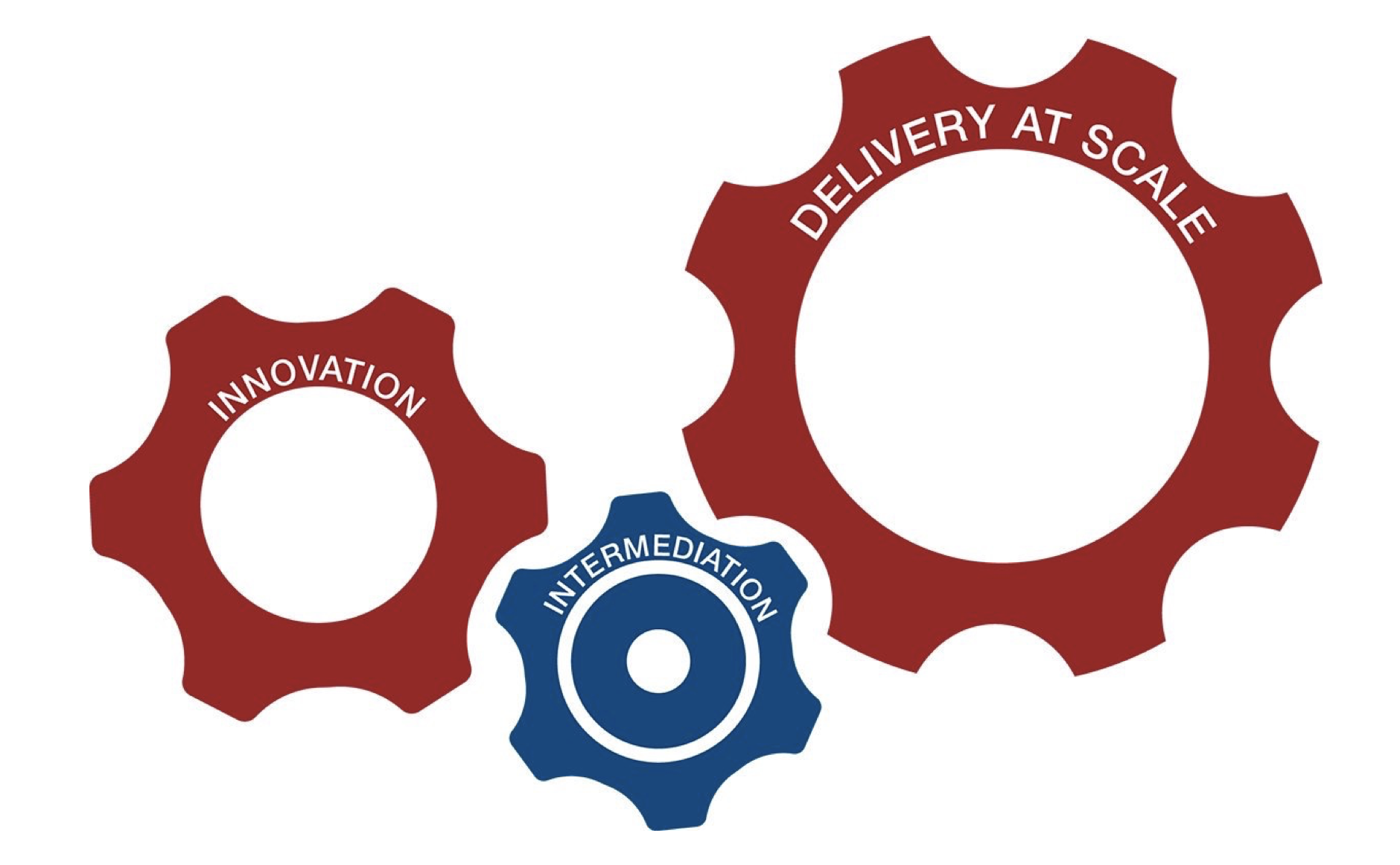
The left gear, at least for international development, is spinning remarkably well. We’ve got thousands of people, good, bad and otherwise, generating ideas and interventions. And on the right side, the big gear, I wouldn’t say it works as well, but it works too: governments deliver services and businesses sell products. But what doesn’t work is the little gear between them, which is trying to move worthy things from the left side to the right side.
In the private sector it works fine: those are the venture capitalists and investment bankers. It’s their whole job and it’s a highly compensated one.
Now take the public space: who would pay that person? Foundations and donors prefer to fund innovation. It’s kind of exciting: you produce a new way of keeping a baby alive, or you produce a new way of educating a child. And, at the other end, the delivery is exciting: you’ve actually provided a service to someone, and they’re better for it. But in the middle all you’re doing is making the system work better. And, in the current formulation it’s very unromantic stuff. You’re neither innovating nor delivering. It falls right between the stools.
(Picture credit: Flickr/Christopher Penn)
Thomas Graham
Make sure to share your own thoughts with the author by leaving a comment below

Log in or sign up to continue the conversation