
This article is written by Muhammad Asaduzzaman, Research Fellow at the Centre for Global Health, University of Oslo, Norway.
I believe all of us are aware of the importance of water, sanitation and hygiene in our daily life, especially in this challenging time of Covid-19.
- Want to write for us? Take a look at Apolitical's guide for contributors
Water, sanitation and hygiene — also known as WASH — can prevent many deadly health hazards, and a lack thereof can be a dramatic risk to public health. Currently, 2.4 billion people globally are in lack of proper sanitation, 663 million people are without access to safe water and 946 million defecate in the open.
Multisectoral cooperation and wide geopolitical commitments are needed to save as many lives as we can
At the same time, another big killer is climate change, which can exacerbate deaths through causes like heat and cold, air pollution, natural disasters, vector-borne and water-related diseases etc. And in particular, climate change and WASH are both significant global health issues with a shared link to the rapid urbanization in developing countries.
From my point of view as a researcher with 10 years of experience in this field, the integration of climate change and WASH education, especially in urban populations, is an important emerging planetary health agenda for the coming decades. Multisectoral cooperation and wide geopolitical commitments are needed to save as many lives as we can.
Impact of urbanization in water, sanitation and hygiene
It is well established that the effects of climate change such as rising temperatures, droughts, changes in rainfall, landslides and floods make people vulnerable. These trends coincide with increased migration both internationally and internally within countries — often from the countryside to the cities.
This is one of the major causes why the world is experiencing rapid urbanization. It is estimated that 55% of the world’s population today lives in cities which is expected to rise to 68% in 2050, equivalent to addition of 2.5 billion people mostly in the developing countries of Asia and Africa. Many of these urban populations are the victims of climate change and mostly live in the shanty slums with poor WASH systems.
The impact of climate change in WASH components (e.g. water) has a subsequent global influence in all sectors like public health, sanitation and hygiene practice. Therefore, adapting to climate change as part of sanitation and hygiene education in households in urban areas should be an important approach to combat the dual burden of climate change and poor sanitation. Unfortunately, the developing countries who experience a rapid trend of urbanization are challenged with lack of infrastructure and stakeholders’ knowledge on these issues.
Put WASH on the agenda
As climate change worsens in the coming decades, the risk of extreme weather events like floods, cyclones and droughts increases, along with increases in temperature. The Intergovernmental Panel on Climate Change (IPCC) is expecting an enormous impact on public health and water supply even from increased global warming of 1.5°C in their 2018 report.
The harmful economic, social and health impacts interlinked with climate change, WASH, global health and SDGs should be addressed in the policy brief and health education programs
Access to safe drinking water, sanitation and hygiene is compromised both in floods (because of turbidity and pollution in the drinking water source, flooding of latrines and increased risk of waterborne diseases) and droughts (due to reductions in the water level in wells, ponds, and rivers with increased pollutant concentration and worse hygiene practice). In addition, some urban health issues, especially vector-borne diseases like dengue, chikungunya etc. are closely related to both WASH and climate change in developing countries due to highly dense populations and the increasing number of urban slums.
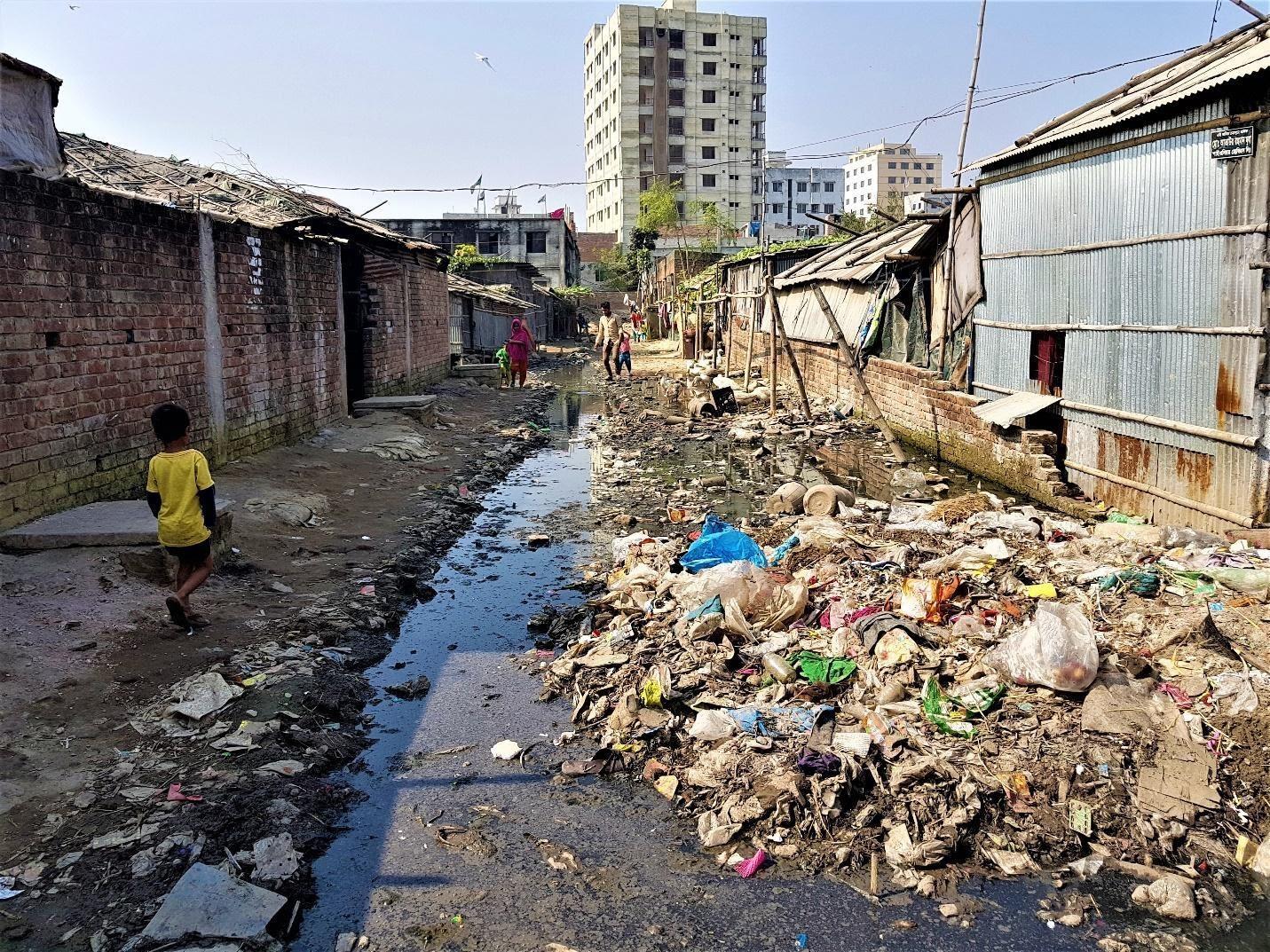 An urban slum in Bangladesh (Image credit: Muhammed Asaduzzaman)
All the relevant stakeholders such as civil society, program managers, government agencies and development partners should work together to ensure adequate infrastructure for safe water and proper sanitation coupled with the integration of WASH education in the context of climate change. The harmful economic, social and health impacts interlinked with climate change, WASH, global health and SDGs should be addressed in the policy brief and health education programs. Therefore, climate-resilient WASH programs need to be developed as a Planetary Health agenda.
Integrated mitigation and adaptation to climate change into WASH
In developing countries, there are many priority issues other than climate change, whereas the victims of WASH and climate change are mostly from there. Due to the very limited resources that governments have in these parts of the world, infrastructures associated with WASH programmes are also very poor.
One possible solution is to include women and children along with community leaders when dealing with WASH and climate change
Many structures known as “cyclone centres” in rural and coastal areas in low and middle-income countries are used as schools where people take shelter during an episode of extreme weather.
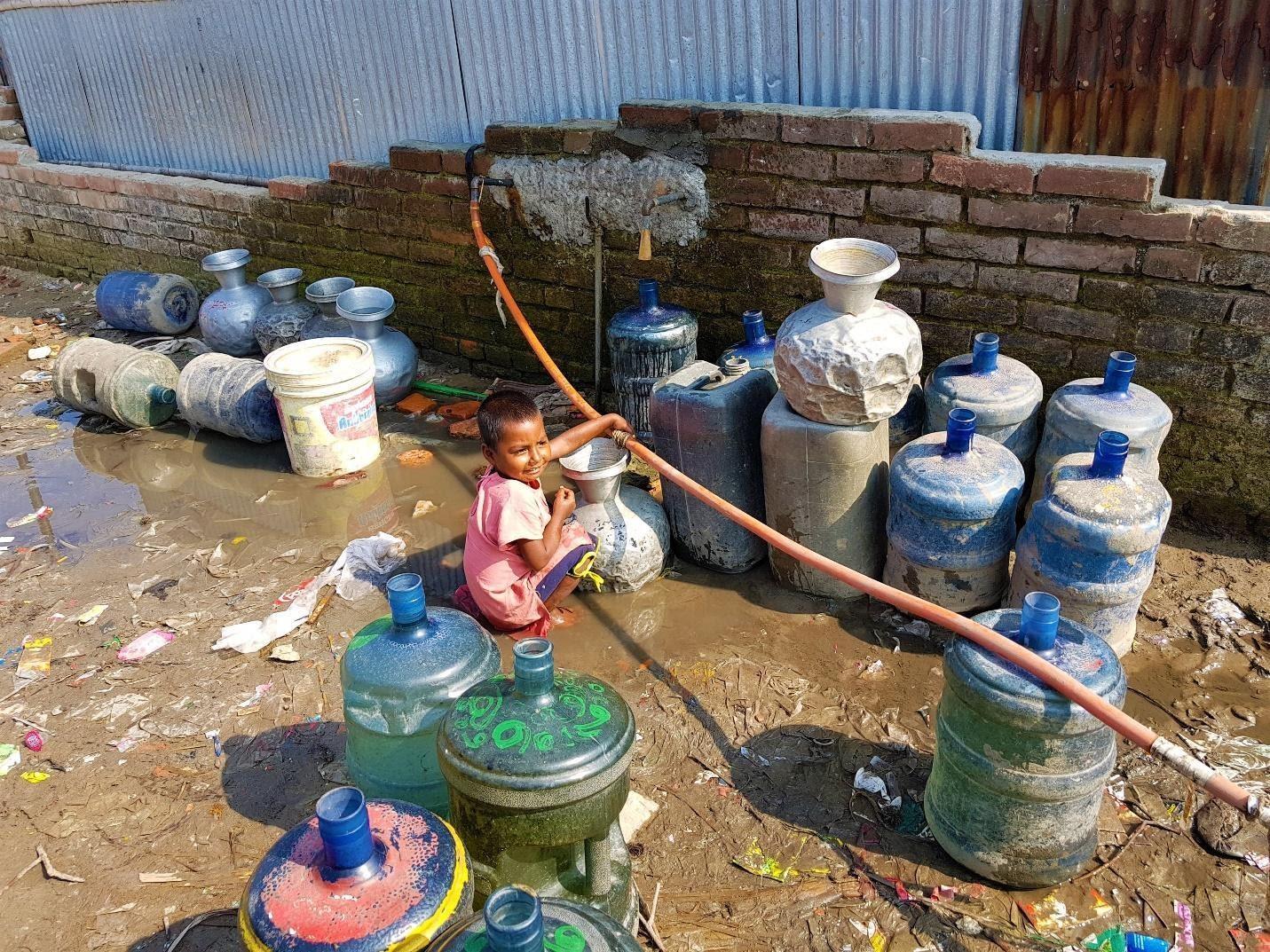 Collection of drinking water in poor hygienic condition (Image credit: Muhammad Asaduzzaman)
As a result, education in these areas is halted for longer durations after extreme weather events. Community learning among the sheltered people may be initiated in such situations on the topics of climate change and WASH. Moreover, preparation of natural disasters with active community involvement, awareness about climate change effects and inclusion of WASH education in school syllabi can be launched as a part of integrated mitigation and adaptation processes.
It has been observed that the perception and behaviour change regarding climate issues are very poor among urban households, although it’s been in the media for decades. One possible solution is to include women and children along with community leaders when dealing with WASH and climate change. Children learn very fast and they are after all the future citizens who need to adopt these sustainable habits. And women are often responsible for collecting drinking water, washing utensils, cooking and handling younger kids. If Women are excluded from the awareness and mitigation programs, these programs won’t succeed.
What’s Next?
We all are already living in the era of frightful climate change effects, and WASH education can be a simple but powerful tool to face that challenge.
Adapting to climate change is impossible without access to WASH
The lack of coordination between climate change mitigation, adaptation and resilient WASH programmes is evident in developing countries, and it is a great stumbling block for the success of our planetary health agenda captured by the SDGs.
Adapting to climate change is impossible without access to WASH, which is needed desperately in the daily lives of all people and particularly after any natural disasters.
The other related consequences also need to be addressed. Community participation, integrated behavioural change and resource management for WASH and planetary health advocacy may be the gateway to initiate this cross-sectoral initiative. Both at local and global level, all WASH related projects and activities should include the indicators for relevant SDGs (e.g. SDGs 1, 2, 3, 6,7,13). Civil society and public service platforms may play a significant role to ensure the implementation of these indicators.
An intersectoral professional body comprising representatives from public servants, development partners, technical expertise in climate, WASH and public health might be a functioning monitoring platform. We, therefore, need to build up a global partnership to combat this top priority issue to save our future on this planet. — Muhammad Asaduzzaman
(Picture credit: Unsplash)
Make sure to share your own thoughts with the author by leaving a comment below

Log in or sign up to continue the conversation