
**This article is written by David Adams, lead interventionist, Portsmouth City Council
**
Public sector institutions face a challenging environment.
There are increases in demand, limited financial headroom, not to mention a tangled mess of wicked problems resulting from — to name a few challenges we face — poverty, homelessness, and public health risks.
- Want to write for us? Take a look at Apolitical’s guide for contributors
All these things should prompt us to ask whether we are doing the same things with less money, hoping for “something to turn up”?
While systems thinking is not a silver bullet, it can help you more clearly frame your problems, ask better questions, and ultimately arrive at better answers.
Beware the feedback loops
Recently, public sector institutions have commonly responded to financial challenges by focusing their resources on those that are most in need.
This has meant prioritising spending on “crisis” and/or statutory services and cutting “preventive” or discretionary services, while restricting access where possible.
What happens next? Invariably, not what we intended or hoped for.
The systems scientist Jay Forrester used to say that in any organisation, people would intuitively know where the “leverage point” to fix a given problem is, but everybody would be “…trying very hard to push it in the wrong direction”.
Whenever we act, there is almost always “feedback”, from “the world”, back to us. Feedback loops can be reinforcing — amplifying the direction of travel (like compound interest), or balancing — bringing the system back to an equilibrium (like a thermostat).
If you're about to take a decision, it's worth considering what feedback loops you're creating. How are we expecting the world around us (and the people in it) to respond to change? If, for example, we reduce eligibility for services, are we expecting people to seek help elsewhere?
And if we are, which alternative services will experience the increase in demand, and are they prepared for it? Or, are we expecting people to not seek help at all? What will the consequences of that be? If, on the other hand, people continue to approach our services, we may initially find ourselves spending more time assessing whether we can help, rather than how we should, and ultimately, explaining why we can't or won't help.
When we make services harder to access, we're implicitly aiming to suppress demand to a level that our resources can cope with. Instead, our job gets harder, not easier.
It's perfectly rational to prioritise acute services and the highest needs when financial savings need to be made, but it can be counter-productive
The people with “lower level” problems don't disappear — many will simply keep re-presenting until their problems are “bad enough”. We may temporarily reduce the “flow” of people into the service, but the levels of need “out there” are unaffected.
The feedback loop here is fairly straightforward — we decide to only help people with the highest needs, and so over time, the people that we deal with all have higher needs.
Capacity problems can cause a reinforcing feedback loop, making the situation incrementally more difficult.
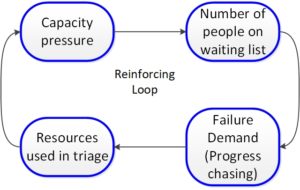 Capacity pressure creates a reinforcing feedback loop, as resources are used on triage and re-prioritisation
For example, when we hold a waiting list for services, we create failure demand, from people re-contacting the service: “when are you going to help me?”. Because people are contacting the service multiple times for the same problem, demand appears to keep on rising.
Worse still, because we can't help immediately, clients' conditions deteriorate, so they become more time-consuming and expensive to support.
It's perfectly rational to prioritise acute services and the highest needs when financial savings need to be made, but it can also be counter-productive. “Lower priority” services obviously suppress demand for acute services. Preventative services are part of a “balancing” feedback loop, helping to keep demand for acute services lower.
When we make the “rational” cuts, we weaken that feedback loop and experience higher demand in acute services.
If every action runs the risk of unintended consequences and apparent savings end up costing us more money, what should we do?
There are no easy answers, but systems thinking can help us avoid some of the pitfalls above, and even release capacity to drive improvement. First, we need to “get knowledge”, and start seeing our services as systems.
Sustainable improvements and savings invariably won't be found in individual services or staffing roles (the “elements”), but rather in the way that the elements interconnect, and in the purpose of the system.
What's the problem?
Three years ago, I worked with a service for people with substance misuse problems. One of the issues, managers and staff told me, was that clients often didn't turn up for appointments.
This created delays in organising support, as well as wasting valuable practitioner time. The service had tried texting clients the day before their appointment, with limited impact.
Some people approaching substance misuse services are very vulnerable, some have “chaotic” lifestyles, so it's not terribly surprising that sometimes they fail to attend appointments.
When we gathered some data, we found:
- 33% of appointments were missed
- 90% of appointments were organised for the service, rather than the client.
We also found that the service design would require a client to attend meetings three to four times at the start of their treatment. A “pre-assessment” process had been introduced to reduce demand by filtering out people for whom the support we were set up to provide was not suitable, but obviously people who were suitable would have to attend the service twice.
Once a care plan was in place, clients would be invited back for regular review appointments, which was a policy requirement. In part because of this fragmented model, it would typically take 18 days for a client to get access to substitute medication (e.g. methadone), but might take up to seven weeks.
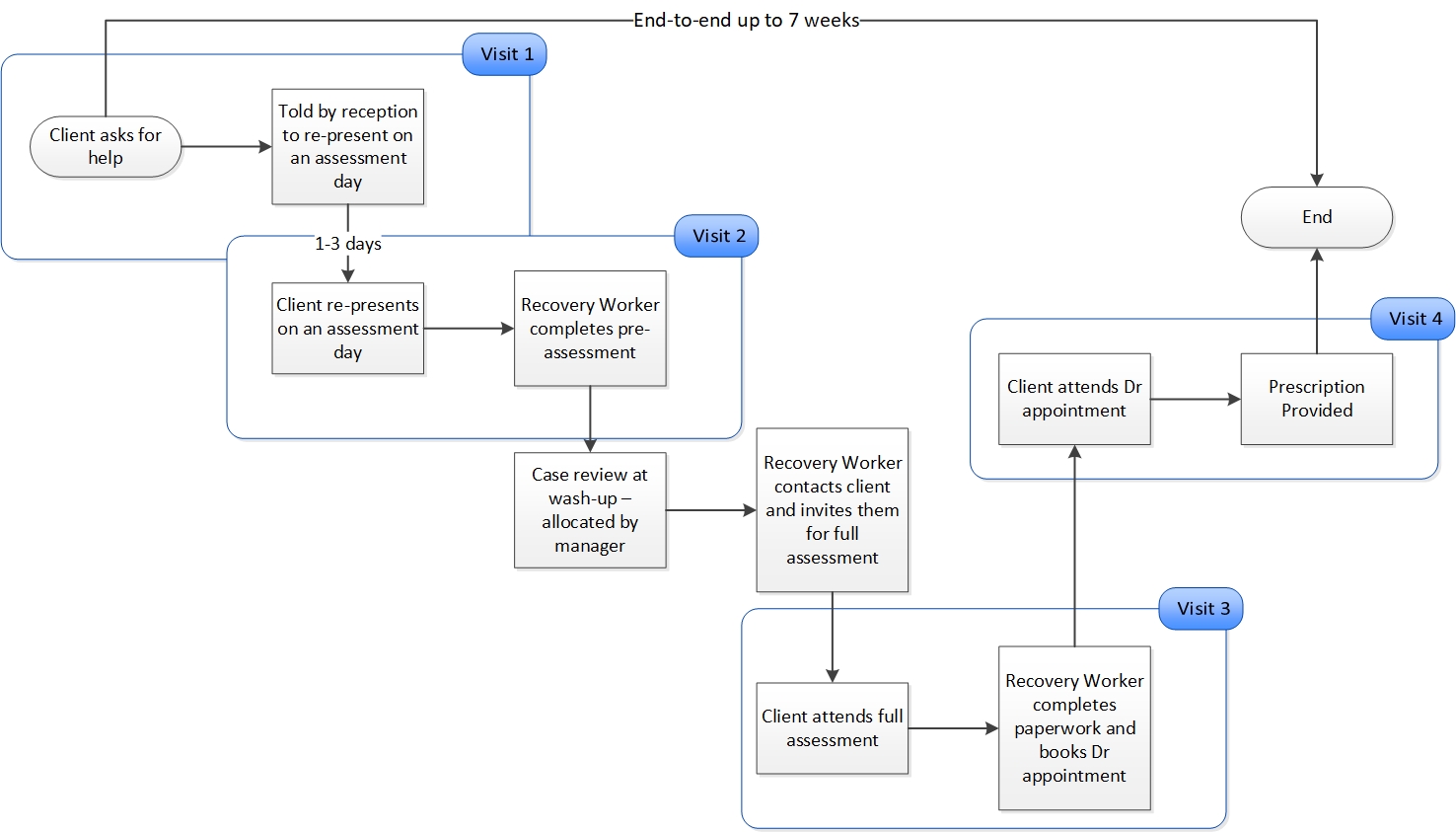 The front end of a fragmented case management system. Clients are required to attend three or four times in order to get a service
Can systems thinking help? A good place to start is asking yourself “What's the actual problem here?”. We had been defining the client as the problem — “How do we encourage them to attend their appointments?”, “What if you step further away from the problem, and go back to the purpose?”, “What is it you're here to do?”.
Now let's ask a better question: "How can we best help this person?".
In complex systems, there are rarely easy answers, much less “right” answers, but we can always begin by asking better questions
We decided to experiment with doing as much of the work as we could at the first visit — when the client asked for help. Rather than “solving” the problem of missed appointments, we “dissolved” it by having fewer post-dated appointments and completing work with the client when they were already in the building.
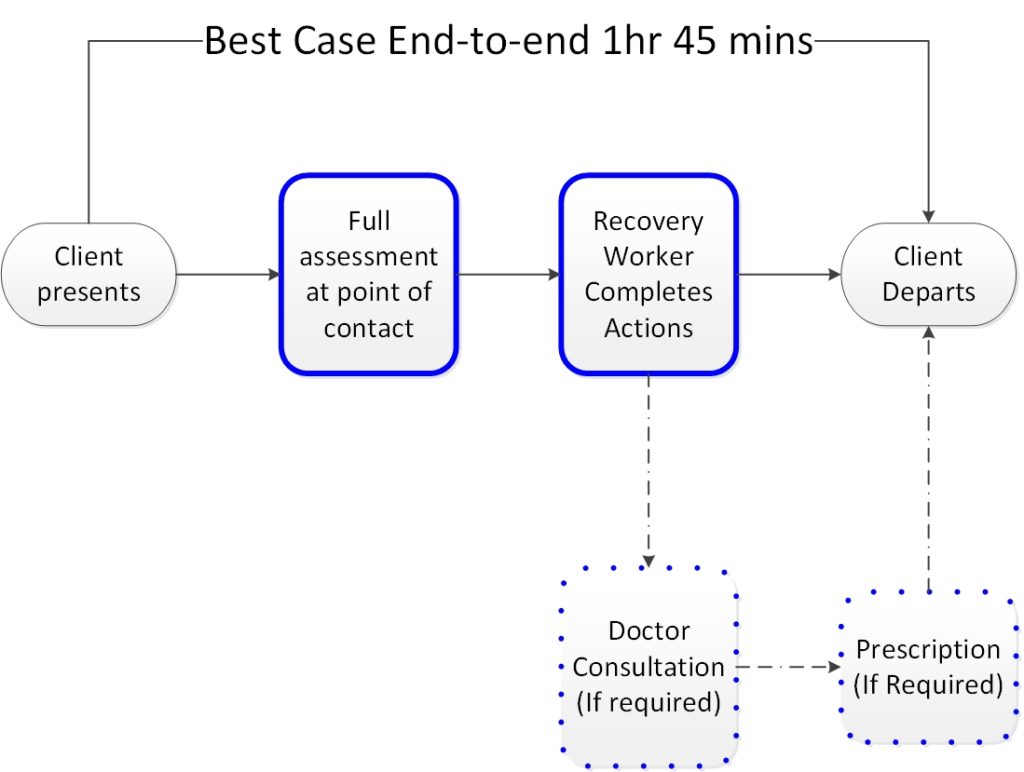 The new model: Assessment and service delivery at the point of contact, in one continuous process
Similarly, we decided to assess everybody at the point of contact. The attempt to filter out “unsuitable” people was plausible, but wrong. In the new system, if someone really wasn't suitable, it quickly became clear. If they were suitable, we could begin meeting their needs on the first visit, rather asking them to come back later (we now knew 33% of them wouldn't).
These are just two small examples of changes that enabled the service to move from providing prescriptions in 18 days to providing them within one day, with a 20% higher caseload, and accepting new referrals five days a week rather than two, with no additional resource.
Three years on, the latest data from ONS show a welcome reduction in drug-related deaths in the area since the changes were made. More detail on the journey here.
In complex systems, there are rarely easy answers, much less “right” answers, but we can always begin by asking better questions.
If you’re a public servant considering using systems thinking in your work, here are three things you can do to get started:
- Spend some time at the “front” of your service — wherever demand comes in, and listen to what clients say, unfiltered by referral forms or our attempts to categorise customers into groups. As you do so — think about what matters to this person
- Walk the gemba (the place where work happens): Follow a single request for help through the service — think about how many “hands” a request passes through and why that happens. Consider whether, along the way, we reframe what the client asked for to be something that makes more sense to us
- Finally, going back to Jay Forrester’s point about leverage — take a look at whatever your service is trying hard to improve right now, and consider whether you might be pulling the right lever in the wrong direction. — David Adams
We want to hear what you think about this article. Pitch an article to us or send your comments to hello@apolitical.co
(Photo Credit: UnSplash)
Make sure to share your own thoughts with the author by leaving a comment below

Log in or sign up to continue the conversation