
This article is written by Rareș Petru Achiriloaie, former Head of Cabinet in the Romanian Government and current Parliamentary Adviser.
Exactly two years ago, in the Summer of 2018, after years of study and constructive experiences abroad, I decided to move back to my home country, Romania. Not in Brașov, Transylvania, where I grew up, but in the capital city of Bucharest – the administrative and political centre of the country. Up until that point, I’ve only just visited the city for brief spells.
- Want to write for us? Take a look at Apolitical's guide for contributors
Prior to the move, I was accepted for an internship in Government. 200 of us were selected out of approximately 2000. After a successful few months as an intern at the Ministry of Youth and Sports, I stayed on as an adviser to the Minister for Romanians Abroad — a diaspora of more than 10 million people who live outside the country. How did I land this job? I managed to convince the internship coordinator to let me participate at a meeting with Minister Natalia-Elena Intotero. I had lived abroad during my studies, so I had a particular interest in this area. Once there, after the discussions ended, I had a very good interaction with the Minister herself, as it seemed we shared the same values. We exchanged contacts and in a couple of weeks, I got a call and was offered the job. It was all very straightforward.
A couple of months into my role, the boat started rocking. The high-level work intensity given by the ministry’s end of the year projects created stress and tension within the staff
Naturally, like any young professional in the public service, I was happy with my new job and was very much looking forward to making a contribution.
Apart from my education, my direct experience with the Romanian communities from France and the United Kingdom, where I lived and studied, gave me an edge. I knew the modern diaspora first-hand and used this experience as well as my contacts from abroad in my work. As an adviser to the Minister, my responsibility revolved around new policy development and international relations, especially in the context of Romania’s upcoming Presidency of the European Union Council (a first for our country).
Overall, I worked long hours, felt useful and did good work. Little did I know, however, that circumstances would soon change again.
Bigger responsibilities, longer work-days
A couple of months into my role, the boat started rocking.
The high-level work intensity given by the ministry’s end of the year projects created stress and tension within the staff. This caused some personnel changes, which proved to be an opportunity for me. Whilst abroad on an official delegation, I was informed that I was to be appointed as the new and youngest Head of Cabinet to a Government Minister. My emotions were mixed. I was both surprised and excited, immensely motivated but also unsure about what the future holds and how the administrative apparatus would react to my promotion.
Long story short, I adapted. I learned the ropes as I went on and worked even more, culminating in 15-hour workdays. From a personal and mental standpoint, failure was not an option. I could not disappoint. Soon after my appointment, we had several big projects to finalise and also, in only six weeks, on 1 January 2019, Romania’s first Presidency of the EU Council would begin.
So much can change in a relatively short period of time and if there is one thing I’ve learned from all of this, it’s that if you work hard enough, it’s near impossible to disappoint others and most importantly, yourself
While we were getting used to the added attention and workload of the EU Presidency itself, my Ministry was travelling through unchartered waters of its own. We were the first in the EU to organise a Ministerial Reunion, with top-level participation from abroad, on diaspora policies. Of course, not all member states have ministries dedicated to this very subject, but most have at least one similar institution led by either a Secretary of State or a General Director.
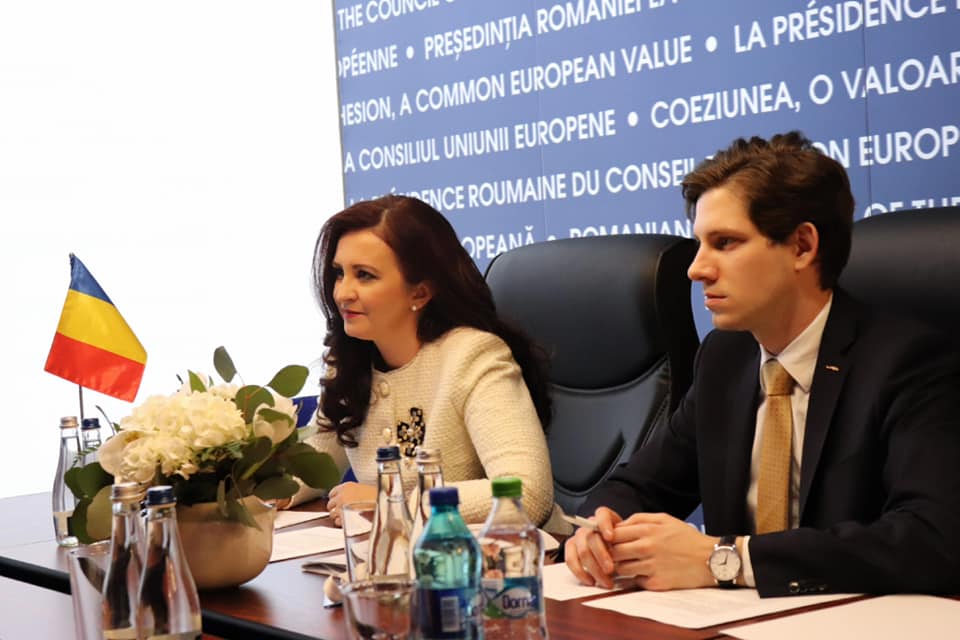
I****nformal Meeting of Ministers Responsible for Diaspora Policy, a bilateral meeting between Romania and Cyprus, Palace of the Parliament, Bucharest, March 18th, 2019.Photo credit: MPRP / Ioana Necula
Preparations for the three events the ministry organised, one at the ministerial level and two for experts, were intense. The team worked tirelessly and in the end, achieved a great result. In his closing speech at our Ministerial Meeting from March 2019, Mr. Photis Photiou, Presidential Commissioner for Humanitarian Affairs and Overseas Cypriots said, ”Today, Romania has made history. You’re the first.”
Looking back, I am very grateful to have been part of that. Contrary to expectations and prejudices from some member states, Romania’s Presidency of the Council of the European Union was a success, managing to push forward 90 pieces of EU legislation in the first 100 days, all of which bring large benefits to the lives of all Europeans.
Don’t let stress get to you
2019 was an extremely busy year for me personally. However, all the tension and stress came to an abrupt halt in November, when the Parliament had a motion of no confidence and voted the Government out of office. As a result, our team left the ministry.
Again, I had mixed feelings. I was proud of my work, sad to leave and also at ease. The pressure was finally off my shoulders.
After that, I started working at the Romanian Parliament, moving from the executive branch to the legislative one. So much can change in a relatively short period of time and if there is one thing I’ve learned from all of this, it’s that if you work hard enough, it’s near impossible to disappoint others and most importantly, yourself. When it’s all said and done, you know you’ve made a mark and that’s what true professional satisfaction is. It’s not about the salary or prestige. Not at this point, in any case.
Now, I’ve given up on imposing long-term goals on myself, because you never know what doors open along the way. In this sense, I sincerely hope that other young professionals or youths looking to get into this field focus more on the present, rather than stress about the next big step. It seems like my generation, especially, is looking exclusively towards the future.
Don’t get me wrong, it’s great! However, it can be unhealthy in certain points, as you end up putting a lot of pressure on yourself and on those around you. Rather, try to build in the present. Work hard for that future. Use your mental capacity to do great work now, rather than later. — Rareș Petru Achiriloaie
(Picture credit: Unsplash)
Make sure to share your own thoughts with the author by leaving a comment below

Log in or sign up to continue the conversation