
This article is written by Syed Imaad, recent Harvard Kennedy School graduate, former mayoral fellow at City of Chicago, and former deputy director at Punjab Higher Education Commission, Government of Punjab
Pakistan is among the bottom 20% of countries in immunisation coverage and has the highest under-5 child mortality rate outside Africa.
Immunisation services can be redesigned using digital technology thus ensuring timely vaccinations for children and facilitating families and health workers.
- Want to write for us? Take a look at Apolitical’s guide for contributors
This article overviews the immunisation crisis in Pakistan, proposes a redesigned immunisation service, and addresses implementation considerations.
Pakistan’s immunisation crisis
Immunisations are one of the most successful health interventions in the world. Not only are they cost-effective but they save up to 2-3 million lives every year.
Immunisation coverage in Pakistan is at 75%, putting it in the bottom 20% of countries worldwide. Additionally, only 66% of children between ages 12 and 23 months are fully immunised while only 55% have had all age-appropriate vaccinations.
Child vaccinations in Pakistan face the following challenges:
Inadequate follow up for subsequent rounds of vaccination: While 75% of children receive the first dose of DPT vaccine, only 65% receive all 3 doses. Similarly, 90% of children receive the first dose of polio vaccine while 80% receive the third dose.
Weak resource management and surveillance mechanisms: Vaccinators and nurses are inefficiently deployed and vaccination records are manually maintained. This weakness in monitoring and evaluation reduces program efficacy.
Vaccinators and nurses are inefficiently deployed and vaccination records are manually maintained
Lack of awareness of immunisation schedules: Up to 35% and 18% of parents cite lack of awareness of vaccinations and non-availability of vaccinators, respectively, as factors for non-vaccination or incomplete vaccination of their children.
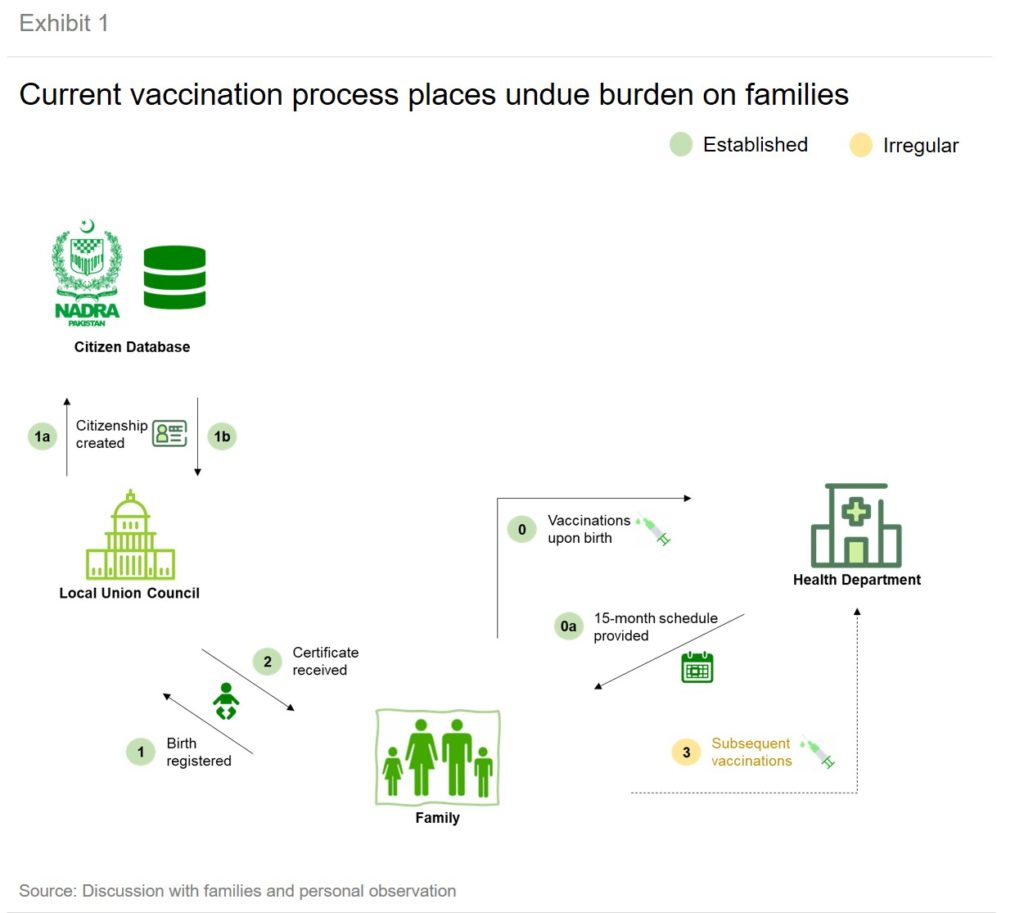
The existing vaccination processes place an undue burden on families, leaving many children without vaccinations (Exhibit 1). Families are expected to visit health facilities for child vaccinations according to an immunisation schedule.
Separately, they also register their child’s birth with National Database & Registration Authority (NADRA) citizen database through local union councils. Despite these challenges and established practices, there is significant potential to improve child vaccinations in Pakistan through an integrated digital platform, such as an Immunisation Information System (IIS).
Redesigning Immunisation Services
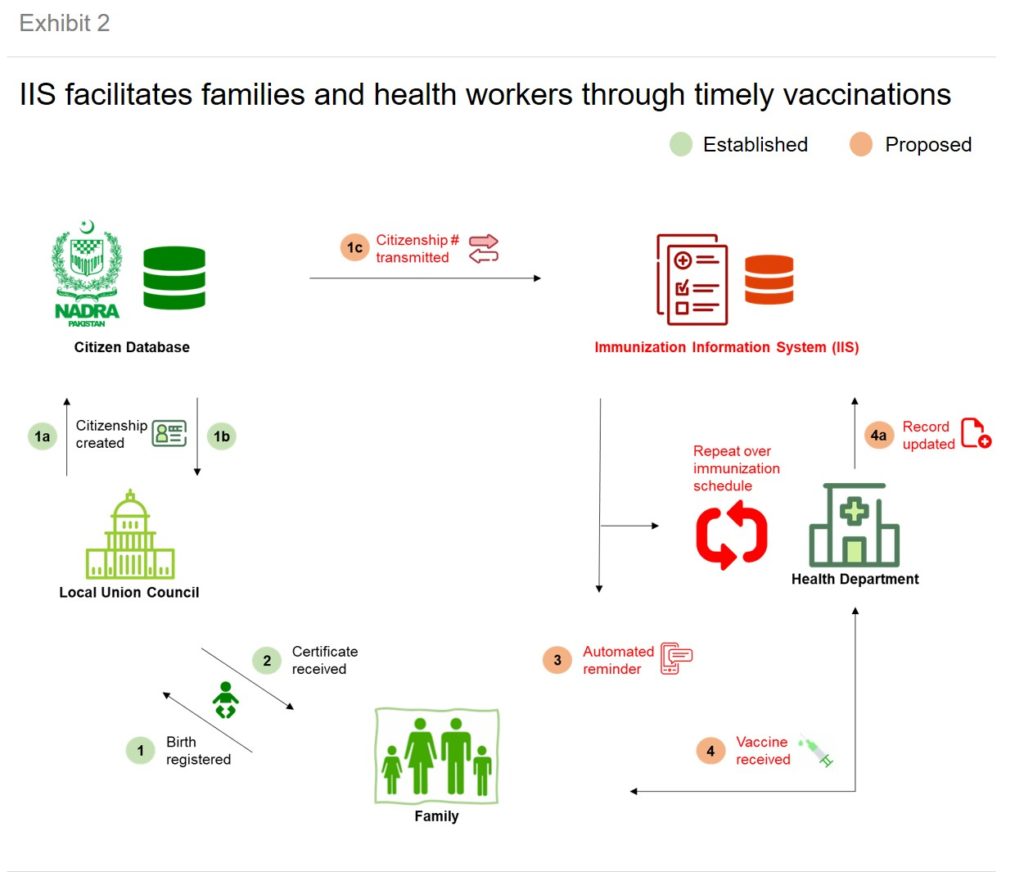
An immunisation information system (IIS) is a confidential, population-based database that contains information on immunisations administered to persons in a given area. IIS-based immunisation registries have three core features i.e. unique identification, real-time tracking, and automated reminders.
These features may be incorporated in an IIS for Pakistan by leveraging existing databases and ICTs to enable a better citizen experience (Exhibit 2). They include the ability to:
Utilise unique IDs from NADRA to track vaccination at the individual level. National Database & Registration Authority (NADRA) manages the citizen database and assigns a unique citizenship number upon registration of child birth.
Enable real-time records at point of service by providing internet-enabled devices to health workers. Similar devices are already provided to field monitoring assistants in other Government departments.
Text messages to parents reminding them of vaccination and measuring their likelihood to bring the child to a health facility
Generate automated reminders through text messages to address lack of awareness of the immunisation schedule. These reminders can help health workers schedule field visits or encourage families to visit a health facility for vaccinations.
The redesigned service can be piloted in an agile and cost-effective manner by developing a minimum viable product (MVP) and testing key hypotheses.
User response to the proposed interventions can be tested using the following MVPs:
Text messages to parents reminding them of vaccination and measuring their likelihood to bring the child to a health facility. Focus groups with parents can help craft effective messages by tailoring language, size, and content.
Mobile app for health officials allowing them to update immunisation records in real-time. Administrators and vaccinators should be engaged during prototyping to encourage adoption.
Hypotheses: The redesigned service aims to increase immunisation coverage by addressing challenges with the existing process for which the following hypotheses should be tested:
Family visits to vaccination centers increase: measure proportion of parents who bring their child to a health facility upon receiving text message reminders.
Administrative burden on health workers decreases: measure time saved by recording vaccination in real-time using an app compared to a paper-based process.
Immunisation coverage increases: measure proportion of children who actually receive vaccinations (e.g. health facility may be short of vaccines).
Implementation Considerations
Several technical, operational, and legal issues must be addressed to successfully implement an IIS-based system:
Technical
Standardising data fields and formats based on intended function with input from stakeholders and consideration for future integration of services.
Encouraging child registration following pilot programs that have shown an increase in child registration rates from 30% to 90%.
Conducting data validation using other data fields (child name, parent name, parent ID) and creating provisional child registration if not already registered in the citizen database.
Operational
Enhancing departmental capacity by training health workers to record immunisations in real-time and streamlining existing procedures.
Ensuring stakeholder coordination given involvement of multiple organisations at the subnational, national, and international levels with clearly defined project responsibilities.
Increasing mobile penetration from the current 76% though it is sufficient for a single member of the household to have a mobile phone to receive reminders.
Legal
Encouraging provincial compliance by federal government using its influence over provincial governments where working relationships exist (e.g. ruling party is in power).
Addressing privacy concerns through measures including opt-out as adults, limited information collection, penetration testing of systems and databases.
Determining access privileges by defining user types (e.g. administrator, vaccinator) and user permissions (e.g. view-only, update record).
Immunisation coverage in Pakistan can be increased by redesigning immunisation services. In the first phase, a proof-of-concept of the IIS-based system can be piloted in a district with sufficient capacity led by a core government digital service team.
Implementation can be scaled across districts in the following phase with oversight from a steering committee including officials from health and IT departments at federal, provincial, and district levels.
Ultimately, using digital technology can help transform immunisation service delivery and improve citizen experience. — Imaad Syed
We want to hear what you think about this article. Pitch an article to us or send your comments to hello@apolitical.co
(Photo Credit: Gavi)
Make sure to share your own thoughts with the author by leaving a comment below

Log in or sign up to continue the conversation