
This opinion piece was written by Robyn Keast, who co-edited the book Network Theory in the Public Sector: Building New Theoretical Frameworks, alongside Myrna Mandell and Robert Agranoff. This article also appears in our government innovation newsfeed.
Many of the tasks previously undertaken by governments now occur through networks of people and organisations working together. Leadership is a necessary element of these collective forms of working, such as networks and collaborations, and is especially pertinent for those efforts aimed at tackling intractable and complex public policy problems and social/environmental challenges.
Alongside formal leadership (i.e. invested in one person), dispersed leadership is important. This leadership is spread across members, with people taking on responsibility for a task or the completion of overall goals or sub-goals. It utilises the diverse sets of skills, leadership attributes and connections required to achieve set goals and has a further function of assuring ongoing commitment to the network initiative, through continued involvement and ownership of tasks.
At the same time, research and practice have isolated two leadership roles held by individuals, known as “champions” and “sponsors”, that exhibit distinctive characteristics and serve different purposes. These roles function in different ways to bring together diverse stakeholders and secure their commitment, action and resources and therefore can significantly affect the outcomes of networked or collaborative arrangements.
Champions mainly work with other members of the network. This role is often, but not always, undertaken by the person or people who initiated the network and/or set it up.
Champions are those people who are steadfast in their commitment to the purpose and work of the network, who have the energy and dedication necessary to sustain their efforts, often over many years. They are the worker bees, the ones that beaver away, often behind the scenes, to keep the network moving forward. They keep projects on track and other members on task.
Because of their high level of personal commitment and a reliance on their own and others’ relational capital and less on strategic thinking, champions can be prone to burn out or to putting effort into the network yet not making the progress desired or needed.
Furthermore, on their own champions usually don’t have a strong enough power to influence the higher level decision-makers who can give the network access to the resources it needs to operate and the legitimacy necessary for sustained operation.
To secure legitimacy and ongoing resources for their work, network leaders strategically identify and engage sponsors. Sponsors are individuals, organisations or groups, usually with substantive formal authority or social/political/cultural influence. They therefore can supply validity for the project, access to resources, formal power, and supportive actions (e.g. freeing up personnel to work on projects, providing secretariat services).
They might hold high level roles within organisations or government departments, or be members of parliament, thought leaders or online influencers.
Sponsors are not closely involved in the day to day work of the network, as champions are. Instead, they use their external prestige, or stronger links to top leadership/decision makers to bring attention to the network initiative, aligning the benefits to the larger whole-of-government or organisational strategy.
In so doing, they can also use their position to change negative attitudes and perceptions of the work of the network. In short, sponsors are well connected people and have the personal clout to make a difference and legitimise the effort — provided they are onboard with the project in question.
However, sponsorship is likely to be an ineffective strategy if the sponsors themselves aren’t fully engaged with the purpose and broader value of the network initiative, or don’t have the level of influence needed to push through barriers.
Securing and leveraging authentic and therefore effective sponsors, is more than just judicious selection and good luck. Ideally, for them to be authentic change agents, it can also involve training and awareness programs, designed to instil the principles of collaborative practice to ensure alignment of thinking, actions and language.
One such initiative was the Graduate Certificate in Interprofessional Development undertaken by all senior members of the Services Integration Project in Australia, as well as community and government leaders.
This course took place over two semesters where participants learned the theoretical groundwork and practical skills for initiating and sustaining collaborative work. They applied the skills of collaboration learned through the classroom and applied learning situations to a community project.
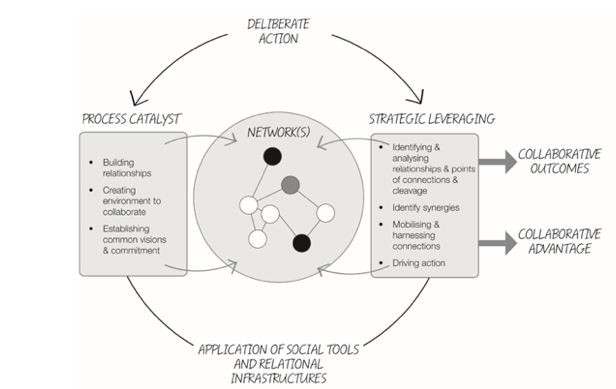
Process Catalyst & Strategic Leverager are two additional leadership roles that come to the fore, particularly for collaborative networks. These exhibit some distinctive characteristics over other network forms, including strong relationships, agreed interdependence, power sharing and pooled resources, and are high-reward but also high-risk entities.
The dual leadership roles attend to both the importance of relationship building processes and the achievement of tasks and goals (ultimately the purpose of any public good network).
While these roles are often the responsibility of the formal leaders, they also can be undertaken by different members at different points. But central to this is their deliberate, rather than ad hoc application.
The process catalyst role emphasises establishing conducive environments for building strong relationships, making connections between the right people, bridging diverse cultures and securing commitment to common visions and goals. In contrast the strategic leverager function looks to harness the relationships established to achieve the assigned or desired tasks.
The figure below (Keast and Mandell, 2014) further explains the two roles and their overlap.
As outlined above, network and collaborative leadership is not "business-as-usual". It demands different ways of thinking about leadership and the development of new roles designed to leverage individual strengths to create collective outcomes.
Although acknowledging the growing need for these new leadership roles, many governments have yet to fully integrate them into everyday practice and appropriately resource, support or value those performing these crucial roles. (Picture Credit: Pexels)
Make sure to share your own thoughts with the author by leaving a comment below

Log in or sign up to continue the conversation