
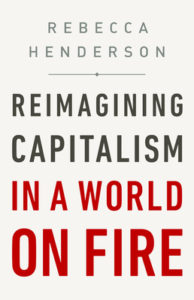
This is an excerpt from Harvard professor Rebecca Henderson’s new book, Reimagining Capitalism, where she introduces the reader to the men and women who strive to change capitalism from the inside.
Hiro Mizuno joined the Japanese Government Pension Investment Fund (the GPIF) in the fall of 2014 as its chief investment officer. He took a significant pay cut, leaving a high-profile private equity job in London to supervise eighty employees on a single floor of a rather ordinary office building in downtown Tokyo. Press coverage at the time noted that it was an unconventional decision, but no one suggested that it had the potential to spark a revolution in the way that one of the world’s largest pools of money worked with its asset managers to address environmental, social, and governance issues.
- Want to write for us? Take a look at Apolitical's guide for contributors
The GPIF is the largest pension fund in the world, holding about ¥162 trillion (about US$1.6 trillion) in financial assets. Before 2013 the fund invested the majority of its portfolio in Japanese sovereign bonds, but in 2014 GPIF’s regulators decided that the fund should diversify its portfolio and invest a significant fraction of its resources in equities (shares of publicly traded companies) in the hope of significantly increasing returns. This presented Hiro with a quandary.
There were two routes he could take to increase GPIF’s performance. One was to try to pick winners by investing only in those firms that were likely to outperform their competitors. This approach makes intuitive sense and sometimes yields spectacular results. For example when Peter Lynch took over management of the Magellan mutual fund in 1977, it had only about $18 million under management. Lynch believed the secret to success was understanding individual companies in depth and investing in those he thought most likely to succeed.
(Image courtesy of the author)
He was spectacularly successful: between 1977 and 1990, the fund averaged a more than 29 percent annual return, making Magellan the best-performing mutual fund in the world. By 1990 it had more than $14 billion under management. But Hiro knew that Lynch’s story was an alluring exception, and that “active” investors—those like Lynch who try to invest only in high-performing firms — on average make consistently lower returns than “passive” investors who buy a defined group of equities and simply hold them. Moreover GPIF is simply too big to be able to invest in only a limited set of firms. It owns about 7 percent of the Japanese equity market and roughly 1 percent of the world’s, and it is also a huge investor in the bond markets. This means that the fund is what is known as a “universal investor” — an investor with so much money to invest that it is effectively forced to hold stock in every available firm. Indeed 90 percent of GPIF’s Japanese equity portfolio and 86 percent of its foreign equity portfolio are invested in “passive funds” — funds that hold every available stock in a particular class and that are designed to track the performance of the entire market.
Hiro therefore decided to try to improve GPIF’s performance by improving the health of the entire economy — by persuading every firm in Japan (and indeed in the world) to embrace the use of ESG (ESG stands for Environmental, Social, and Governance, and is a metric pioneered in the 1980’s to measure the non-financial performance and accountability of companies, red.).
In Hiro’s words,
“Private business is always built upon a competitive model. But GPIF is a public asset owner; we don’t need to beat competitors or the market (...) GPIF is a super-long-term investor. We are a textbook definition of a universal owner. (…) Some people say ESG is not a positive attribute for achieving excess returns. But (…) we are not interested in making excess returns. We are more interested in making the whole system more viable.”— Rebecca Henderson, Reimagining Capitalism
To read more about Hiro's ideas to change the world of international business, and how capitalism might still redeem itself before ushering in a new era of planetary crisis, pick up Rebecca Henderson's new book, Reimagining Capitalism.
(Picture credit: Unsplash)
Make sure to share your own thoughts with the author by leaving a comment below

Log in or sign up to continue the conversation