
This opinion piece was written by Christian Bason, PhD, the CEO of the Danish Design Centre. He is the author of seven books on innovation, leadership and design, including Leading Public Design and Leading Public Sector Innovation, which is coming in 2nd Edition in June 2018. For eight years he was Director of the Danish government’s innovation team, MindLab. This piece appears in our feed on government innovation.
These days, public-private innovation, or ”PPI” gets a bad rap. Recently, one of the largest private contractors of government services worldwide, UK-based Carillion, caused The Economist to suggest that “If the government cannot create a market worthy of the name, voters may throw out the idea [of privatization] entirely.”
This latest crisis comes on the back of more than a decade of research suggesting that public service quality would benefit from more market-based approaches, including contracting out and downright privatisation. At public management conferences and seminars around the world, it is a rare thing if someone really suggests that the private sector holds the key to more productive, innovative, citizen-centric public organisations.
One cannot help but invoke political scientist Graham Allison (of Essence of Decision fame) – who once quipped that public and private administrative organisations are “fundamentally alike in all unimportant aspects."
Perhaps government and the private sector just can’t figure out how to work fruitfully together?
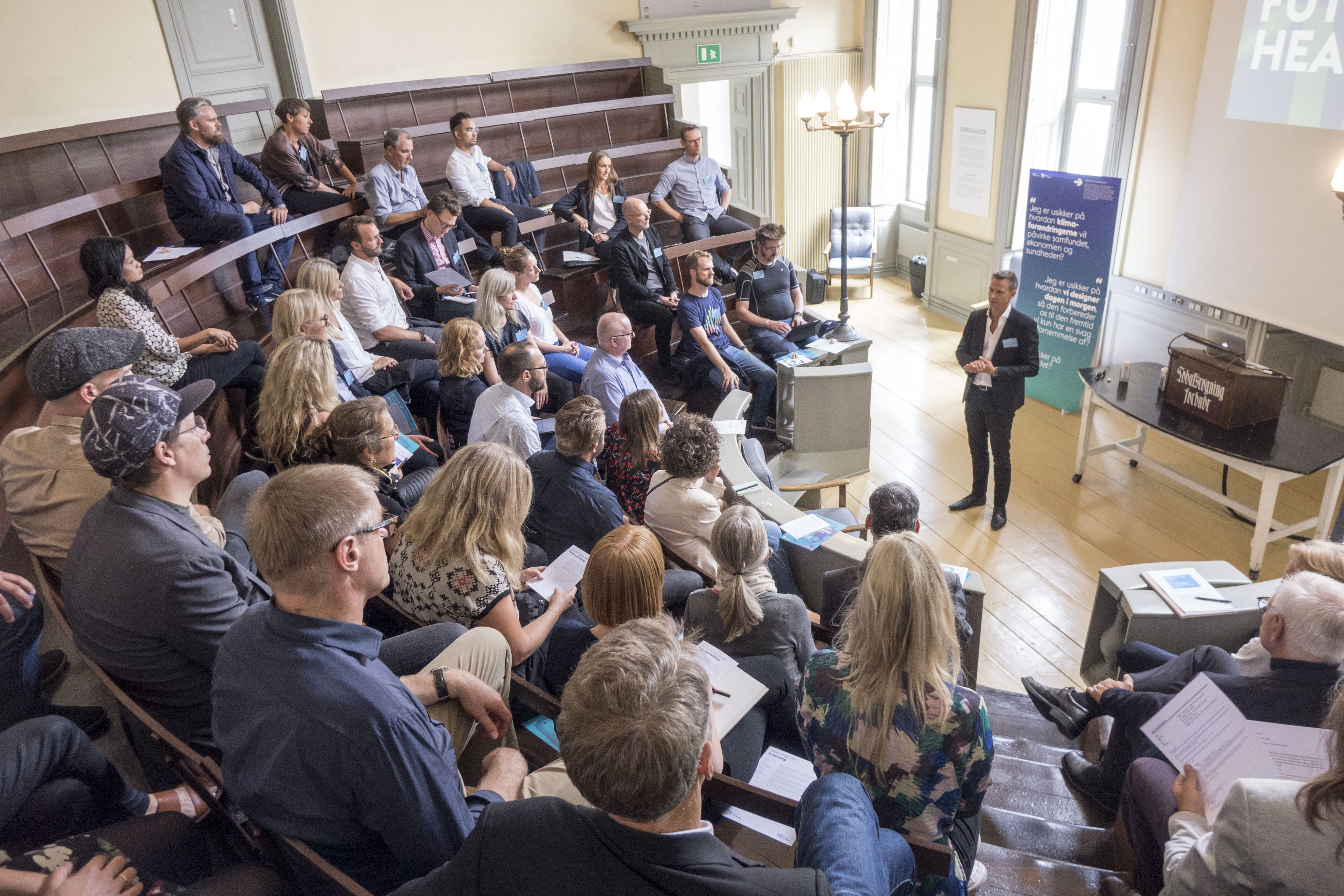 The Danish Design Centre helps public and private stakeholders develop future scenarios together
Government needs business and vice versa
It would be easy to conclude that government should insource and hold onto all forms of service provision, and leave markets to what they do best. Government innovators can then focus inwards on issues of administration, organisation, HR and ”culture”. And business innovators can embrace unbridled creative destruction.
I don’t think so – for at least three fundamental reasons.
First, business needs active government engagement to be innovative and discover new sources of value for the long term. As UCL professor Mariana Mazzucato, founder of the new Institute for Innovation and Public Purpose, has pointed out, we need proactive, long-term public ”missions” fuelled by publicly funded research, in order to enable businesses to experiment faster and accelerate their innovation activities. Governments can essentially stimulate the co-creation of new markets.
"We create experiments where designers, businesses leaders and public organisations can all explore new ways of creating value"
Second, government needs businesses to bring agility, dynamism and creativity to address public problems large and small in a digital world. Even though current developments in areas like Internet of Things, artificial intelligence (AI) and machine learning may have originally started out in government-funded labs, today these technologies’ practical application is created by firms, ranging from small startups to Alphabet and Amazon. Many of these technologies will in due course also be adopted by government: sometimes through partnerships; other times by procurement.
Third, new forms of policies and regulations will be needed as new business models disrupt not only markets. but our social fabric. Think of what Uber is doing to mobility or Airbnb to housing. Think of what AI-enabled personalised medicine does to areas like health behaviour, health insurance and citizen interactions with public health services. As the World Economic Forum’s new Centre for the Fourth Industrial Revolution in San Francisco has pointed out, governments need to engage with business to create the governance and policy response and frameworks prompted by new emerging technologies.
Using scenarios to explore complex futures
At the Danish Design Centre – which is part of Denmark’s Ministry of Business and Financial Affairs – we work with leaders to enable the transformation of business and society through design. Over the past few years, we have increasingly asked ourselves how governments and businesses can collaborate to enable innovation in this context. Our approach has been to create systematic experiments where designers, businesses leaders and public organisations can all explore new ways of creating value.
We recently developed a programme, ”Boxing Future Health”, which combines the methodologies of scenario-building and design to power a more collaborative and potentially fruitful exploration of value across the private and public sectors in the healthcare space. Based on our learnings to date, I believe the program holds wider lessons for how public and private sectors can work together. It does this in three ways.
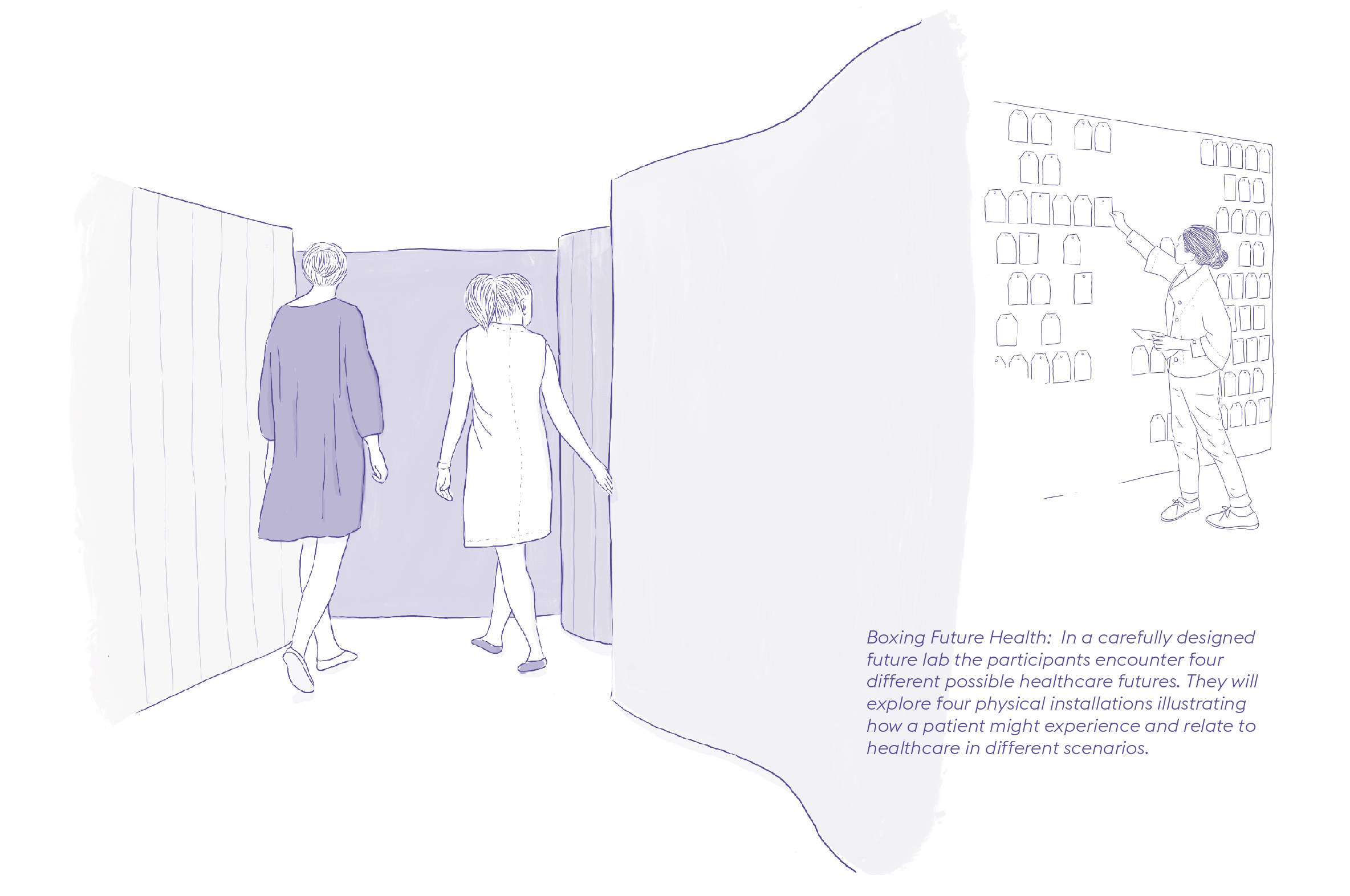 An illustration of the scenario-building process used by Boxing Future Health
Future-oriented business engagement by design
First, by establishing a shared context: we have created four long-term scenarios (for the year 2050) through an extended co-design process with business leaders, hospital administrators, policy makers, futurists and a wide range of experts. For example, one scenario involves eliminating sources of illness: how can we do this by incorporating all aspects of daily life that affect citizen health – from transport and traffic to personal relationships – into public health policy?
However, traditional foresight methodology rarely triggers real change, as scenarios risk becoming too abstract and intellectual. We have therefore added two additional components to the process.
"You can walk into and smell, hear, touch and interact with a particular future world"
Second, enabling immersion: we have drawn on the field of speculative design to create narratives from the future and build patient stories as well as physical and digital artefacts. In other words, we have created each of the four possible future scenarios as spaces you can walk into and smell, hear, touch and interact with a particular future world. Participants are thus invited to empathise with how patients and health professionals would experience radically different futures. This experience makes the future concrete and enables stakeholders to build an immersive, emotional connection with the scenario.
Third, conducting co-design: we are using design approaches to run collaborative workshops with both private and public leaders and innovators to explore the consequences of alternative futures for their products, services, and business and governance models. Using graphic tools and interactive workshop formats, the participants are invited to explore what different scenarios (which they have just been immersed in) would mean for them in the near to mid-term. These dialogues open up for new questions such as “What policies would be needed?”; ”Which new markets will arise?”; and ”What are the ways we in business and government would need to interact?” These are exactly the questions we need to drive more collaborative public-private innovation.
We are displaying and presenting the outcomes of Boxing Future Health at the EU’s Future in the Making conference in Brussels on June 5, 2018. Whether you work in business or in government, you are welcome to join us in rethinking how to explore the future. Together.
(Picture credit: the Danish Design Center)
Christian Bason
Make sure to share your own thoughts with the author by leaving a comment below

Log in or sign up to continue the conversation