
This article is written by Sandra Naranjo Bautista, founder and CEO of Better Govs and former minister and acting vice president of Ecuador. A version of this article was first published by Better Govs
Politicians and civil servants think about public policy differently. This seems obvious, but understanding how and why their views and priorities differ is crucial to improving policy implementation. To highlight the distinction between the two perspectives, I will describe how differently civil servants and politicians approached rebuilding destroyed housing after Ecuador’s 2016 earthquake. But first, let me explain why this distinction matters.
One reason why the lack of shared sympathy between politicians and public servants matters is that it threatens national and international development goals. I’d advise any public servant reading this article to check out a fantastic TED talk by the novelist Chimamanda Ngozi Adichie on ‘The danger of a single story’. In her talk, Adichie warns that when we become used to a single narrative, whether it be about a person or a country, we risk mistaking our side of the story for the whole truth. Again, Adichie’s point might seem obvious, but it is true of public policy. Politicians and civil servants have their own interpretation of how things should work, but development objectives require these distinct parts of government to work together.
• Want to write for us? Take a look at Apolitical’s guide for contributors
I used to think that the gulf separating public servants and politicians was a problem only in countries with weak institutions, such as Ecuador. And yet, even in countries like the UK, which ostensibly recognise that at the heart of good policy is “an effective relationship between ministers and civil servants”, the same disconnect exists. After working in many different countries, I’ve come to the conclusion that the problem is universal. Public servants should take it more seriously.
The table below maps out the underlying differences between politicians and civil servants:
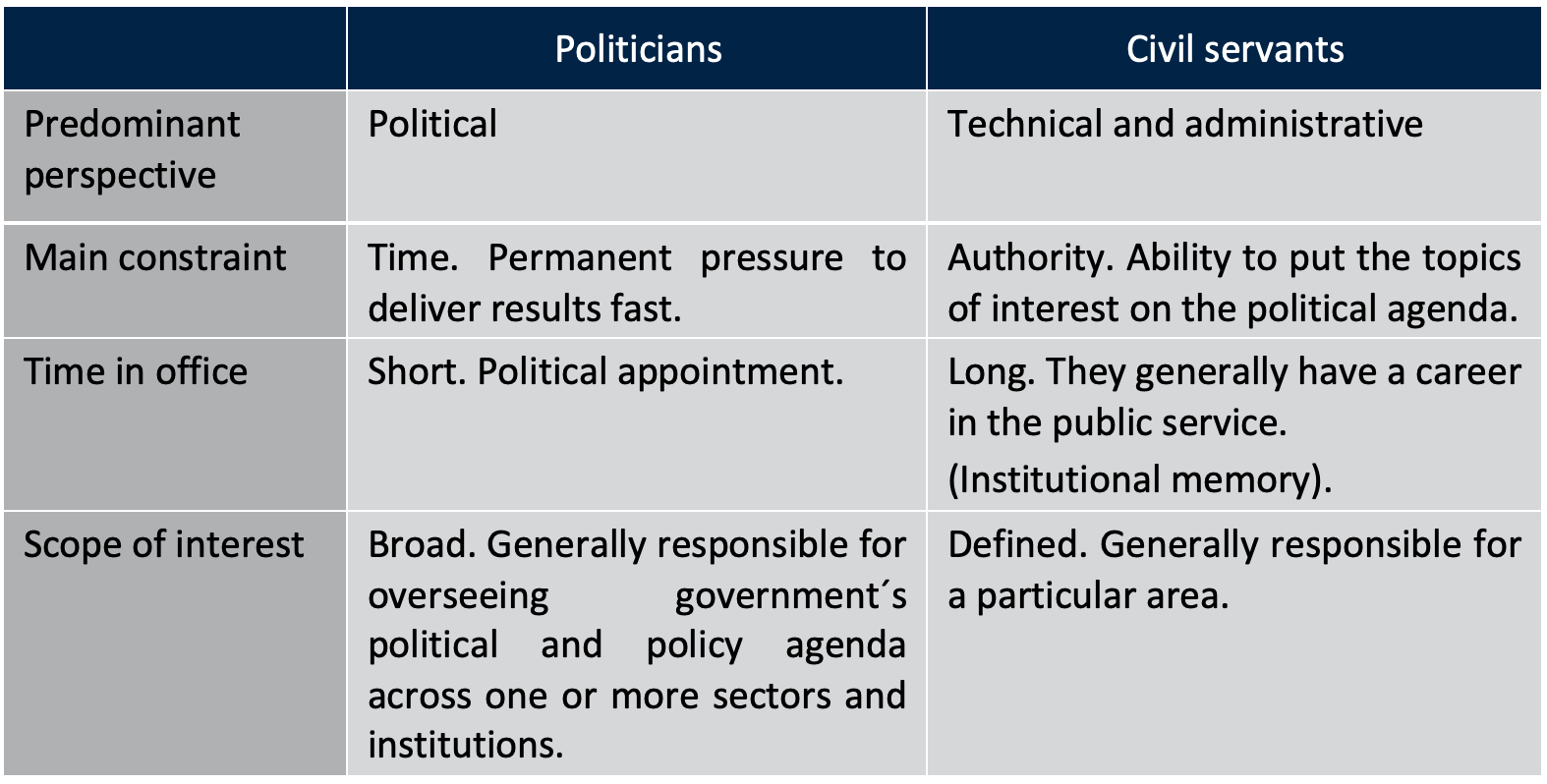 A table listing the biggest differences between politicians and civil servants.
In a recent blog, I shared five secrets for effective policy implementation (you can download the full guide here). Now, by citing Ecuador as an example, I will analyse four of the five secrets from both perspectives — that of a government minister and a civil servant.
Be clear about your goal
After Ecuador's 2016 earthquake, one of the government’s priorities was making sure that every family affected by the disaster was given permanent housing as quickly as possible. This would be an important milestone for the country, as it would allow us to close all of the temporary shelters constructed in the aftermath of the earthquake. To achieve this goal, the government put forward a plan to build 4,000 new houses. While civil servants and ministers agreed on the policy’s objective, they did not share the same sense of urgency. At the time, I was working as the acting vice president of the country, and implementing it was my number one priority.
Those of us who had been politically appointed wanted to accomplish the goal quickly — we were in the middle of an election, and the elected government was likely to change in five months. The pressure to deliver results piled on. Civil servants, however, are not beholden to election cycles, so they saw the problem as one that would be solved over a longer period of time.
Choose a course of action
Both sides agreed on how best to build the houses, including the kind of material that would need to be used and the services that would need to be mobilised. The housing programme was also unilaterally seen as feasible in terms of the economic, administrative, and logistical resources needed.
Communication between civil servants and politicians is essential to getting things done.
From the point of view of the politicians, everything was in place. In theory, there was no reason why the houses couldn’t be built in five months. However, we were not the ones dealing with the administrative issues. For civil servants, the time pressure was a huge burden.
In this case, civil servants and politicians agreed on what needed to be done, but the process put strain on them in different ways. The politicians faced higher political stakes, whereas civil servants faced overwhelming logistical pressure to deliver significant outcomes on a tight deadline.
We, the politicians, knew that if the houses were not built before the government transition, there’d be problems. Projects would be delayed, if not completely stopped, until the new administration settled in and felt confident continuing. That could take months, and would leave people without permanent housing for more than a year after the disaster.
On top of this, people trusted us to deliver. Failing them was unthinkable. I remember once, on a weekly tour of one of the construction sites, a woman living in a temporary shelter grabbed my hand and said: “Please, help us! I trust my President will give me my house. I am just not sure the others will. Don't abandon us!” These people had lost everything in the earthquake. Understanding what this meant to them reminded me why I was putting so much pressure on myself and others.
Monitor your progress
Monitoring our progress was an important part of our success. When the standing president, Rafael Correa, entrusted me with the role of acting vice president, he said: “You have to learn to use power. Use your authority to make sure those houses are built on time. People trust us, we can't fail them!” I still remember these words, as well as his hopefulness and determination. Development outcomes depend on how power is used.
I did as he said, and used my authority to create synergy between politicians, ministers, and civil servants. I visited the construction sites on a weekly basis to assess our progress and take action where needed. At first, the construction managers thought I was running on beginner’s enthusiasm. They soon realised I meant business. Together, we made sure those houses were built and that all the temporary shelters were dismantled and removed before the end of the administration’s term in office ended.
Adjust as needed
I have found that one’s point of view in government is based on how easy one finds it to adapt. If you are a politician, you are the decision-maker, which means you have the authority to make adjustments. If you are a civil servant, that isn’t quite the case. You are asked to follow procedures and to implement projects once the politicians have made their decisions.
Communication between civil servants and politicians is essential to getting things done. Decision-makers have to communicate their goals clearly to the civil service, who, in turn, need to open up clear lines of communication. In the case of the earthquake, having direct input from project managers in the field was vital for decision-making.
Effective policy-making requires the right blend of technocracy and political will. Both perspectives are important, and can often be complementary. Whichever role you are in, think of what could bring these two perspectives closer together. The result will invariably benefit the greater good. — Sandra Naranjo Bautista
We want to hear what you think about this article. Pitch an article to us or send your comments to hello@apolitical.co
(Picture Credit: Pexels)
Make sure to share your own thoughts with the author by leaving a comment below

Log in or sign up to continue the conversation