
This article is written by Richard Sandford, Professor of Heritage Evidence, Foresight and Policy, UCL Institute for Sustainable Heritage.
Evidence has a central place in policymaking. Evidence might come in the form of data from a university or industry researchers. Or it might have been produced inside government: such as quantitative data from a longitudinal study, perhaps, or the kind of qualitative ethnographic data that design teams in policy labs have become expert at.
- Want to write for us? Take a look at Apolitical's guide for contributors
Often, the policy will be addressing an established challenge, one described by historic data. Increasingly, it might be anticipating an issue, and the data that describes the challenge will have come from some kind of predictive model, like those used by climate scientists, economists, or behavioural scientists.
Policy is future-facing by default
These models tend to give us the impression that we know the future shape of a challenge.
Where we know that we don’t know the future, but we know that policy still has a role to play in managing it, some other form of anticipatory governance might be adopted, establishing institutions and norms around innovation and emerging technologies. Examples of this approach include the UK’s Human Fertilisation and Embryology Authority, or the various AI Councils set up around the world.
Whatever the approach, any policy will be trying to address some aspect of society that needs improving. It will be future-facing, by design and nature, and the people developing it will likely think of it that way.
Policies that take things for granted aren’t future-proof
All these ways of managing the future — models, governance, existing data — rely on some fundamental things remaining constant.
For models, the conditions under which they can be used to project future circumstances are usually made explicit (or, at least, they should be), as long as the system retains the characteristics assumed by modellers, over the length of time being considered, it’s useful. If these aren’t true, then it isn’t.
Our world is complex: emergent features of the systems that make up our natural and social worlds can form a rupture in the way things are organised
This is just as true outside quantitative models: our ideas about the future of something are only useful as long as the mechanisms that create that future continue to work as we expect. Of course, the idea that policy design involves questioning our assumptions is commonplace. But actually looking hard at the building blocks that a policy relies on is easier said than done. Teams often assume that a “policy lever” will just work, and do not question what needs to be there for that to be true.
Recent events, however, have illustrated how easily seemingly fixed aspects of life can change — and shown how vulnerable to these changes policy can be.
- What if governments paid people not to go to work?
- What if cities turned roads into bike lanes?
- What if technology firms decided how we educate children?
- What if private homes became offices?
These questions would have been outside the scope of a traditional policy design process — yet they are (part of) the real context of current policy development. Our world is complex: emergent features of the systems that make up our natural and social worlds can form a rupture in the way things are organised.
The systems and categories that we use to make sense of the world can change rapidly. Taking the wider world for granted seems like something of a risk in the circumstances: working with taken-for-granted assumptions about the future can leave us vulnerable to unanticipated events.
Making deep assumptions clear with futures thinking
Techniques from the fields of foresight and futures studies can provide ways of examining and testing the underlying assumptions that often go unquestioned in policy design. This “futures thinking” offers policy teams a way of embracing uncertainty and discontinuous change, exploring interactions between system elements within multiple possible futures.
There are many other approaches within futures thinking for exploring the assumptions about cause and effect that underpin policy design. All of them offer an opportunity to avoid the business-as-usual thinking that makes policy vulnerable to discontinuous change
There are approaches that sensitise an organisation to new possibilities, like speculative fiction (see Nesta’s recent stories on AI, for example). There are some that prepare the ground before policy development (like horizon scanning) or ways of understanding underlying structures that are highly specialised (like morphological or multi-criteria analysis).
But what if you have a policy under development or about to launch, and you need to think about its resilience now?
Here are a couple of exercises that you can use right now to think more creatively about the future.
Futures Wheel
Developed by futurist Jerome Glenn in 1971, The Futures Wheel is essentially a structure for asking “and then..?”
The futures wheel offers a quick way into assessing the possible impacts of a policy, and the different domains in which they might be seen. Draw a circle, surround that with another ring of circles, and another, and write your policy intervention in the middle.

Now map the immediate outcomes (planned and unplanned) in the first ring of circles. Use circles in the second ring to map the effects of these outcomes: draw a third ring to capture a further order of impacts, if it’s useful.
Inductive scenarios
“Inductive” scenarios are a lighter-touch version of the familiar 2x2 matrix approach, introduced to me by the futurist Scott Smith. They depend on your team having a good sense of the trends and drivers shaping the world (perhaps you have a trend inventory from regular horizon-scanning, or can spare some time to construct one).
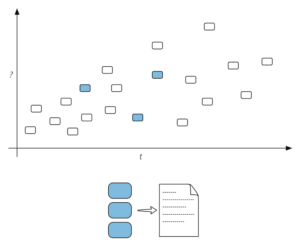
Organise your trends and drivers on two axes, with the y-axis indicating how certain you think they are, and the x-axis showing how far in the future they are. Pick two or three trends or drivers from inside the horizon that you expect your policy to have an outcome — or have a colleague deal you some at random.
Now improvise a future narrative in which all three are present (you are likely better at this than you might assume). Now write your policy intervention into the script. Is it relevant? Did it help? Does it face unexpected barriers? Try this a few times with different prompts.
These two methods are rough-and-ready approaches that can be done with minimal resources. They can be done (indeed, usually are done) with much more rigour and structure — but if you need a quick prompt to test your thinking, they’re quick and approachable.
Get started
There are many other approaches within futures thinking for exploring the assumptions about cause and effect that underpin policy design. All of them offer an opportunity to avoid the business-as-usual thinking that makes policy vulnerable to discontinuous change. And all of them can give a team confidence that they know the scope of a policy, and the conditions under which it succeed. — Richard Sandford
(Picture credit: Unsplash)
Make sure to share your own thoughts with the author by leaving a comment below

Log in or sign up to continue the conversation