
This article is written by Sydney Lund, former transportation demand management intern at the Colorado department of transportation
In the United States, the transportation sector is responsible for a larger amount of greenhouse gas emissions than any other sector. In fact, it accounts for 29% of total US greenhouse gas emissions.
Approximately 4.6 metric tons of carbon dioxide are released every year from the average combustion engine passenger vehicle.
- Want to write for us? Take a look at Apolitical’s guide for contributors
The Colorado department of transportation (CDOT) and many other departments of transportation (DOTs) throughout the United States have converted their fleets to hybrid or electric vehicles to reduce greenhouse gas emissions related to employee work travel.
CDOT is taking its commitment of electrifying its fleet to new heights by adding eight electric bikes to its fleet to reduce congestion, improve air quality, and provide employees a fun way to commute to nearby work meetings. CDOT is one of the first DOTs in the nation to bring electric bikes to its fleet. This can allow CDOT to provide a blueprint and lessons learned to other DOTs across the nation to launch similar projects, which could amplify the positive outcomes of reduced emissions and increased health benefits related to adding e-bikes to a government fleet.
Going electric
Although hybrid and electric cars help reduce greenhouse gas emissions and improve air quality, they still contribute to congestion issues. Electric bikes were brought to CDOT’s headquarters office as a way to avoid contributing to congestion and eliminate the need for employees to pay steep parking prices when going to downtown meetings.
With CDOT’s main headquarters being located half a mile away from downtown Denver and located near two of Denver’s longest biking and walking trails, it provides a ripe opportunity to test out innovative mobility options that could later be scaled to other CDOT locations throughout the state. Due to CDOT headquarters’ location, electric bike trips could often be just as fast or faster than car trips, accounting for the time spent in traffic and circling around the block to find a parking spot.
Bringing electric bikes, or even pedal powered bikes, to a government or transportation agency can allow governments to pursue low-carbon alternative transportation while helping to promote biking as a viable commuting option to employees and the public at large
To launch the pilot program, CDOT is bringing together thirty employees across multiple departments and positions to identify barriers and improvements to the program. Specifically, the pilot test group will give feedback on the e-bike safety video, safe bicycling quiz, and in-person training that have been created by the e-bike pilot project team. This will help ensure a smoother launch when the program becomes open to all employees. The online components of the pilot project were kicked off in spring of 2020. The in-person components will take place shortly after CDOT’s workforce transitions back into the office due to working from home during COVID-19. If the trial period is a success, this project will be open to all CDOT employees.
The pilot project was necessary to receive stakeholder buy-in and ensure that processes are running smoothly, while being able to make easy changes to the program before a full launch to all employees.
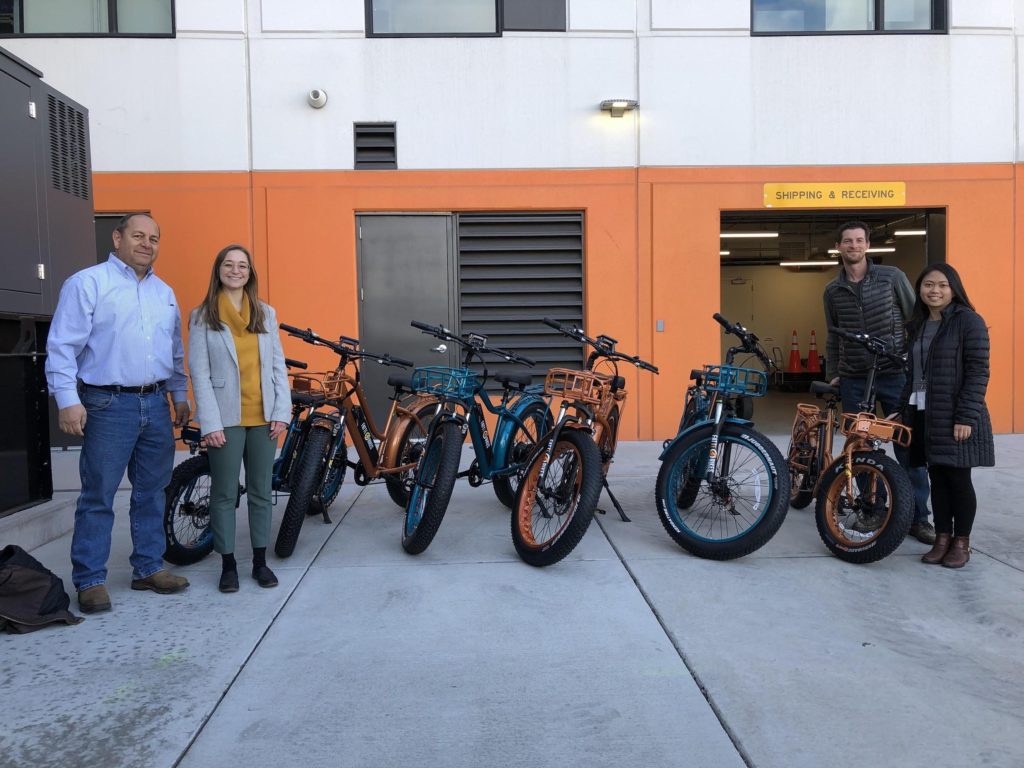 CDOT’s E-Bike fleet project team and FattE-Bikes co-founder. From left to right: Tom Pacheco, light fleet administrator, Sydney Lund, transportation demand management intern, Kenny Fischer, co-founder of FattE Bikes, and Christelle Matsuda, Office of Innovative Mobility intern.
Bringing electric bikes to CDOT required the participation of several internal stakeholders, including the Office of Transportation Safety and Risk, Facilities and the Communications Office. Safety is one of CDOT’s six key values, and making sure that employees are safe on the electric bikes was CDOT’s No. 1 priority during the pilot program.
Working with the Office of Safety and Risk, the project team created a training program that requires employees to attend an in-person training where employees are able to learn how to operate the electric bikes in a closed environment. Additionally, a safety and training video was created to inform employees about the new program while also providing safety information to employees.
As with any change, hurdles are expected, which is why running a pilot project is vital to a project’s long-term success
The Communications Office ensured the video and internal messages were in line with CDOT’s brand. Collaboration with facilities was needed to designate a space to store the bikes and related equipment.
One of the key successes to this project was partnering with FattE-Bikes, a local bike shop that manufactures fat tyre electric bikes in Denver. The fat tyre electric bikes offer more stability to riders while providing more visibility, which increases rider safety. Partnering with this local bike shop allowed the project team to customise the colours of the bikes, put speed restrictions of 20MPH on the bikes, and use the bike shop’s team to help train our employees on how to use these electric bikes.
Bike power
Adding electric bikes to a government fleet is best suited for offices located near a downtown city centre, where there are ample locations employees already attend that could be easily accessed by bicycle.
Identifying key employee destinations located near your government building will help make the case as to why electric bikes would be a benefit to the organisation. Additionally, governments can save money from fleet maintenance and fuel costs by offering employees the ability to choose this alternative form of transportation for work travel.
Bringing electric bikes, or even pedal powered bikes, to a government or transportation agency can allow governments to pursue low-carbon alternative transportation while helping to promote biking as a viable commuting option to employees and the public at large. As with any change, hurdles are expected, which is why running a pilot project is vital to a project’s long-term success.
With the purchase cost of eight electric bikes being less than the cost of one new fleet vehicle, electric bikes can help government agencies expand their fleets while under tight budgetary constraints. — Sydney Lund
Make sure to share your own thoughts with the author by leaving a comment below

Log in or sign up to continue the conversation