
This article is written by Skaidra Puodziunas, Senior Advisor, Ontario Digital Service and an active member of the Global Lithuanian Leaders
A year ago I was scrolling Facebook when I came across an event bringing together GovTech leaders across the Baltic Sea region.
This instantly piqued my interest as a Canadian-Lithuanian working in the digital government ecosystem. By day I work at the Ontario Digital Service, a hub within the provincial government working to deliver simpler, faster and accessible services for Ontarians.
“GovTech Baltic Leaders is the first of its kind GovTech conference in the Baltic sea region, that gathers leading policy makers, IT companies, startups, investors and interested individuals to explore the potential of technologies and innovation to solve social and public sector challenges.”
- Want to write for us? Take a look at Apolitical’s guide for contributors
Estonia’s journey to becoming one of the most digitally advanced societies in the world has long been an inspiration. Last fall I even participated at Latitude 44 TO- a tech conference in Toronto which featured Estonian tech, e-Governance and start-ups. The message was clear – the path to government innovation is through public-private partnerships.
 Arūnė Matelytė, manager of GovTech Lab Lithuania, and Elijus Čivilis, former Vice-minister of Economy and Innovation of the Republic of Lithuania receiving the Innovation in Politics Award
However, with all the focus on Estonia, what about Baltic neighbour Lithuania, home to my ancestors and now Europe’s second largest fintech hub?
I was excited to learn this GovTech Baltic Leaders event was part of a broader project backed by the Lithuanian Government to launch a new team in public sector, GovTech Lab Lithuania.
Fast forward almost a year later, just before the launch of the team’s first Global GovTech Week, I virtually chatted with the lab’s founder and current manager, Arūnė Matelytė, to reflect on what has been a historic year for the team.
The lab’s beginning
Interestingly, Arūnė’s entry into the Lithuanian public service is largely the reason GovTech Lab Lithuania exists today. She enrolled in a talent program called Create Lithuania, aimed at attracting and retaining top talent into the public service.
As the website notes:
“Since 2012, “Create Lithuania” has been annually inviting professionals with internationally acquired experience to participate in the programme. For 12 months participants of “Create Lithuania” advise (on rotating basis) public sector bodies on national and regional issues in the areas such as the improvement of Lithuania’s image, the enhancement of competitiveness and business environment, the promotion of entrepreneurship and foreign direct investment, etc.”
Arūnė was placed at the Ministry of the Economy and Innovation of the Republic of Lithuania where she was empowered to implement a capstone project which led to the test piloting of GovTech Lab Lithuania. Months later, her small team was awarded (by the citizens’ jury!) a European Innovation in Politics Award.
“This was a big moment for our team as it validated our ideas early on and gave us the momentum to keep pushing on,” said Arūnė. “When you’re a small country like Lithuania, outside validation can serve as a useful catalyst for propelling ideas.”
As I reflected more broadly on our conversation, below are three takeaways that standout for me and hopefully inspire public service teams globally to start small and lead innovation hubs that reinvigorate the importance of public-private partnerships, particularly with the start-up ecosystem.
Innovation doesn’t have to be expensive in government
“At quick glance, the idea of investing in experiments with public dollars might seems like a waste of money,” said Arūnė.
But her team exists to counter this idea and believes that by allocating small chunks of funds for startups outside government to experiment and solve government challenges can in fact save governments big money in the long run.
Take for example their lab’s ongoing response to Covid-19.
In the first weeks of the pandemic, their teams focused efforts to partner on Lithuania’s Hack the Crisis Online Hackathon. Over the course of 48 hours from Saturday, 22 March to Sunday, 23 March, over 1,000 Lithuanians distributed across 10+ countries and three continents gathered online to hack away at 50 different project ideas. The initiative helped launch a number of start-up initiatives including:
- ViLTe bot - an automated conservation robot, helping distribute reliable information, particularly around Covid-19 public-facing information
- VoiceMed - a technology with built in voice recognition software powered by artificial intelligence (AI) to identify Covid-19 related illness symptoms
- UVIRESO – using UV radiation to destroy viruses, bacteria and other germs to help prevent the spread of Covid-19 and other harmful viruses
Focus on building awareness to build a community of understanding
When Govtech Lab first launched in 2019, there was little to no awareness of the term “Govtech” in Lithuania.
“We had a lot of convincing to do, that opening public sector to partnerships with startups to enable innovative solutions is a good idea,” said Arūnė.
The work at the offset to build awareness of the lab and its goals paid off.
This summer the Lithuanian Government launched an economic recovery plan, where seven million euros are now being allocated towards piloting GovTech solutions across Lithuania’s public sector.
In addition, the Lithuanian Government recently launched a new strategy (only available in Lithuanian), which will determine how Lithuania is branded to the rest of the world. “GovTech” is listed as one of the key strategic elements.
Find your allies
“For anyone looking to launch a GovTech Lab in their country, start small and find your allies,” notes Arūnė. The key is to do the hard work of aligning your approach with ministries, departments and/or teams that believe in your vision and can help pilot your idea with a few initiatives.
While GovTech Lab Lithuania is just getting started, I hope what this small team has accomplished in such a short period of time can serve as inspiration for other public service teams to start small and find ways to partner with teams outside of government.
And most importantly, as Arūnė notes,”Don’t be afraid to experiment with your ideas and see where they take you.”
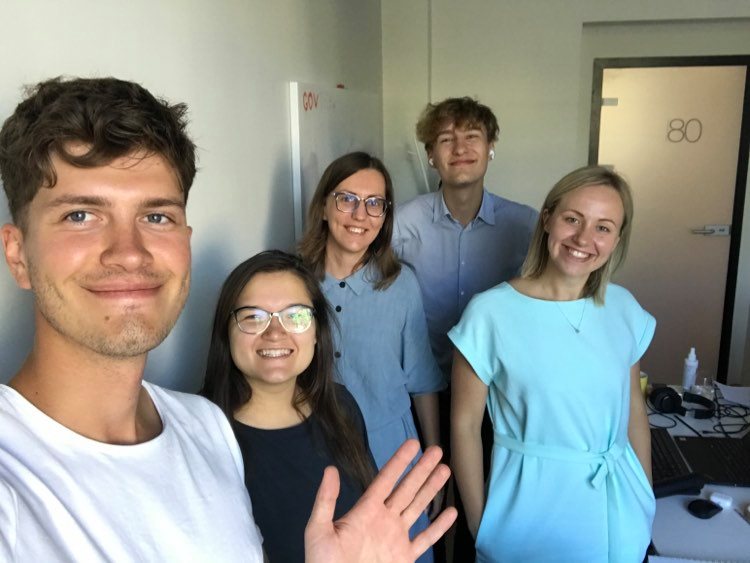 GovTech Lab Team team members saying hi!
Learn more about the GovTech Lab Lithuania and they current projects on their website.
Want to know more about GovTech and how it’s changing government - read more here.
We want to hear what you think about this article. Pitch an article to us or send your comments to hello@apolitical.co
Make sure to share your own thoughts with the author by leaving a comment below

Log in or sign up to continue the conversation