
This article is written by the Web team, Communications Nova Scotia, Government of Nova Scotia.
Like most other governments, the Government of Nova Scotia (GNS) has a website. Ours has been online for 25 years—aeons by any digital yardstick. It has grown organically to meet the needs of thousands of program owners and policy administrators. Often our content about a given subject would be described from the perspective of each department, each writing from their own interpretation. In effect, we were asking users to know which departments would have the content they were looking for, visit them all, and stitch together an official message from all sources. This is obviously an unrealistic expectation, especially for the generation of users that came online in the age of Google, so a new strategy was needed.
- Want to write for us? Take a look at Apolitical's guide for contributors
A website a million pages large doesn’t get replaced overnight, so instead of replacing everything at once, we decided to create a “beta” website, beta.novascotia.ca, a functioning proof of concept that would let users interact with a new way of organizing our content. The first content launched in October 2018, and since then we have been gradually moving content to this new way of providing government’s programs, services and information to our users, and gathering feedback from them about their experience.
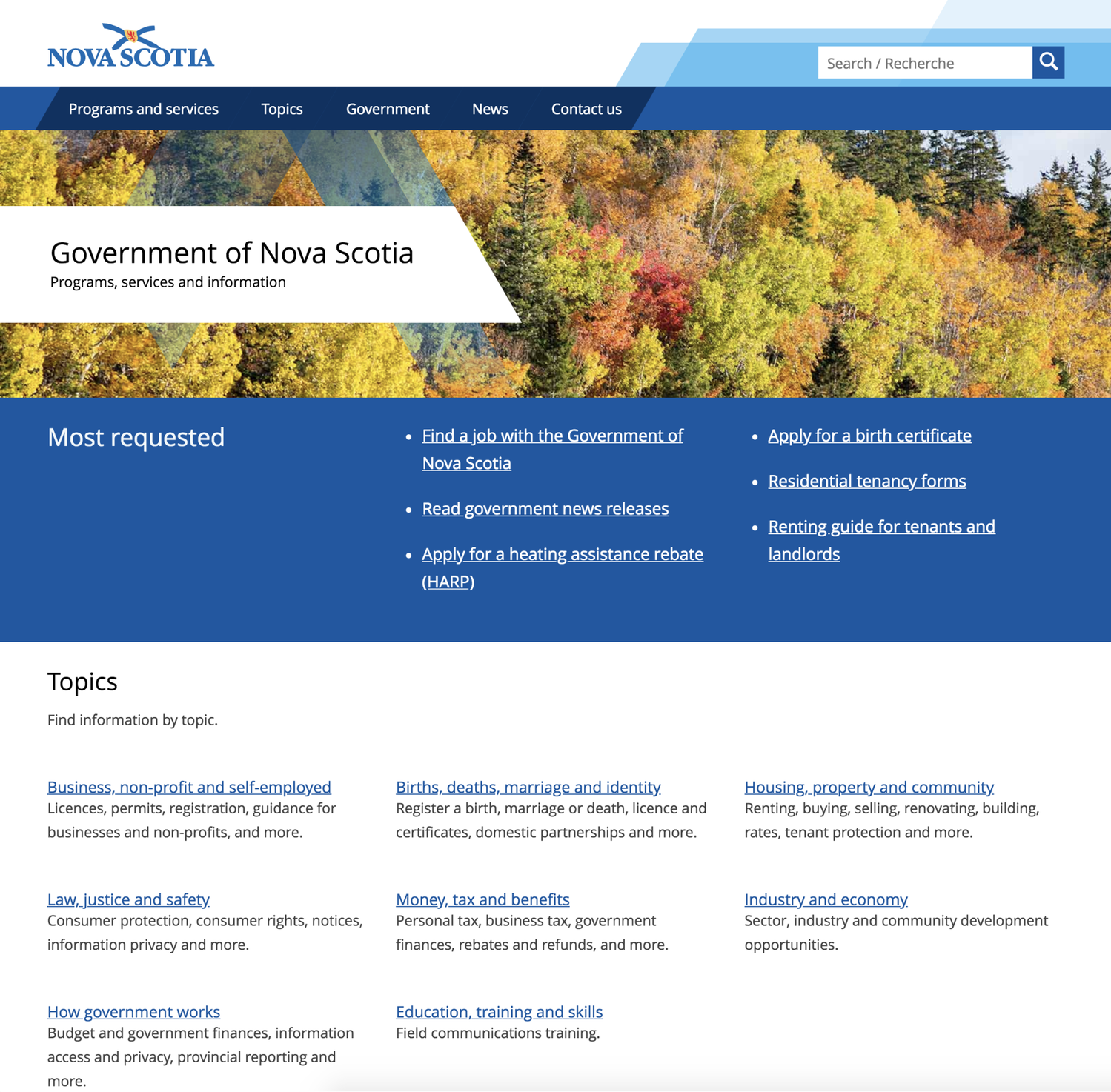
beta.novascotia.ca
One government voice
We had seen the success that other organizations and jurisdictions have had in creating a website organized around user tasks and as one government voice, not departmental boxes. Inspired by examples such as the beta.gov.uk website, our web team decided to rebuild our content in a similar way. We challenged ourselves and our colleagues to not simply migrate old content, but rethink what users need to complete tasks with digital government, resulting in the creation of our web strategy document in April 2016.
It defined a set of content criteria to ensure that each piece of content that gets published is government’s content and is there for at least one of the following reasons:
- Part of a government service
- Part of a government program
- Official information
- Legally required
- Response to a significant event
- Policies, acts and regulations
- Engaging citizens
- Raising awareness
- Helping users follow the law
- Explaining how government works
Adopting these criteria meant leaving behind a lot of content that had always been there. It meant collaborating with other departments in new ways where subject matter overlaps.
Buy-in and support of GNS’s digital transformation from the highest levels of our civil service aided in conveying the need for change, so we were able to take this model to government’s subject matter experts.
Helping our colleagues find alternative homes for this content that aligns with where the audience is reassured them we weren’t here to change how they do their work. The use of blogs, open data platforms, social media, libraries and feature stories are some of the methods we found helpful.
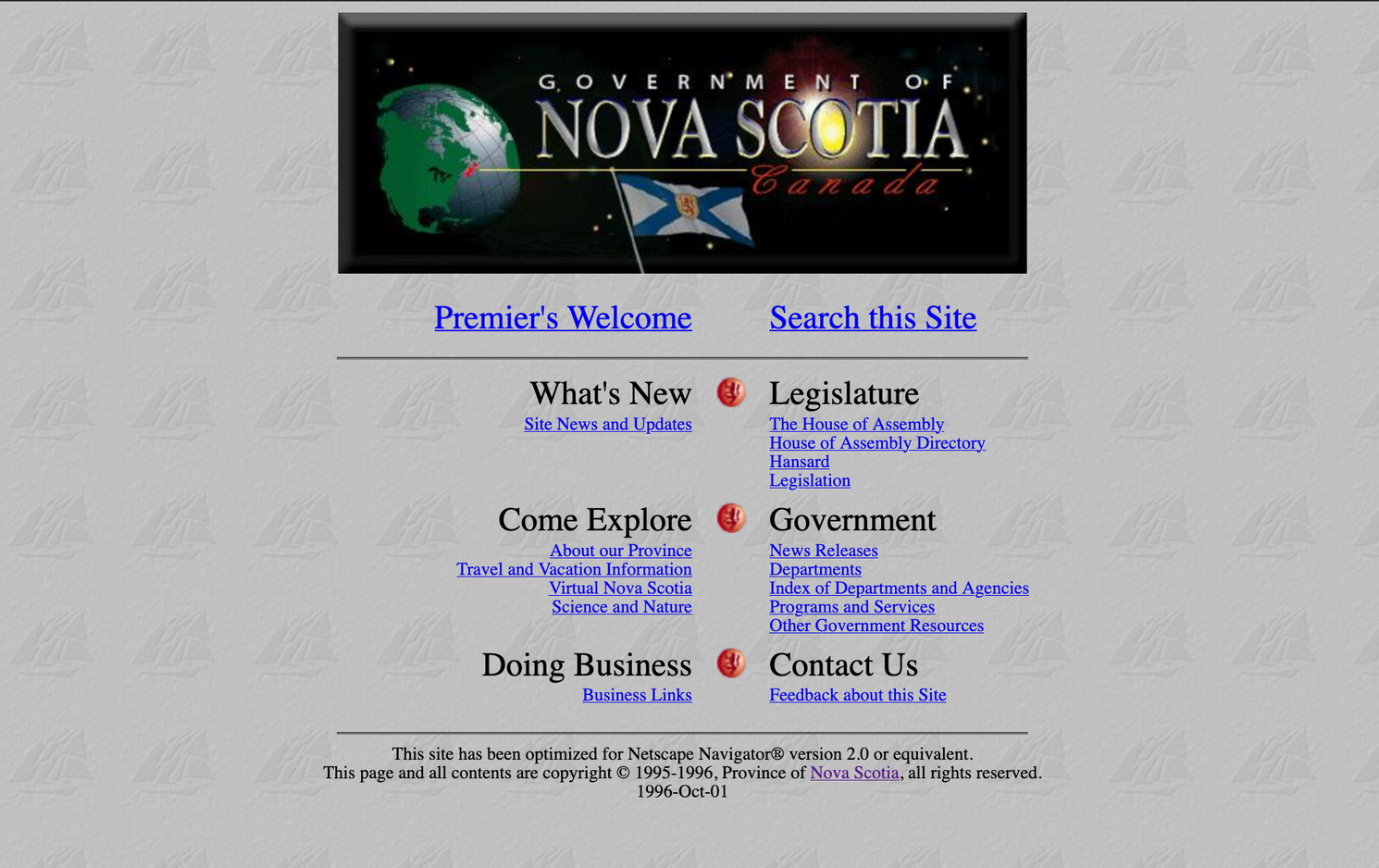
The Government of Nova Scotia's website as it appeared in 1996.
Identifying content leads
In June 2016, with our strategy charted out, we began inviting government’s subject matter experts (SMEs) to a series of workshops to help us identify what content needed to be online to serve user needs. These horizontal government SMEs became our “content leads” for each program, service, and piece of information. Now every word on the website has someone responsible for it—verifying its accuracy and relevance to the delivery on that user task.
This person worked closely with the website content developers during the initial stages of their content reorganization and publishing. They are also the person who can request changes to that information. This person is usually, but not always, a program administrator, or the decider for what changes are necessary. Professional content designers and editors work with the content leads until the information is accurate, accessible, complete, and in agreement with all related content.
Since, generally speaking, users imagine government as a monolith, rather than dozens of departments and individual units, it’s important for us to bring content leads together when a subject crosses departmental boundaries. In these cases we assign a primary content lead who is supported by those with additional perspectives.
Shifting to user-centric, task-focused content
The existing website had followed the pattern of putting up everything we know, and let the users figure out what they need. This approach is intended to be transparent and helpful, but the end result is users say our websites are cluttered and difficult to navigate. Educating content leads on the search-centric behaviour of internet users, and reassuring them that their programs will still be findable through search helped gain buy-in.
Our first launch was in the fall of 2018. Since then we have published over 2100 new pages, replacing tens of thousands of legacy pages
Breaking a program that consisted of a handful of forms and guides into steps in a process turned out to be the biggest part of the entire project. When everything is put online, fewer decisions are required. When you only put online what users need to proceed to the next task, a lot more care is required. This exercise identified overlapping information, contradictory instructions, and gaps in processes that were being addressed in other channels such as telephone support.
Two years into the project, the initial pages of beta were launched. Having live examples helped the onboarding process as subsequent content owners can see how other programs, no matter how unique, fit into the strategy and format.
Create structured content once, publish everywhere
Throughout the monthly workshop phase, the content leads taught us about the types of tasks users do with government and the types of information that support them. We started to identify patterns, so we formalized these into content types. For example; now every time a user encounters a program, they can expect the same basic presentation of that content.
Beta.novascotia is built using the Drupal content management system. Drupal’s content type system was a good match for our strategy, and our team’s familiarity with the software let us keep our technology constant while changing our content processes.
A website, however, is never complete
Another advantage of Drupal is it allows us to manage information such as contact details or links to legislation once in a central place, and reference it in other parts of the site as needed. This avoids keying in the same information over and over, and keeps things consistent.
Mindset and culture-changing
Our first launch was in the fall of 2018. Since then we have published over 2100 new pages, replacing tens of thousands of legacy pages. Each month we add to the new website and come closer to having completed our initial migration. A website, however, is never complete.
The content maintenance model we described above does take a bit more time up front; however, the results are more consistent, the content is more clear and easier to understand for the end user, and the overall number of website edits is drastically down. Having a person responsible for everything on our website has proven invaluable for ownership and the sustainability of content. Content leads ensure all edits are accurate, and when content does cross our organizational boundaries, we already know who needs to be included in discussions. Having content designers, content developers, web designers, user experience and web developers working closely together is also instrumental in ensuring our beta.novascotia.ca platform continues to evolve and change to support the content and user needs.
Instead of encouraging our colleagues to make the change, we often get asked when they can get on the new site. Other jurisdictions have reached out to learn about our project as they are facing the same content design and system design challenges we have lived through. With this momentum and almost half of our departments on the new website, we have almost reached the point where it’s time to remove the “beta” label. Once the technical measures are in place to ensure legacy URLs connect people to the content they need, we’ll take this next step and beta.novascotia.ca will become novascotia.ca.
(Picture Credit: Unsplash)
Make sure to share your own thoughts with the author by leaving a comment below

Log in or sign up to continue the conversation