
This article is written by Alexis Pala, Research Associate at Y Lab, the public services innovation lab for Wales, with contributions from public servants and practitioners (see acknowledgements at the bottom of the article).
This article also appears in Apolitical's better meetings microcourse.
Why are you reading this piece?
Likely because you, like many other public servants, recognise that we only hear from a fraction of the people in most meetings. As Karen Bradley, a NHS Principal Consultant of the Strategy Unit explains, Liberating Structures "create an antidote to the highest paid person's view being the only one in the room".
- Want to write for us? Take a look at Apolitical’s guide for contributors
This article is designed to demystify the jargon behind these 33 (approved) easy-to-use “Liberating Structures” techniques that help people get better outcomes from meetings. These structures are entirely free to use, apply, and learn more about (click here).
But, what do they do?
Liberating Structures provide alternative ways to work together by disrupting usual meeting styles, which are often inefficient, dry, and largely performative in the public sector.
Each technique challenges the status quo in subtle, respectful, and mutually beneficial ways to invite new perspectives, connections, and ways forward. The instructions that accompany each structure provide a template for slowing down, going deeper, and creating space for reflection and listening, which usually gets overlooked until a problem arises.
Liberating Structures have impacted people across many sectors and disciplines. Agile coaches use them, teachers have integrated them into the classroom, public servants across the globe practice them, and some in the healthcare sector have adopted them to tackle the challenges of integrated care. The list goes on. But why? What’s so great about them? How do they adapt to so many contexts?
What: the anatomy that makes a Liberating Structure
The simplest way to understand the ultimate aim of a single Liberating Structure is to examine the graphic below.
“Liberating” is focused on tapping into the collective intelligence in the room — engaging the many rather than the few. “Structure” is focused on moving from meeting formats that limit the sharing of ideas/next steps to formats that create space for diversity and the cross-fertilisation of ideas.
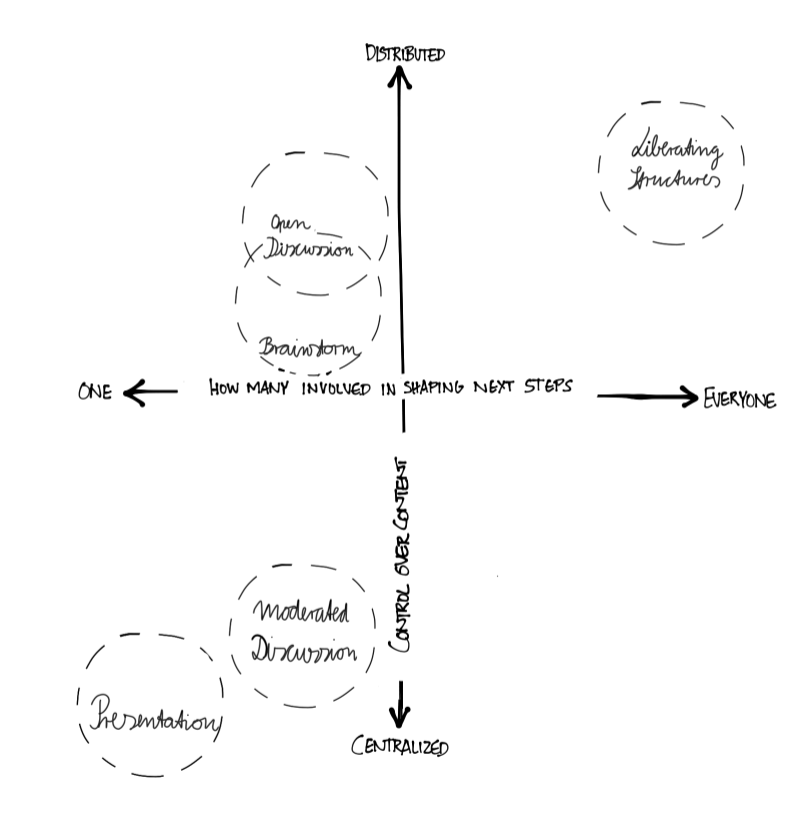
Presentations, status updates, open discussions, brainstorming sessions, and moderated discussions (such as panels) are what the Liberating Structures community call the “Big 5” — the typical ways we choose to structure how people engage, exchange, and learn. Although they are useful in certain circumstances, ultimately, they all limit participation, which can stifle creativity, keep us stuck in bad habits, and overlook opportunities for growth. Liberating Structures expand your toolkit and provide alternative formats.
The instructions that make up the DNA of each Liberating Structure are broken down into sections which we call “design elements”. Each of the six design elements outlined below are key ingredients to engaging people. Ultimately, you cannot force people to participate. Instead, focus your energy on creating the right conditions for their participation by contemplating the following six elements.
The question you ask and how you ask it matters... a lot
In Liberating Structures we call the prompt or question posed to the group an “invitation” because it can intrigue people, inviting them to share, or, it can do the opposite. If a prompt is unclear, poorly phrased, or carelessly considered it can derail a meeting partially or entirely, or even worse, turn-off people’s interest.
Configuration, how intimate or large should groups/engagements be?
Simply, the number of people working on a task will affect the outcome.
There is a delicate balance between time and people that needs to be considered when placing people into groups. Numbers influence things such as the intimacy or depth of what gets shared and how long people have to share. The more people you introduce to a group the less time others have to speak. Is ten minutes really enough for ten people to work together on the task at hand? Or is it better to break them up into two groups of five people? How does your platform or meeting space affect group (re)configuration?
Think about how people will participate
Configuration and participation go hand-in-hand. Participation is thinking through the when and how participation is distributed.
Size doesn’t have to mean we participate less, but it does impact how we engage and how comfortable people may feel speaking out. If you were to watch Bill Gates speak, the likelihood of you asking him a question would probably go down the bigger the audience gets. Large configurations are more or less daunting for some. But you can break a large audience down and reconfigure into smaller groups to distribute that participation in question generation for Mr Gates.
Through Liberating Structures you learn to be in command, not in control
By layering configurations (different group sizes), you build participation. One example is by using a basic Structure called 1/2/4/All, which allocates time for self-reflection, then speaking in pairs, then in fours to finally nominate your top question to the group. This provides an opportunity for people to combine, abandon, and/or sharpen their questions.
How can you arrange a space? How will people interact with that space?
Negotiation theory talks a lot about the psychology and power of space and how it consciously and subconsciously influences the way people think and engage. For example, if place parties on opposite sides of the table rather than in a circle or mixing teams so they interact with each other rather than their own colleagues.
With a workshop it can be more practical, thinking through the number of tables and how they can be spaced so groups don’t have to shout over each other. However, the question invites us to ask questions like: Are tables even necessary? Do the chairs need to be arranged in theatre style? Should the seating be flexible? For virtual meetings, it’s thinking through questions like What is the best flow of events? Should I put people into breakout rooms/groups early? How can we create a tech-support space to calmly connect participants with support?
Time matters
Sometimes we need time limits to focus our attention. Timings can be a useful way to escape a bad discussion or to move a group on/away from complaining.
At times Liberating Structures can make participants feel like they are being moved on too quickly, but it’s for a reason. Small acts and dynamic discussions can help us to move forward together rather than freeze progress by attempting to boil the ocean. You can always test and keep refining what surfaces, but perhaps that’s for another meeting.
Timings can also help to promote everyone sharing. For example, in Conversation Cafe, rounds are five minutes and each group consists of five people. If someone decides to speak for more than a minute, they very clearly take away from other people’s ability to share.
Materials are extremely important. Tools help us to clearly communicate, listen and participate
For face-to-face workshops, this could mean providing people with simple materials such as pen and paper or visualising steps through videos, graphics or bullet points. A favourite, simple but high-impact example, is UK Civil Servant James Cattell’s 18 second video showing how to correctly fill out a scorecard, which eliminated the usual error rate.
Let the Structure liberate you and go with the flow. If you get stuck or are unsure how to get your colleagues to try something new, please reach out
Virtually, this can mean combining your meeting with other digital options such as polling, Mentimeter surveys, using platforms such as the GSuite (GoogleDocs/Sheets/Slide) Miro, and MetroRetro, so people can work together remotely. Just be sure to ask your team which they feel most comfortable with so the platform is a facilitator, rather than a barrier.
So what: what value does this create and why does it matter?
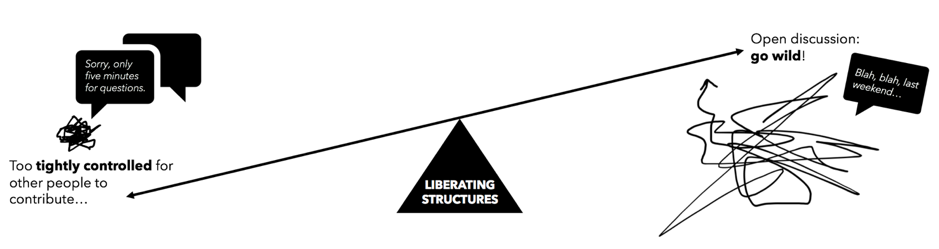
Through Liberating Structures you learn to be in command, not in control.
Instead, control is distributed — you transform into a fulcrum, balancing the engagement to leave room for growth, new connections, diverse voices, and intrinsic motivation (see graphic below). The best part is, although they may sound daunting, they are intentionally designed to be easy-to-use by almost anyone, regardless of experience.
The engagement and how people feel afterwards speaks for itself. Without sharing the purpose, principles or use of Liberating Structures in a recent engagement with public officials they said it: “gives everyone an opportunity to contribute more easily” and that they “really liked how it gave everyone an equal voice” Others said they “enjoyed hearing where others were at with their experience” and that the process felt like “capturing innovation in real-time”. One participant said it delivered “the closest thing I have had to a real virtual meeting”.
Now what: what value does this create and why does it matter?
The best way to really understand “why” and ”how” you should use Liberating Structures is by experiencing them. In the next article, Scott Seaward, a UK public servant, explains how he uses two of the most popular Structures and gives a few tips to help you get started.
Spoiler: you just experienced What, So What, Now What — What (facts/data), So What (analysis/interpretations/meaning), Now What (actions, takeaways).
Just throw yourself into the arena — riff, remix and string together Structures as you see fit.
First, try them out in safe spaces, such as internally at team meetings or with critical friends, before implementing them in a higher-stakes situation or with larger numbers. Just trust that there is something chaotic about the process. You may feel like it’s not working or going well, but don’t worry, we’ve all been there.
Let the Structure liberate you and go with the flow. If you get stuck or are unsure how to get your colleagues to try something new, please reach out. There's a growing number of people familiar with Liberating Structures, so get plugged-in via Twitter, join a user group (the UK user group hosts monthly virtual meetups with global participants), add yourself to the Slack channel, or, if you prefer to explore alone first, you can download the free app or order the book.
Seriously, we don’t bite and are extremely supportive, often practising together and generously sharing our time and experience.
Thank you to everyone who contributed their thoughts, input and ideas to this piece:
- David Heath, Lead Developer at the UK’s Government Digital Service (GDS)
- Leah Lockhart, freelance designer and co-ordinator of the Scottish node of the Design Justice Network
- Dan Harley, Quality Improvement and Evaluation Manager, NHS Scotland
- Karen Bradley, the Strategy Unit, NHS Midlands and Lancashire
We want to hear what you think about this article. Pitch an article to us or send your comments to hello@apolitical.co
(Picture credit: Unsplash)
Make sure to share your own thoughts with the author by leaving a comment below

Log in or sign up to continue the conversation