
This article is written by Syed Imaad, a Harvard Kennedy School and MIT graduate and former mayoral fellow at City of Chicago, and Dr. Mohammad Nizamuddin, former chairperson at Punjab Higher Education Commission, and founding vice chancellor at University of Gujrat
Doubtless this past year has led public servants like you to think about the state of public services before Covid-19, and how they have fared since.
- Want to write for us? Take a look at Apolitical’s guide for contributors
One public service to have noticeably struggled worldwide throughout this period is publicly-funded education. But public universities in Pakistan, which we focus on in this article, were facing financial difficulties well before the pandemic. Now, in order to address their budget shortfalls, these institutions are having to cut salaries and staff pensions.
Based on our experience in higher education policy and administration, we suggest how public universities in Pakistan can preserve and generate revenue with the aim of securing long-term financial sustainability.
Our analysis may be of use to public servants and higher education administrators in other countries, particularly given the financial health of higher education institutions elsewhere in the world.
Payment defaults and funding cuts
In 2019, three public universities in Khyber Pakhtunkhwa (one of the four provinces of Pakistan) could not pay salaries and pensions to their staff for the month of July. That same year, four public universities in another province, Sindh, obtained loans from private banks to manage salaries and other operating expenses.
In Punjab, Pakistan's most populous province, one public university was forced to impose cuts on salaries and pensions for the month of June 2020.
These cases have a common thread — cuts in grants from the federal government (grants in other words given to the Higher Education Commission), and provincial governments. The federal government had given the commission a grant that was 10% lower than the previous fiscal year, and this year’s grant increase is 8% lower than expected.
These grants make up a large share for public universities’ revenue, over a third of total revenues for many universities (Figure 1). How then can these universities, and others like them, manage their budgets?
While universities differ in overall revenue and expenditure, the constituent mix of these for each university suggests possible overlapping financial weak points. We looked at eight public universities in Pakistan, for which fiscal year statements for 2017 to 2018 were publicly available.
Revenues
Recurring university revenues can be split into two categories – ‘government funds’ and ‘own-source revenues’. Government funds primarily come from the federal government through the Higher Education Commission, while own-source revenues typically include tuition, fees, investment income, concessions, and services.
Governments and public universities both have an incentive to ensure financial sustainability of publicly-funded education
As Figure 1 shows, there is quite a wide variation in the share of government funds in total university revenue, ranging from 14% to 58% for the subset of universities considered. Clearly, some universities are significantly more dependent on government funding than others, and hence financially more vulnerable.
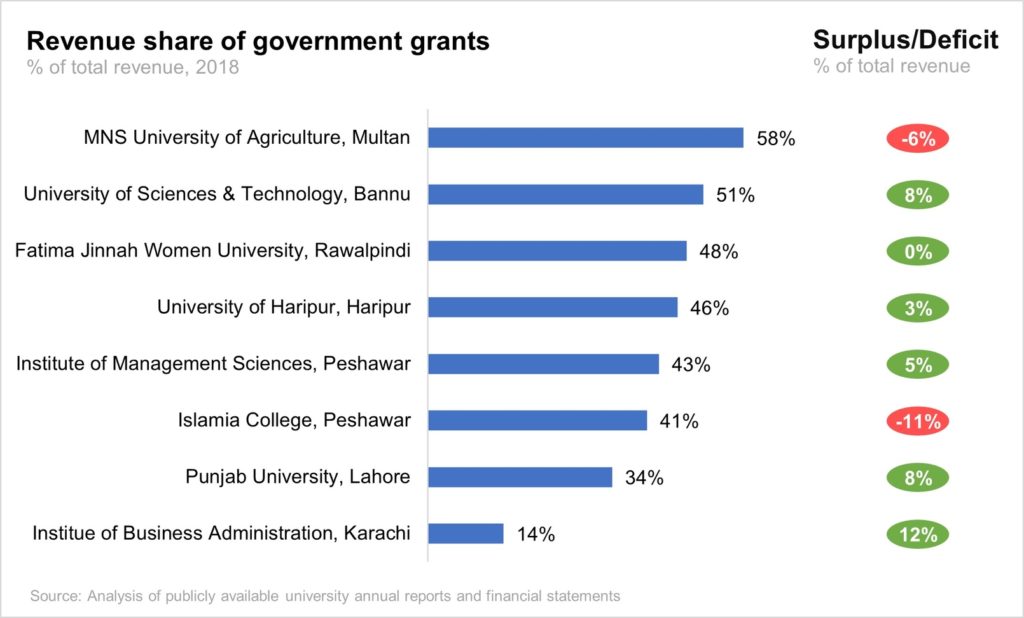
Figure 1: Public universities vary significantly in terms of their revenue mix.
Expenditures
Salaries and allowances of public universities comprise their largest operational expense, in many cases more than half of a university’s total operational expenditure. Pensions are another major expense, as well as utilities, maintenance, scholarships, and research.
Universities classify expenditure categories differently, making direct comparisons difficult. However, a deep dive into available data on the expenditure mix over time for one university raises an important concern: escalating pension expenses (Figure 2). Other public universities most likely face a similar challenge. If pension expenses are not managed, their growing share of overall expenditures will inevitably place pressure on a university’s budget. University leadership should therefore make plans to manage future pension liabilities.
Surplus/deficit
Universities with lower share of government funds in total revenue may be more likely to generate an operating surplus, though more data is needed to test this hypothesis. While occasional deficits are generally not a cause for concern, persistent deficits are. Universities manage occasional deficits by drawing down on existing funds or seeking loans. Universities that rely on government funds are currently taking an immense risk, especially where funds consistently fall short of budgeted amounts.
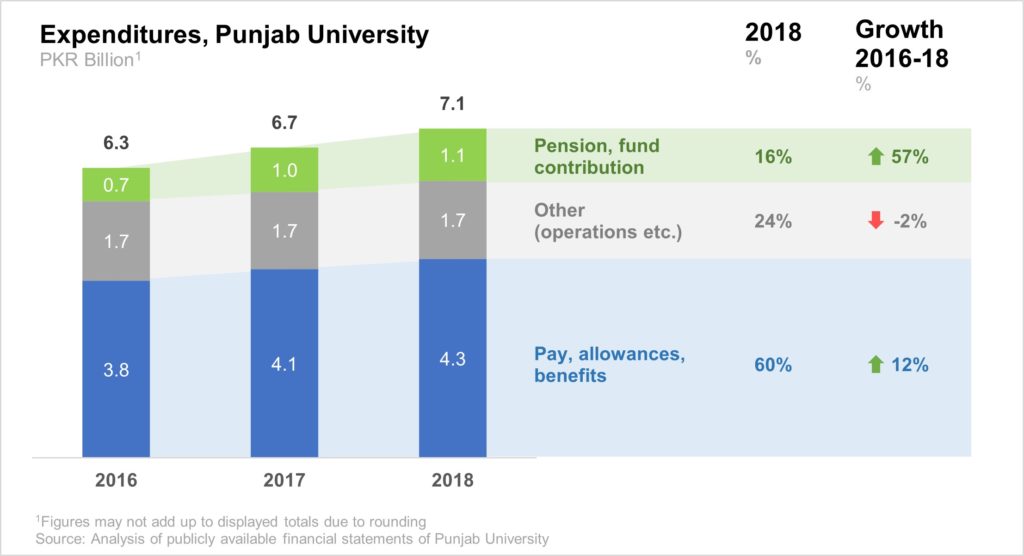
Figure 2: Pension is among the fastest growing expenses for Punjab University and, most likely, for many other public universities.
What we’ve tried to show above is that an analysis of revenues and expenditures is imperative for higher education officials to identify financial vulnerabilities and to spur stakeholders, including the government, into action.
Towards financial sustainability
Higher education authorities and university leaders should consider the following three areas in charting a path towards financial sustainability for public universities in Pakistan. This advice in particular might help public servants in other countries who are considering how to manage budgets for their own public higher education institutions and other services.
Analysis and benchmarks
We suggest conducting comprehensive analysis of revenues and expenditures at public universities including what those expenditures are made up of, what past trends of expenditure are, and how these are set to run going forward. Second, we suggest that leaders of public universities benchmark the financial performance of their institutions against financially more resilient ones. This will allow these financially less secure public universities to understand their relative financial performance and to identify best practices from peer institutions.
Measures and evaluation
We suggest leaders use this analysis to decide measures for increasing revenues and managing expenditures, while evaluating their feasibility for individual universities. Potential revenue generators include new programmes, such as those which train and educate prospective business leaders and functional managers.
Public universities can turn adversity into opportunity by adopting bold measures to improve their financial health, especially where fiscally tight governments may be open to supporting such action
Others might include revising tuition levels, or looking into asset monetisation, such as using land owned by the university for alternative uses such as conference centres and technology hubs. Yet more possible avenues include professionally-managed endowment funds and dedicated fundraising campaigns through alumni, philanthropists or industry.
Managing expenditures meanwhile could mean reducing operating costs through efficient use of resources and professionally-managed funded pension plans.
Governance and oversight
Finally, we suggest leadership considers reconstituting university boards and syndicates to include financial management and fundraising experts. This, as well as efforts to strengthen institutional linkages with alumni, industry and foundations, could secure greater financial stability for the duration of the pandemic and beyond.
Governments and public universities both have an incentive to ensure financial sustainability of publicly-funded education. After all, governments cannot just let public universities go out of business while university leaders are responsible for their institutions.
Public universities can turn adversity into opportunity by adopting bold measures to improve their financial health, especially where fiscally tight governments may be open to supporting such action.
The approach proposed in this article may help public servants and higher education administrators shape a strategy that can inspire such action, and ensure the financial sustainability of public universities well into the future. – Syed Imaad and Dr. Mohammad Nizamuddin
We want to hear what you think about this article. Pitch an article to us or send your comments to hello@apolitical.co
(Picture credit: Unsplash)
Make sure to share your own thoughts with the author by leaving a comment below

Log in or sign up to continue the conversation