
This opinion piece was written by Siobhán McKenna, a Senior Policy Officer in the Greater London Authority's Communities & Social Policy Unit. It can also be found in our gender equality newsfeed.
London is one of the most diverse and inclusive cities in the world. Despite this, gender inequality remains an issue in the capital — particularly in the workplace. Women in London are paid less than men and face unacceptable barriers to career progression, especially in reaching the most senior roles within organisations across the capital.
The gender pay gap in London is the largest in the country with an average woman working full time earning 14.6% less an hour than the average man working full time. Between 1997 and 2017, this gender pay gap only narrowed by 0.5%. At this rate it will take over 500 years to close the gender pay gap in London.
This workplace inequality exists across the city’s public and private sectors and civil society. Less than a third of all MPs are women, and female councillors and female third-sector board chairs also find themselves in a clear minority. In business, there are only seven female FTSE CEOs in the whole of the UK, and less than a quarter of boardroom roles are held by women.
The playing field between men and women in the workplace has to be levelled, women need to be able to access the same opportunities that men have been able to. Traditional approaches, such as mentoring schemes, whilst valuable and widely used, are not working fast enough to help women into senior positions.
Last month, as part of the #BehindEveryGreatCity campaign on gender equality, the mayor launched a new program to tackle this problem.
https://www.youtube.com/watch?v=byq-EH9cR00
The "Our Time — Supporting Future Leaders" initiative, the flagship policy of the year-long campaign, is a more structured, pro-active approach to getting women into senior leadership posts across city hall and the wider Greater London Authority (GLA). The recently identified 6% gender pay gap in city hall ain’t going to close itself, nor is the 16% ethnicity pay gap, if you are a woman of colour.
The program will support women in the middle tier of city hall’s civil service by pairing them formally with senior sponsors to help them access opportunities, networks and the skills necessary to lead.
The impact of this type of sponsorship support is measurable. Research indicates that when senior staff members get behind female employees in this way, it increases the share of female employees who ask their manager for a stretch assignment (from 36% to 44%).
When it comes to asking for a pay raise, the majority of men (67%) and women (70%) resist confronting their boss. With a senior staff member in their corner, however, nearly half of men and 38% of women negotiate. Whilst similar formal pairing schemes can be found in some large private sector organisations, these are not commonplace, especially across the public sector and civil society in the UK.
The initiative is flexible, and it can be adapted depending on the different issues organisations within the GLA have related to women’s progression. To help other London organisations in all sectors to adopt the initiative, we will be publishing a set of formal tools, guidance and learning materials. A methodology for baselining and measuring delivery will be built into the toolkit to help assess the value of the investment of time.
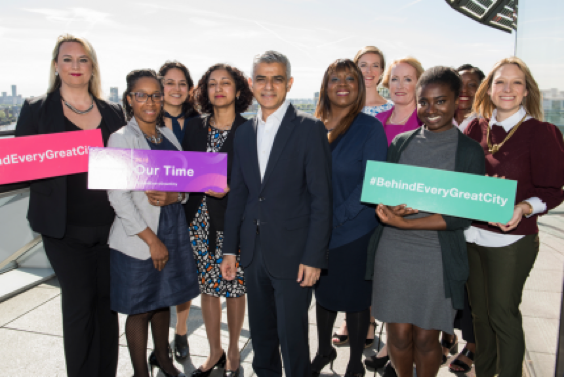 London's mayor with employees taking part in the program
The progression of women in London’s workplaces is a city-wide issue and needs city-wide action. The mayor is calling on London’s businesses and organisations to join him in tackling gender inequality in the workplace so that we can help make our capital one of equality, opportunity and progress.
The policy is a key part of the mayor’s wider, year-long campaign across London to address gender inequality in various guises through a wide variety of initiatives.
These include the unveiling of the statue of suffragist Millicent Fawcett in Parliament Square, at the heart of British government. It's the first statue of a woman in that public space and a permanent reminder that the fight for gender equality is not yet won.
For the first time, Art on the Underground, Transport for London’s public art program, has commissioned a year of work exclusively by women artists to celebrate the centenary.
And in a recent effort to challenge gender inequality online, the #BehindEveryGreatCity campaign joined forces with Wikipedia to host an ‘Edit-a-thon’ with schoolgirls and women in the tech sector to create a surge of new pages about women online. Some 83% of Wikipedia biographies are about men and 85% of page editors are men.
"The mayor is a proud feminist"
The mayor is a proud feminist and it has been an inspiring campaign — in a year when there has not been that much to be inspired by — which turns words into deeds and leads by example to ensure that the workforce of London’s regional government reflects the diversity of the people it serves.
Just the small matter of delivering that change now .... — Siobhán McKenna
(Picture credit: Flickr/User:Colin)
Make sure to share your own thoughts with the author by leaving a comment below

Log in or sign up to continue the conversation