
This article is written by Ian Smith, strategic designer for Child Friendly Edmonton.
Here is a challenge for you: imagine you are an architect or a contractor constructing a new building in your city. If you failed to consider the needs of children, what could some of the implications be? While you are mulling that over, here’s an additional question: what should a city in 2020 or 2050 look like to be safe, playful, connected and ultimately livable for an urban childhood?
If you want the answer to the first question, in all likelihood you simply have to look around. Most cities today have not been built with children in mind but we have the ability to change that.
- Want to write for us? Take a look at Apolitical’s guide for contributors
We shouldn't be trying to design the perfect city for children. Instead, children should be meaningfully participating in creating better cities for themselves, and for the rest of us, too. Now, I bet you're a bit sceptical about this idea. And honestly, you should be, it’s a new way of thinking about city building and there is much more to it.
Childish ideas
Whenever the idea of involving children in city building is suggested there are numerous objections.
How could children possibly understand complex and difficult ideas such as the affordable housing crisis or how to develop a transportation master plan? What do they know about mass public transportation or prioritizing density housing solutions? And even if they had ideas, wouldn't they be childish? Or impossible to implement? Do our cities really need a park made out of foam pits, or zip lines, or free transit (well actually that last one can be debated)? These concerns are very real and legitimate.
But while these questions shouldn’t be swept under the rug, I have found on many occasions that not including children in civic issues is a bigger design problem. It’s not about just designing parks, it’s about the values we exhibit in our collective city building efforts.
After all, shouldn't we include end users and respect children's ideas and try to entice them to continue living and contributing in our cities? If we're building a park to be largely used by kids, then kids should have a say in the park's design. Or a mental health campaign, or policy on child care, or safety on transit or public washrooms, the list goes on.
When kids dream up a space, they very often include fun, playfulness and activities in their designs. This is not how adults tend to prioritize public spaces
At Child Friendly Edmonton we facilitate and work with children to come up with innovative city-design solutions. Since 2006, Child Friendly Edmonton has been cheerfully obsessed with educating Edmontonians about this opportunity. We’ve sparked meaningful projects and rallied experts and volunteers around the galvanizing idea of child friendliness.
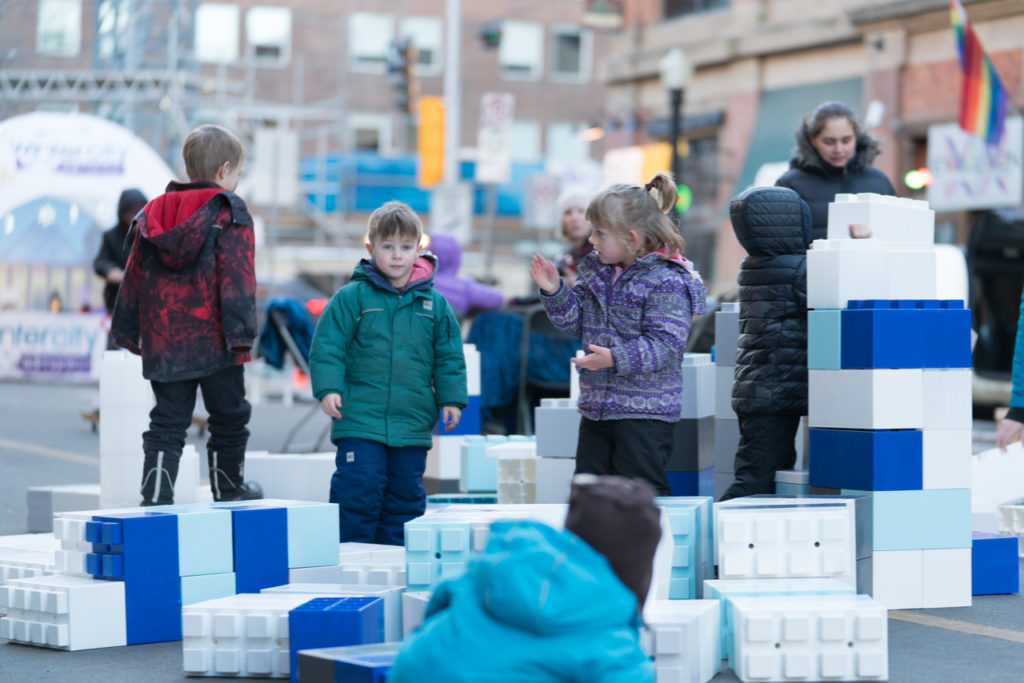 Winter Play Street 2018, Edmonton
For instance, as part of our consultation for Edmonton’s draft City Plan, we facilitated a process that included feedback from more than 1600 children. Later, we gathered that feedback into a comic book for children (also enjoyed by adults) that captured their thoughts about our future city. In Edmonton, we try to think of people of all ages and circumstances before we put another shovel in the ground, or sign off on another strategy. But too often, outside those laughter-filled rooms in our homes and schools, the city feels dismissive of our smallest citizens.
We’re one of the youngest cities in North American, but to 150,000 of our young citizens, Edmonton can still feel out of scale, out of reach, out of touch.
Adults think about constraints, children about opportunities
When we talk about letting children help design the city, a common question is whether the ideas are always implemented? Of course not. Democracy and decision making is a messy process. Does every well-informed adult citizen expect all of their ideas to be heard? Yes. But do they also expect everything to be implemented? Not always. Guess what, a nine-year-old doesn't either.
However, children do come up with some realistic ideas, like a fully electric transit bus fleet, no fees for recreation and leisure centres, anti-bullying measures or adventure playgrounds in every neighbourhood. Also, just because something isn’t immediately feasible, it doesn’t mean it should be dismissed. We need to seriously consider and use these ideas as visioning and concepts for the type of city we want to create.
Children have an inclusive mindset in their city planning
When it comes to city building, children think differently than adults, and that's a huge value that is often underappreciated. Adults think about potential constraints and risks. When kids dream up a space, they very often include fun, playfulness and activities in their designs. This is not how adults tend to prioritize public spaces. But research shows that fun, play and movement are exactly what adults (and everyone) need to stay healthy.
Overall, children have an inclusive mindset in their city planning. Without even being aware of it, it just happens. They design for everyone, from their elderly friend with a walker, to their multicultural friend who is struggling to learn English, to the marginalized individual they see resting at the transit stop. Children design for people not for cars, politicians, special interest groups, egos or corporations. The last and perhaps most compelling discovery I have made is that a city which is friendly to children is a city friendly to all. As Mayor Enrique Peñalosa of Bogotá, Colombia, has famously said, “children are a kind of indicator species. If we can build a successful city for children, we will have a successful city for all people.”
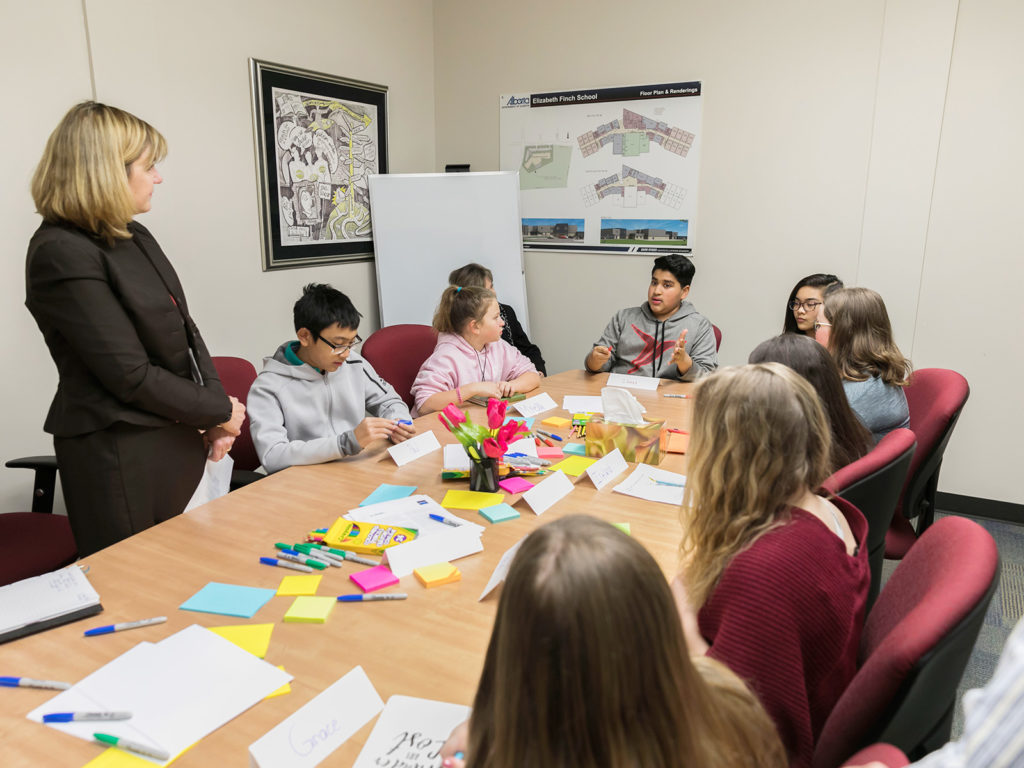 Grade 5 students participating in a Vision 2050 engagement session
I believe that statement reveals something important, something, that has for long been a blind spot. If we aren't including children in our planning, who else aren't we including in the process? We can't possibly know the needs and wants of other people without asking. That goes for kids too.
So, adults, let's stop thinking of our children as future citizens, and instead start valuing them for the citizens and leaders they are right now. Go and read the “Sixth Grade Science and the City of Tomorrow”, and see if any of the ideas in there are too far fetched? Our children are designing the cities that will make all of us happier and healthier and our city more sustainable. Children are designing the cities we all want to live in.
The goal is a generation of Edmonton children who don’t have to wait until they’re 18 to really feel a part of the city. They’ll feel connected, invested, engaged in a place that feels joyful and optimistic. A place designed for them. — Ian Smith
(Picture credit: Child Friendly Edmonton)
Make sure to share your own thoughts with the author by leaving a comment below

Log in or sign up to continue the conversation