
This article is written by Josh Solinger, operations data analyst, Pierce County, Wisconsin.
While working on a new system for prioritising vehicle replacements, I discovered a way to integrate staff welfare and community values into robust data-driven decision-making. Then I used this data to create change.
People are the most important resource within local government organisations. Investing in well-trained and well-equipped staff should be the highest priority for government spending. When staff have access to high-quality equipment, we optimise the organisation’s potential to provide the best services, and we also keep staff morale high.
• Want to write for us? Take a look at Apolitical’s guide for contributors
Most small equipment falls under the thresholds many public sector organisations consider to be capital expenditures. Such equipment can be paid for and absorbed into the operating budget with relative ease. But vehicles do qualify as capital expenditure. And that means that purchasing managers need to plan carefully to ensure that staff have high-quality equipment and that taxpayer money is used in the most efficient manner possible.
Many local government organisations, particularly those that serve small communities, prioritise vehicle replacements based solely on the age of each vehicle. Aging vehicles do generally have higher maintenance costs. But it’s possible for older vehicles to cost less to maintain than newer vehicles. Other factors also come into purchasing decisions. For example, in response to climate change, many communities have goals to reduce the use of fossil fuels.
Saving money on vehicle replacements
Recently, I worked with the City of Eau Claire, Wisconsin. The Streets/Fleet Manager in the city government was interested in exploring new ways to prioritise vehicle replacements. We started with a model used by the Village of Bellevue, Wisconsin, but customised it for our organisation and to match our community’s priorities.
At the time, the City was working on its 2020-2024 Capital Improvements Plan (CIP). It operates a large fleet, and the total cost of replacing vehicles in the CIP was budgeted at US$9,246,000. We created a composite scoring system and applied it to the fleet, and we demonstrated a five-year total replacement cost of US$7,895,000. The annual cost reduction ranged from US$223,000 to US$304,000.
Now, imagine you wanted to do the same for your organisation. To start, let’s say you have 10 vehicles in your fleet, and your current model for prioritising replacements relies only on the age of each vehicle. In this case, you replace vehicles when their age reaches the same number of years as their useful life. Table 1 illustrates what this model might look like.
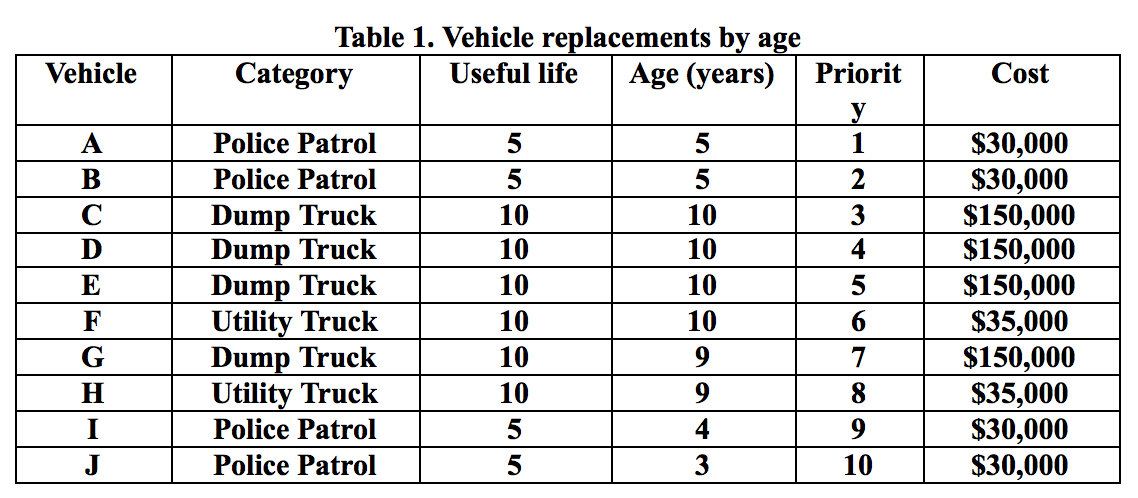
If every vehicle that reaches the end of what we determine to be its useful life is replaced, the organisation will incur a cost of US$545,000. In addition, three vehicles will be due for replacement next year, totalling US$215,000. What does this schedule look like when additional variables are included?
Bringing your community’s priorities into the decision
To account for your community’s priorities in this decision, you must first create a list of variables.
If your organisation has a strategic plan or a mission statement, those may inform some of your variables. For this example, we will use the following five:
- Age
- Miles or engine hours
- Life-to-date maintenance costs (% of replacement cost)
- Physical condition
- Fuel economy (miles per gallon)
Because age was already discussed as a variable, we’ll move on to the others. Mileage or engine hours are an indicator of the quantity of usage, and how the vehicle is used will determine if you want to base your score on mileage or hours. Some vehicles, such as police squad cars, idle frequently. Thus, engine hours are a more useful indicator of usage than mileage.
Bringing your processes to the next level means engaging with staff and understanding community priorities.
The life-to-date maintenance costs of each vehicle are a good indicator to help us understand when vehicles are becoming too costly to maintain. How you determine when this stage has been reached will depend on your organisation. When I’ve worked with this model, a vehicle is considered “overly costly” when the maintenance costs it’s incurred so far reach 30% of the purchase price.
If your organisation employs mechanics, asking them to note the physical condition of each vehicle they observe during routine care should be straightforward. If you outsource maintenance, this activity could be incorporated into the scope of services you request your vendor to perform. Like any variable, this can be as simple or complex as you want. For ease of illustration, we will use “like new”, “acceptable”, and “deteriorated” as the three options for scoring this variable.
If environmental sustainability is a priority for your organisation or community, add fuel economy into your composite score. Your enterprise resource planning (ERP) platform may give you the data needed to calculate how many miles per gallon a vehicle achieves for a specified period. Alternatively, keeping a fuel log in each vehicle that includes the current mileage and quantity of fuel needed each time it’s refueled allows you to determine the gas mileage. You can also create a simple score for “acceptable” or “not acceptable” based on the professional judgment of your mechanics.
Now that you have developed some variables for the composite score, it’s time to assign a range of possible scores for each variable. To do this, you first need to consider the relative importance of each variable to your organisation. The more important the variable is in the context of your organisation’s values, the higher the possible score you’ll want to give it. In addition, each category of vehicle will have a different range for each variable, but the same total amount of points available for the score.
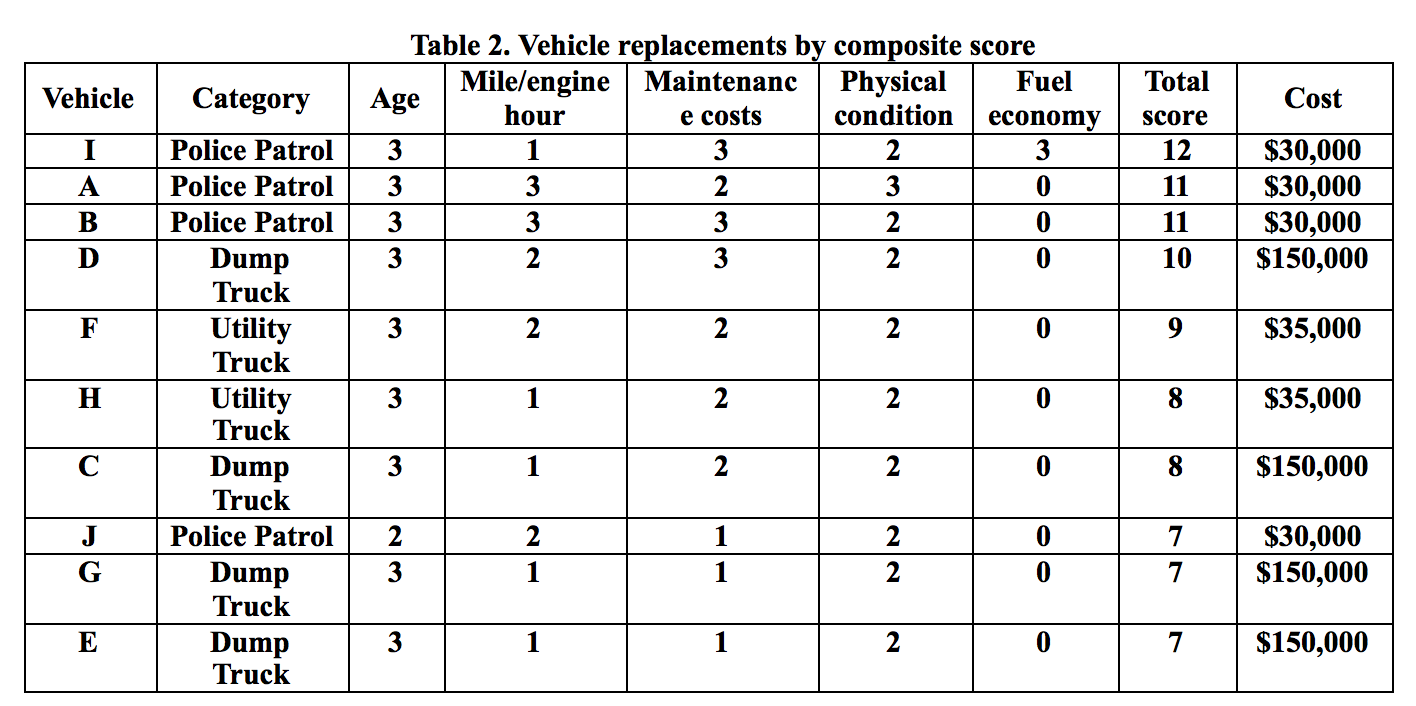
The result of your composite system may look something like Table 2. After you’ve created variables, assigned a range of possible scores, and then scored your vehicles, you can sort the vehicles by score to prioritise replacements. In this case, vehicles with the highest scores should be replaced first. If vehicles with a score of 10 or higher are replaced now, the total cost of replacements is US$240,000, or US$305,000 less than the total cost of replacements in Table 1. Most importantly, your priorities now reflect your community’s values.
How to use data to create change
You now have a new way of prioritising vehicle replacements, which may produce a huge cost reduction compared to prioritising replacements based only on age. However, the hardest work is arguably still ahead: convincing your vehicle operators of the need for change.
The important thing to remind staff of is that a composite scoring system does not mean sacrificing the quality of the vehicles. In fact, it can be exactly the opposite. By giving staff more control over a composite scoring system, they’ll take into account factors other than age, such as condition, fuel economy, and maintenance costs. Vehicles will be replaced when the composite system indicates they’re ready, and, in the meantime, they’ll be in good working order.
Staff will have more ownership over the process, which will keep them happy. And your elected officials will appreciate the fiscal benefits that come with a composite scoring system. The challenge we faced in Eau Claire was that costs for the City’s fleet outpaced funding sources. A dedicated fund was used to finance costs of vehicle maintenance and replacements, and that fund was losing cash every year, and would soon run out of cash completely.
Fortunately, the cost reduction we projected from adopting the new system would put the fiscal health of the City’s vehicle fund on a new trajectory. It will no longer be in danger of running out of cash, and its fund balance will be stable for the foreseeable future. As the fund’s health improves over time, the City will be able to consider additions to the fleet, additions to fleet-related staffing, or investing in new technologies that will advance the community’s priorities, such as fuel efficiency.
A data-driven process helps optimise fleets and promote good fiscal sustainability. However, whole data-driven decision-making should be employed as frequently as possible, it’s just the start. Bringing your processes to the next level means engaging with staff and understanding community priorities. If you do this, your outcomes will be framed by community values. You’ll be more effective because staff agree with you, and more efficient because you’ve followed the data to make objective judgements. With good data, good staff morale, and good community stewardship, your organisation will achieve great things. — Josh Solinger
We want to hear what you think about this article. Pitch an article to us or send your comments to hello@apolitical.co
(Picture Credit: Pexels)
Make sure to share your own thoughts with the author by leaving a comment below

Log in or sign up to continue the conversation