
This article is written by Shannon McHarg, innovation specialist, US Department of the Interior’s Office of Natural Resources Revenue. This article was shortlisted in Apolitical's 2020 American Public Servant Writing Competition.
How do you bring digital talent into the government when hiring restrictions make it challenging? You train people you already have.
I work for the US Department of the Interior’s Office of Natural Resources Revenue (ONRR) as an innovation specialist focused on user experience for an open data website. On this website you can see how the US government manages energy and mineral resources, revenue and disbursements from federal lands and waters.
- Want to write for us? Take a look at Apolitical’s guide for contributors
The website is used by journalists and academics who tell stories using our data and public servants at the federal, state and county levels, who use the data to understand and answer questions about the domains of which they’re in charge. Our website was started by 18F, a digital consultancy within the US General Services Administration, who were the first to bring user-centred design skills to our agency.
Getting started
When it was time for their team to roll off the website, our agency wanted to hire people with similar skills to continue working on the website. However, hiring permanent government employees can be challenging as there are several roadblocks.
These include the difficulty of attracting people with the right digital skills because of a cumbersome application process and resumé requirements, pay that isn’t always competitive with the private sector, human resources departments gatekeeping applications based on stated qualifications that they might not know much about, reviews required for technical positions, and telework policies for permanent employees.
To get around these roadblocks, our agency hired a team of three term-limited innovation specialists focusing on content strategy, development, and user experience.
Our experience shows how much can be done with a creative approach
In addition to the term-limited innovation specialists, our team has four career government employees — a product manager and three program analysts who are subject matter experts in the site’s data and have backgrounds in economics and financial management. To ensure that the site can live on after the innovation specialists term out in four years, we’re training the career employees on the team to do some of the digital tasks.
User research seemed like a natural fit for our first foray into training the program analysts. It’s foundational to the user-centred design processes that are necessary for the site to be useful in the long-term, well suited for people already trained in analysis, the program analysts had already been participating in studies by taking notes, and two of them wanted to pick up the skill. We also thought we could spread digital literacy further in the organisation by increasing user research capacity because other teams in our agency had expressed interest.
Teaching our user research process
Prior to beginning training, I documented our usability testing process and the program analysts read A Practical Guide to Usability Testing by Joseph S. Dumas and Janice (Ginny) Redish to learn the nitty-gritty skills involved.
The analysts were already familiar with some pieces of the process, but I elaborated on the details, including recruiting participants, preparing for interviews, and analysing findings. After teaching the process, we decided that the best way for the analysts to learn was by doing and conducting a mock study themselves.
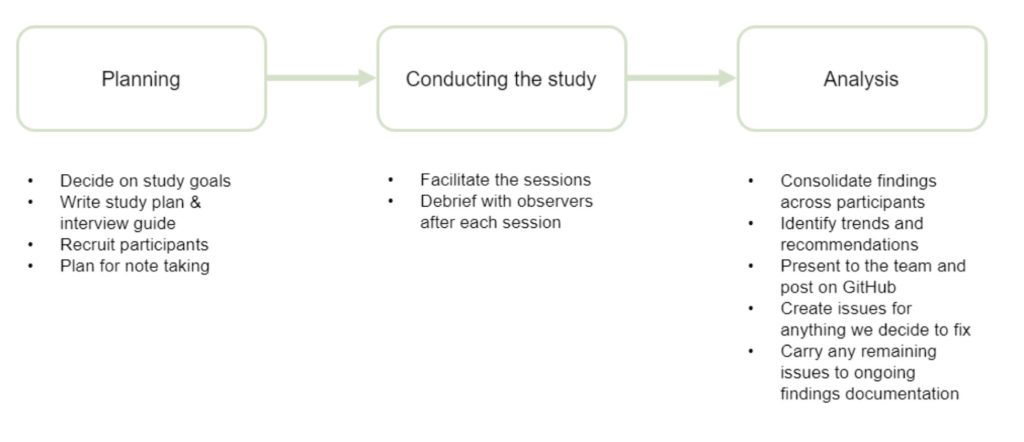 Figure 1: Our user research process
Planning the mock study
Using the documented process, the analysts each put together a study plan to test a prototype for a new design we hadn’t yet tested with users. They both presented their plans for feedback and then we combined the best parts of both to create the version they used for the mock interviews.
The analysts then created a study guide for the user interviews and practised interviewing each other. I recruited colleagues to serve as our users and asked them to role-play people who fit into our typical user types to give the analysts experience dealing with different users and scenarios. I also had participants role-play common technical issues, so the analysts could get experience troubleshooting.
Conducting the study
Our team is mainly remote, so we conducted the interviews over Google Hangouts. One analyst conducted each session and the other one took notes, so both were there for all of the sessions. The analysts and I conducted a debrief following each interview to make sure everything was captured, and I provided feedback on facilitation.
Analysing the findings
After completing the interviews, the analysts consolidated findings using a template we use for all our studies, identified trends across participants and made recommendations for mitigating the issues. They also distilled the findings into a findings summary to share with the team. I provided feedback throughout this process.
Lessons learned
Our experience shows how much can be done with a creative approach. What’s more, this has also been an opportunity for our team to grow. Training the program analysts has fostered team engagement and empathy for users by involving more of the team in the details.
Maroya Faied, a program analyst who participated, said: “Learning usability testing was both fascinating and eye-opening. The experience of conducting an interview and analysing the results stimulated my interest to approach future projects by observing problems and finding solutions by considering different perspectives.”
We now have standardised, documented processes that are being repeated by multiple people. Increasing our capacity for user research is also enabling us to build bridges with other teams in our agency who are interested in user-centred design.
If you find yourself unable to hire tech talent in your agency, think about opportunities to train the people you have. You may just get more out of it than you expect. — Shannon McHarg
(Picture Credit: Death to the stock photo)
Make sure to share your own thoughts with the author by leaving a comment below

Log in or sign up to continue the conversation