
 This article was written by Jordana Globerman, Design Thinking and Innovation Advisor at the Innovation Lab, Canada. The views expressed in this article are the author’s own and does not necessarily reflect the opinions of the ESDC innovation lab.
This article is part of the 'Build your leadership skills in the public service' boot camp. Sign up here.
Where does collaboration come from?
Does it develop from certain skillsets or is it a phenomenon that emerges from the right organisational design? Most of us think of certain structures as more collaborative than others. We picture the foosball-tabled startup as primed for team work, and the stuffy hierarchy, often a stereotype of the public sector, as bogged down by silos.
• Want to write for us? Take a look at Apolitical’s guide for contributors
This is not the case in the real world. Strong leadership within a hierarchy can enable collaboration, while a “flat” organisation can be full of territorial individuals.
Based on my experience of working with both private and public sector organisations to foster collaborative problem-solving, I would instead argue that collaboration is a mindset. Any organisation can foster collaboration, regardless of the skills of its people or the industry in which it operates, as long as the culture inspires people to think openly.
In this article, I will describe three enablers of a collaborative approach. These enablers aren’t public sector-specific because collaboration can happen in any sector, and I’ve seen them work across sectors.
Ego-loss: Let yourself go
Our egos play a big role in our work.
We each have a way of doing things. We trust that way and feel safe within its confines. We want credit for our work and we want to be seen as experts in our area of focus. This drive for control and credit is a powerful motivator. From a more positive perspective, we may refer to it as autonomy and recognition.
Work without autonomy and recognition is rarely satisfying, but we do not need to work alone to have decision-making power or to receive credit for achievement. There is a myth, especially in more individualistic cultures, that value must be attributed to an individual, rather than to a collective. A workplace that enables collaboration destroys this myth. It assures leadership and employees that their agency and value is stronger when combined.
Openness is key to diluting the egos of a workplace
Our egos are, to a certain degree, innate. As children, we run around seeking attention, get gold stars for crayon masterpieces, and are praised or chastised based on what we produce. This amplifies our egos; it teaches us that our individual worth can be gauged in relation to the worth of others.
This egoism can be untaught. Leaders can measure the collective efforts of groups rather than focus on the output of individual employees. They can encourage open conversation so peers feel safe sharing their struggles, in order to better learn from one another.
Learning from geese
Nature is replete with models of egoless leadership.
Geese manage to fly great distances together, and they manage this by rotating leadership roles. Everyone gets the chance to lead, which in turn, gives everyone a break (important when you are several hundred feet up in the air).
Workplaces can rotate leadership as well. I currently work in a place where we rotate leadership for projects. This allows everyone to improve their leadership skills and detaches ego from the role of leader by proving anyone can do it.
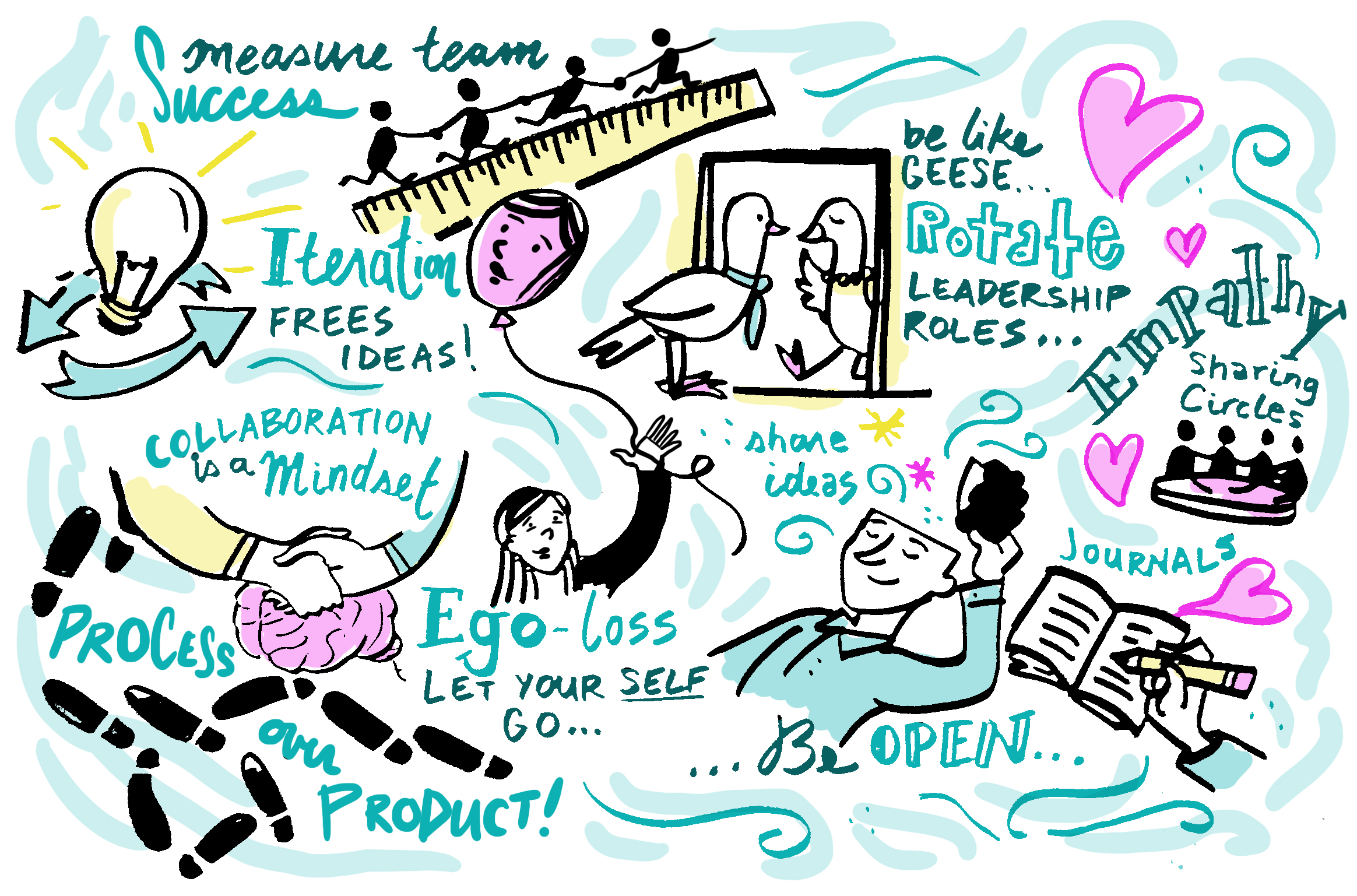
(picture credit: Jordana Globerman)
Openness is key to diluting the egos of a workplace. Openness is a relinquishment of control through which we give ideas away and don’t fear losing credit for them. Openness also allows us to take criticism without attaching it to our self-worth. and approach new opinions and ways of working without fear that we will be unable to grasp them.
An open workplace counters an ego-driven workforce.
An open workplace can be established at a peer-to-peer level, by practices that encourage sharing and self-awareness. These practices might include appreciative inquiry, journaling activities and empathic sharing circles. Leaders can teach openness by example. The more bosses keep hidden from their employees, the less employees feel trusted.
When trust isn’t established at this higher level, it is very hard for it to emerge within the team. Instead, everyone wants to ensure their personal success and lives in uncertainty of how they are perceived by their leadership and by each other. Thus, collaboration cannot be established.
Incentive: make it worth it
Appealing to self-interest may seem counter to an approach that eschews ego, but these two points are not mutually exclusive.
It is possible to open yourself to working with others because of the benefit this collaboration might bring. For example, someone who is social might find it easy to “check their ego at the door”, if it means they won’t have to work alone. We might seek out partnerships with those who have skills that we lack because such a partnership ensures a better final product. The benefits of collaboration can encourage us to abandon the parts of our ego that are detrimental to effective teamwork.
However, the benefits of collaboration are not always evident and, in those cases, it’s up to leadership to make the incentives of teamwork clear. The simplest way of doing this is to let staff know their performance evaluations will consider their ability to work with others. That said, fear is a superficial motivator. It’s more effective to demonstrate the positive effect teamwork will have on a final product. Leaders and teams can demonstrate the improvements incurred from collaboration by setting metrics for process and product.
A creative design process doesn’t allow groups to stop at their first idea
For example, an organisation might measure the success of a product, the speed and effectiveness with which a team navigates “stuck points”, the number of breakthroughs, and the enjoyment or fulfilment of the team in working through the project. These measurements can be used to compare solo work to team projects, demonstrating the benefits of the latter. Once team members see how collaboration helps them to more effectively generate ideas and navigate challenges, they will be encouraged to work together and expand the parameters of their teams.
If they have achieved more together than alone, they might be encouraged to further broaden their knowledge and expertise by expanding their collective beyond the parameters of their organisation.
We are surrounded with precedents for the incentives of collaboration. Take trade for example; without strategies for working together beyond the confines of our immediate group (in this case a nation) our resources would be limited and our pleasure significantly diminished. Is life without chocolate really worth living?
Process: from relay race to design
Process can be used to encourage collaboration.
Certain processes are not conducive to collaboration, such as an assembly line, in which consistency and role delineation are key success factors. A design process can enable collaboration. In a design process skillsets come together to create and iteration becomes priority.
Artists have long understood the importance of process over product. The Fluxus artists of the 20th century provide a good model for process-enabled teamwork. To them, the process of creating art was more important than the art itself. They formed multi-disciplinary teams to explore the concept of creation.
A creative design process doesn’t allow groups to stop at their first idea. Instead, it encourages redoing, retrying and continuous improvement. Many versions of an idea are tested and revised, which diminishes team-members’ attachment to their own ideas. Groups see how their combined efforts improve products from version to version, which allows them to let go of their egos and further incentivises their collaboration.
These are, together, small but tangible shifts in ways of working. They can be accomplished within any organisational structure. I’ve seen these enablers in action in both the public and the private sector. I am always inspired by how much better ideas can be when a group treats them as something to be explored, rather than something to be held sacred.
By making these changes as leaders, as employees and as peers we can relinquish vanity, grow trust, resolve personal and interpersonal conflict, and work better, together. — Jordana Globerman
In addition to her role at the ESDC Innovation Lab, Jordana Globerman also works as a graphic facilitator where she uses illustrations to facilitate and aid collaborations. Visit her website to learn more.
(Picture credit: Unsplash)
Make sure to share your own thoughts with the author by leaving a comment below

Log in or sign up to continue the conversation