
This article is written by Sarah Lewis, Policy Adviser at the department of infrastructure, transport, cities and regional development in Canberra, Australia.
Most of us could say what the main challenges in our policy areas are in the next year. But could you say what governments need to do to prepare for challenges in the next five years? The next 10? The next 20 years?
Public policymakers are often called on to enact long-term visions for governments. Quantitative data and forecasts are useful tools to identify where governments need to act, but only to a certain point. Disruptive events can significantly change what the future looks like — such as natural disasters, societal changes, political upheavals and technological breakthroughs.
• Want to write for us? Take a look at Apolitical’s guide for contributors
Policymakers must be prepared to meet these uncertainties while keeping the long-term vision of the policy issue in question.
This was the challenge recently faced by Australian governments as they planned how to tackle Australia’s growing freight demand.
Drivers for change
Australia is a country characterised by distances — with its vast agricultural land, long distances between cities and great expanse of ocean between it and its major trading partners. Moving goods in, around and out of the country effectively and efficiently is essential to Australia’s way of life. As a result, the freight and logistics industry represents approximately 8.6% of Australia’s GDP.
Similar to many other countries, Australia’s freight demand is growing and changing. The volume of freight is expected to grow by around 35% between 2018 and 2040, while the nature of freight movements is changing with growing population density pressures - urban freight is forecasted to grow by nearly 60% when we reach 2040.
The scenarios revolved around two key groups of driving forces — environmental pressures (in particular, climate change) and automation. These were found to have the highest combination of impact, likelihood and uncertainty that may shape the future of the freight sector
Australian Governments — encompassing a federal government (referred to either as the Australian Government or Commonwealth Government), six state governments and two territory governments — play a central role in the long-term planning, provision and management of transport networks that allow freight to get to where it needs to go.
The federal, state and territory governments provide infrastructure and balance public and private interest through regulation, and the federal government takes the lead on opening up trade opportunities with other countries.
On the flip side, governments can hinder the freight sector through poor infrastructure planning, inconsistent or overly burdensome regulation, and considering only one or two aspects of the supply chain at the expense of the whole network.
An uncertain future hits the road
In 2017, Australian Governments agreed to form a national, 20-year vision for Australia’s freight system that would identify the areas that governments needed to act in now to meet Australia’s growing freight demand.
While freight volume forecasts provided some insights, positioning Australia to meet its growing freight task over the coming 20-years required deeper thinking about what the future could look like. One of the mechanisms the Australian Governments used was scenario planning — a way of problem thinking aimed at anticipating possible future events to prepare for potential effects.
Broadly, scenario planning exercises usually pursue one or more of the following general objectives:
- To anticipate what the future may bring, i.e. what challenges we may face, and what opportunities may open to us within the time horizon explored.
- To brainstorm what we may do in the future, i.e. to generate ideas about what areas, directions, policies and measures we may decide to pursue within the chosen time horizon.
- To identify blind spots in the decision under consideration, i.e. to explore, given a set of areas, directions, policies and measures we are considering, whether we have left out anything important.
- To acid-test decisions under consideration, i.e. to explore whether the areas, directions, policies and measures we are considering would play out well — and be future-ready — in our scenarios.
In partnership with state and territory governments and industry, the Australian Commonwealth Government commissioned the Centre for Supply Chain and Logistics, Deakin University, to conduct the scenario planning project. This project sought to address all the above objectives through a two stage process.
The first stage, conducted in 2017, focused on the first two of the four objectives, namely anticipating what the future may bring, brainstorming what Australia may do, and identifying blind spots. This informed the 2018 Inquiry into National Freight and Supply Chain Priorities.
Policy teams can use scenario planning as a way to work through possible futures and impacts for their policy areas
The second stage was conducted in 2018 and focused on the third and fourth objectives, namely identifying blind spots in the Inquiry’s recommendations, and acid-testing the elements of the draft National Freight and Supply Chain Strategy and National Action Plan (both released in August 2019).
What did the scenario planning identify?
This resulted in four scenarios:
The Rise of the Machines — a possible future featuring high technological advancement and high concern for the climate.
Enter the Dragon — a possible future dealing with advancing technology, but one with little concern for the climate.
Flat, Crowded and Divided — a world where population growth has boomed, while technological advancement and actions to address climate change have slowed.
Big Brother Goes Green — a world of high climate concern, but where there promise of automation development has failed to come to fruition.
In addition, the project outcomes concluded the following:
A technology-driven revolution is imminent, powered by automation data. Regulators should stay ahead of the technological changes that automation and data will bring, enabling the implementation of the most promising advances for the sake of greater competitiveness.
The focus of education and training may need to change focus toward more numerical, technical and analytical subjects, as well as future focused courses on subjects such as robotics and optimisation.
New generations of consumers embrace different values and have increased expectations, such as the direct delivery of their goods with few delays, and aligned with their views of social and environmental sustainability.
A lack of coordination across levels of governments, combined with the effects of Australia’s short political cycles, which may prevent the development of a harmonious regulatory framework and long-term plan for infrastructure development. There is some concern amongst industry about a lack of coordination.
The scenarios revolved around two key groups of driving forces — environmental pressures (in particular, climate change) and automation. These two were found to have the highest combination of impact, likelihood and uncertainty that may shape the future of the freight sector.
How scenario planning can help you
Long-term planning requires deep thinking about what the future could look like. Policy teams can use scenario planning as a way to work through possible futures and impacts for their policy areas.
Firstly, policy teams should identify potential drivers of change in their policy area, their impact, likelihood and uncertainty in the future. The below table has some topics to help start the conversation.
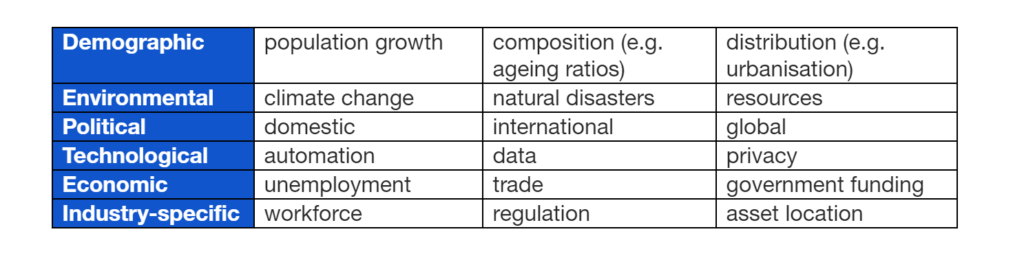
Policy teams should then seek to test and validate these with industry and affected stakeholders. Those drivers that have the highest combination of impact, likelihood and uncertainty on the future of that policy area can then be combined to create different future scenarios.
Policy officers can use the scenarios to generate ideas about what areas, directions, policies and measures could be pursued, identify blind spots in actions under consideration and explore whether actions might have unintended consequences in different scenarios.
The Australian Commonwealth Government is making the reports from its own scenario planning exercise public as a resource for others seeking to work through what the world could look like in the future. The reports present the freight sector scenarios with fictional newspaper articles showing what the world could look like under each scenario. The reports are available on our website. — Sarah Lewis
(Picture credit: Unsplash)
Make sure to share your own thoughts with the author by leaving a comment below

Log in or sign up to continue the conversation