
This article was written by Daniel Abadie, undersecretary of Digital Government for Argentina. For more like this, see our health and wellbeing newsfeed.
The UN Millennium Development Goals were succeeded by the Sustainable Development Goals (SDGs) in 2015, but not all goals had been accomplished.
The fifth Millennium Development Goal aimed at reducing the ratio of maternal mortality (RMM), meaning the number of women who die in childbirth, by 75%.
• Want to write for us? Take a look at Apolitical’s guide for contributors
Argentina took on this commitment and, in order to fulfil it, the RMM should have been reduced to 1.3 women out of every 10,000 live births by 2015. But, unfortunately, the ratio for that year was three times higher than the goal.
The infant mortality rate in Argentina is also higher than aimed for, reaching 9.7 per 1,000 live births during 2016. A staggering 70% of these cases of infant mortality are preventable.
One of the most successful strategies to reduce the mortality of pregnant women and their babies is to have at least five prenatal check-ups, the first within 13 weeks after conception.
“In Argentina, more than 30% of all women fail to attend prenatal check-ups and almost one in 10 have their first contact with the public health system when they give birth”
But, in Argentina, more than 30% of all women fail to attend these prenatal check-ups and almost one in 10 have their first contact with the public health system when they give birth.
What pregnant women want
To tackle this problem, our secretary of health made a plan in 2016 to contact women during their pregnancy and send them emails to communicate the importance of attending these prenatal check-ups.
Unfortunately, the emails were not personalised and were written in a cold, technical tone that made people feel as if the government was yelling at them.
In my role as undersecretary of Digital Government for Argentina, my team is in charge of building the government digital platform to interact with citizens.
After several meetings with the National Office of Maternity and Childhood of Argentina, with the goal of analysing their approach, we concluded that sending an email was not the right way to communicate with women during their pregnancy.
We still needed more information in order to understand what the right solution was, but we knew the most important thing was that it should be the solution that users needed – not what the government assumed it should be.
So we set up a team of anthropologists, psychologists, designers and process analysts, led by Florencia Rolandi, who is a cardiologist and senior advisor of health and disability at the Undersecretary of Digital Government.
This team conducted a six-month research effort, visiting health centres in different parts of Argentina to understand how women interact with the public health system and why some of these women didn’t attend the check-ups.
Our team built a user profile based on interviews (with patients and obstetricians) and observation that allowed us to have some conclusions about the users’ conduct and behaviour during pregnancy.
There are almost 40 million mobile phones in Argentina and 90% of the population own one. However, 70% of these phones are prepaid. For this reason, sending an SMS was not an option for us.
But, through interviews with potential users, we discovered that 90% of them were active users of Facebook and Facebook Messenger.
These interviews revealed that many women had questions about their pregnancy and the controls offered by our health services, with the need to access information simply and quickly.
Some women told us they did not attend the controls because they hadn’t received a reminder, but also through lack of information or fear. Their phones always accompanied them in the waiting rooms of health centres.
At the same time, we started working with the National Office of Maternity and Childhood of Argentina to develop the necessary content for a tool that could inform women about the health aspects of pregnancy and guide them during their pregnancy and the first year after birth.
We decided to build a virtual assistant that could work outside the health system, building an interaction channel with women via their phones and providing them with information and check-up reminders so that they can follow up on their pregnancy.
Say hello to Chat Crecer
Chat Crecer is a virtual assistant – a bot – based on Facebook Messenger that works independently of the health system, identifying and enrolling pregnant women where they are.
The bot is designed to accompany women during their pregnancy and the baby’s first year, giving the new mothers personalised information and reminders to attend pre- and postnatal check-ups.
Because the bot provides simple access to health information and is easily scalable – as it is not constricted by being in a physical location and does not have any additional costs per user – it has been a bridge to access health services for a population that is otherwise isolated from them.
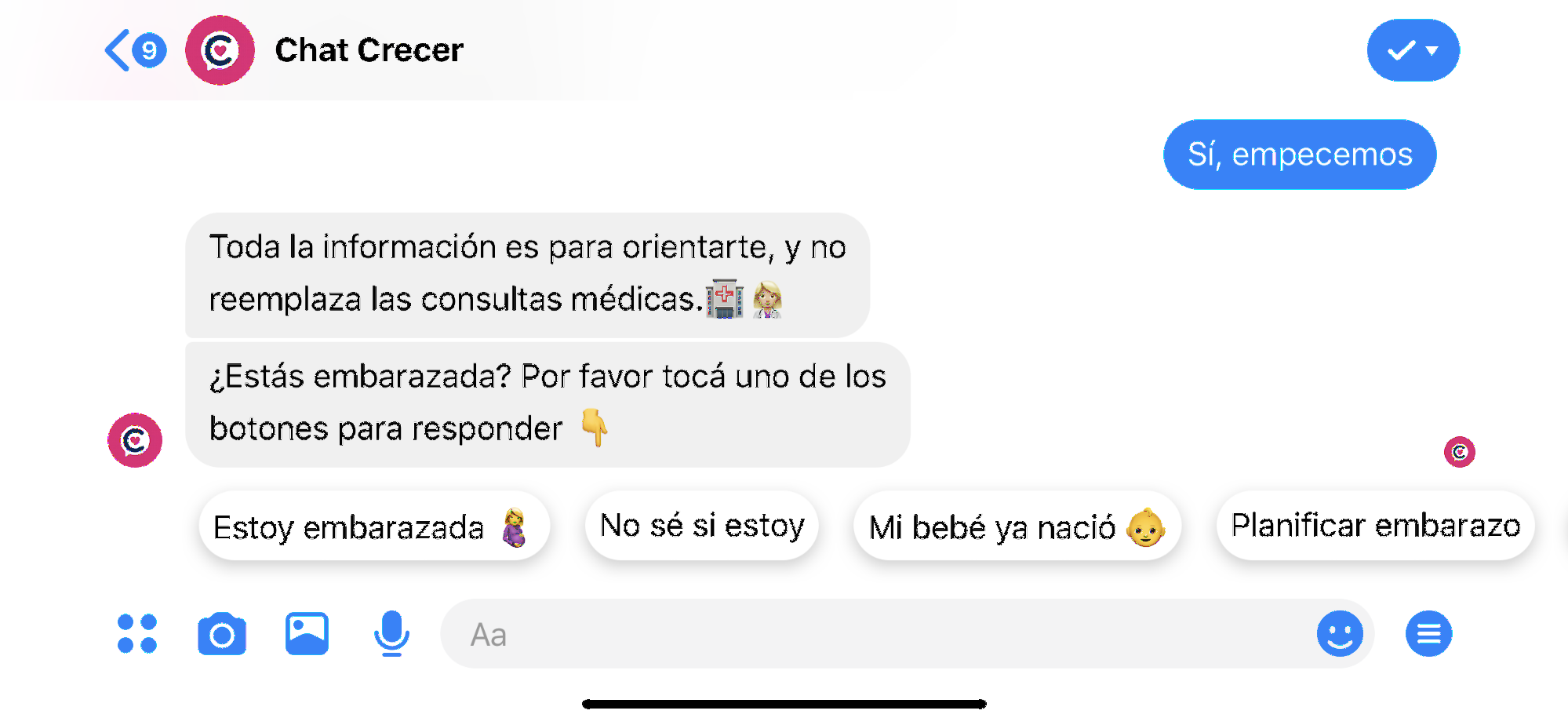 A screenshot of a conversation with Chat Crecer
We first implemented the project in Pilar, Buenos Aires, where 4,000 women give birth each year and the infant mortality rate is 11 per 1,000 live births. We enrolled a population of pregnant women to test the evolution and adoption of the bot.
A team of 10 university students led the field implementation and acted as digital literacy tutors (this initiative is part of our National Plan of Digital Inclusion), who find pregnant women in primary-care waiting rooms, school canteens or at social events.
Obstetricians also promoted the bot when they met women for check-ups. At the same time, usability tests and analyses of the platform were carried out (topics consulted and questions asked) that allowed us to implement improvements in the content and performance of the tool.
We implemented a “guerrilla communication strategy”, creating graphic material to use in health centres to promote the use of the bot, such as posters, reminders of next controls, tutorials on how to download and install Facebook Messenger or prescription forms.
And we decided not to use the government brand in any piece of communication as we believe the tool is agnostic of political context. To facilitate its acceptance and to be able to measure its impact as a public policy, we decided this step was necessary.
From July 11, 2018, to June 1, 2019, 4,000 pregnant women and 1,260 mothers of babies under the age of one were contacted by the digital literacy tutors. Of these, 4,200 are now using the platform.
Did it work?
The users took full control of the platform, our team watched the conversations and every missing topic was a requirement to the health team to create and make it available.
“We discovered that women consulted the bot on thousands of issues that the government did not have on its radar, and we launched awareness campaigns on vaccines, influenza, lactation and healthy eating”
We discovered that women consulted the bot around the clock on thousands of issues that the government did not have on its radar, and we launched awareness campaigns on vaccines, influenza, lactation and healthy eating.
We evolved the conversation flows. In addition to accompanying women during their pregnancy, we defined five main conversation flows:
- I am pregnant.
- I do not know if I am pregnant.
- Plan my pregnancy.
- I want to accompany a pregnancy.
- I want information.
The main functionality of remembering appointments was improved by incorporating the location of 25,000 health centres across the country to help our users find the closest one. We created and designed illustrations to support breastfeeding and added information on social benefits and how to obtain a national identity document for babies.
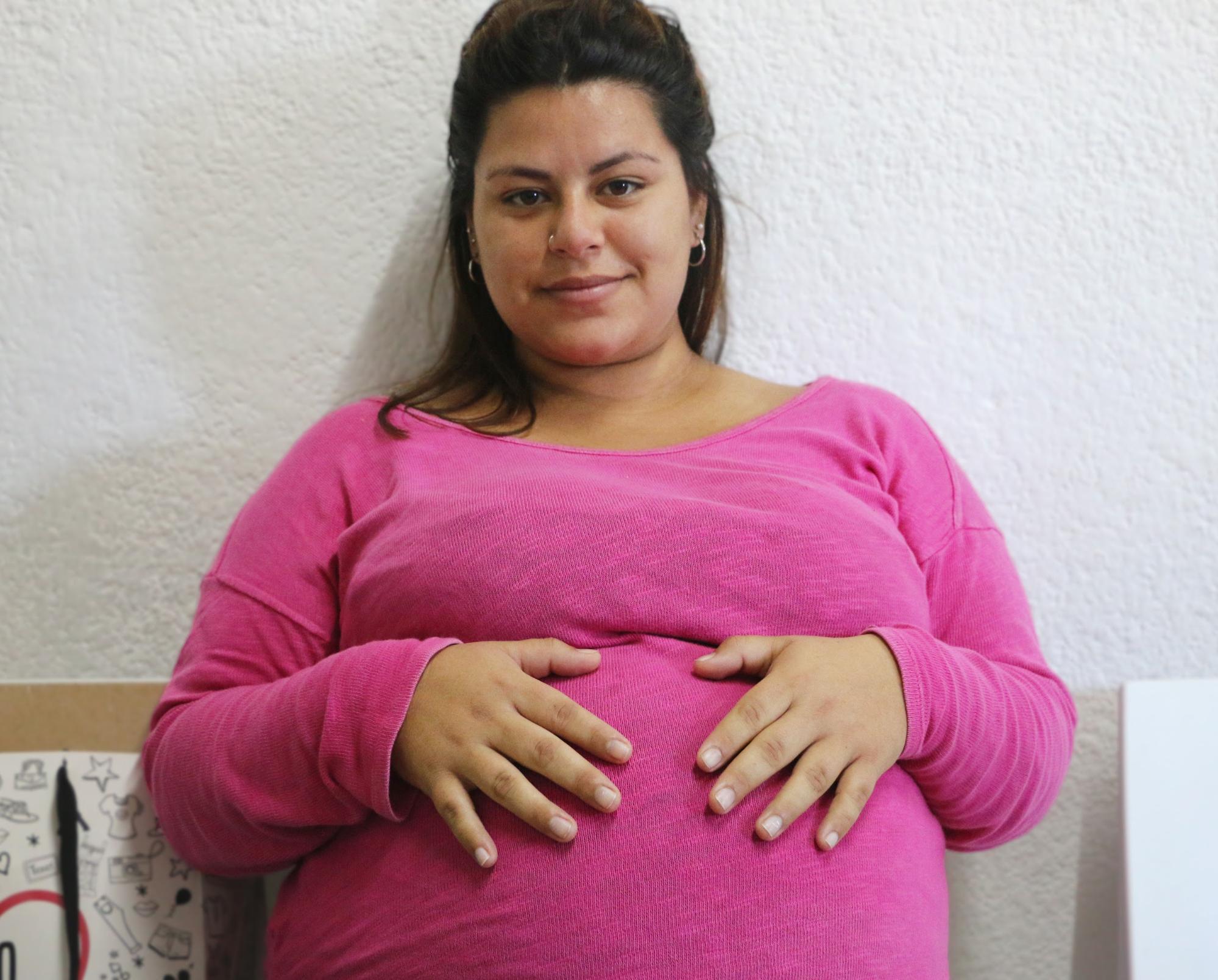 Many women don’t attend prenatal checkups in Argentina, which increases the risk of complications for both the expecting mothers and their babies
To strengthen the link with the user, Chat Crecer sends personalised information according to the week of gestation, with the aim of reducing uncertainty and fears.
Also, once a week, the bot asks: “How are you today?” This triggers different actions according to the response (“good”/“more or less OK”/“bad”), providing information and recommendations.
During the last weeks of pregnancy, the bot asks the users: “Is your baby already born?” Many users, after days of no response, send us a photo of their baby. This is perhaps the best moment of the project, where the bot really became the “pregnancy chat”.
Time to measure the impact
With the epidemiological team of the secretary of health of Argentina, we are evaluating the impact of the tool by measuring the prevalence of women with proper prenatal control, defined as at least five prenatal controls during pregnancy, in a sample of 800 women.
To do this, we designed a non-randomised intervention study with two comparison strategies.
One of these strategies looks at the historical controls reported in a health management system (perinatal information system) employed by the public health services.
The second strategy is a comparison between two groups of women: one that uses the bot and another that doesn’t.
To carry out this analysis, we used a local maternity database where key data on the number of controls and characteristics of the birth is recorded. For the purpose of this study, we added a question for the mothers about whether or not she used used the virtual assistant.
This enables us to compare several variables, including:
- Percentage of mothers without control during the pregnancy (almost one in 10 have their first contact with the public health system when they give birth).
- Percentage of mothers with insufficient prenatal consultation, which we defined as fewer than five consultations.
- Percentage of mothers that were recruited early, which we defined as having their first control within the first 13 weeks of pregnancy.
At the same time, we conducted interviews to measure the satisfaction of our users with the bot. We asked: “Would you recommend Chat Crecer to a pregnant woman?” with the answer on a scale of one to 10 (we used Net Promoter Score to create a score).
We interviewed 400 women, of which eight out of 10 recommended the bot (77.78 NPS).
The results so far show that women who have used Chat Crecer attend more prenatal check-ups (1.2 more) than those who haven’t used the bot.
Also, we observed that women who use the virtual assistant have their first prenatal check-up earlier, usually at the first stage of pregnancy, reducing the time to access the health system by 50%.
We are working to publish a scientific article with these findings, together with the secretary of health of Argentina.
We are also proud to say that Chat Crecer has won a Webby Award, which are given each year by the International Academy of Digital Arts and Sciences.
Chat Crecer is nationwide now and we are working along with the different provinces in Argentina to interact with their public health systems.
We created a resources website for any organisation that wants to implement the bot, and we are evaluating joining efforts with international organisations to replicate this experience.
Chat Crecer is a health policy that interacts outside the health system that is easy to use, easy to scale and simple to replicate. I invite you to try it: m.me/chatcrecer.
— Daniel Abadie
Picture credit: Undersecretary of Digital Government of Argentina
Make sure to share your own thoughts with the author by leaving a comment below

Log in or sign up to continue the conversation