
This article is written by Luis Lafosse and Jen St Jack, board members with the Australian Institute of Urban Studies – South Australia.
A hundred years ago, a single flight launched Qantas Airways and willed the entire Australian aviation industry into being.
The Great Air Race – connecting Britain and Australia by air in less than 30 days – resulted from one of the most successful public policies ever to promote innovation and economic development in Australia. And it was so simple that it fits in one telegram and a 30-second Parliamentary announcement.
• Want to write for us? Take a look at Apolitical’s guide for contributors
With today’s mantra of “Jobs, jobs, jobs” commanding the political conversation, and wicked problems and complex challenges permeating discussions on the future of government, it is worth revisiting that policy and considering how public servants and policy designers can relearn to solve our problems more simply.
Liftoff
In late 1918, soon after the first world war ended, Australian prime minister William “Billy” Hughes gathered with global political leaders in Europe for the Paris Peace Conference. At that time, the aviation industry was still in its infancy. Hughes had the privilege of being among the first to experience the flight between Hendon (London) and Buc (Paris) in a Royal Air Force Handley Page. He rapidly became an aviation enthusiast.
“It is worth revisiting that policy and considering how public servants and policy designers can relearn to solve our problems more simply”
In those days, the streets of London were full of soldiers awaiting demobilisation. On a Christmas Day visit to wounded Australian veterans, Hughes met airmen who were impatiently waiting to be sent back to Australia. They told “the Little Digger”, as he was affectionately known, that they wanted to fly their own machines home. Hughes expressed reservations about the safety of such a trip, but he was impressed by their determination.
Hughes was aware of a £10,000 prize on offer at the time for an aircraft that could fly non-stop across the Atlantic Ocean. A similar idea that could connect Great Britain with Australia began to fly in his head.
Within weeks, Hughes had made contact with key political organisations and figures, including the British air minister, who “supported the race wholeheartedly”.
On 18 February 1919, Hughes sent the historic telegram to his cabinet colleagues in Melbourne: “Several Australian aviators are desirous of attempting flight London to Australia in a Handley Page machine. They are all first-class men and very keen… It would be a great advertisement for Australia and would concentrate the eyes of the world upon us if the flight were undertaken.”
The circus flight lands
No one knew how, exactly, to fly the 18,000 kilometres from Great Britain to Australia.
The first international passenger service between London and Paris had yet to be inaugurated. Airplanes crashes were frequent. There weren’t any landing strips along the route. The risk of fatal failure was high.
Despite this grim outlook, acting prime minister William Watt made an official announcement on 19 March 1919 in the House of Representatives: “With a view to stimulating aerial activity, the Commonwealth Government has decided to offer £10,000 [approximately £500,000 in today’s money] for the first successful flight to Australia from Great Britain, in a machine manned by Australians.
“The rules and conditions governing the contest are now being drawn up, and it is proposed that competitors be required to supply their own machines and to make all other necessary arrangements in connection to the flight.”
On 25 May 1919, two months later, the competition rules were announced. There was a 16-month window to undertake the flight and entries were open to any Australian pilot and navigator completing the journey within 30 days.
All the aircrafts had to be privately financed and British-made. Teams had to waive the right to claim for injuries or loss. By 18 October, eight teams had entered.
The reaction of the press in Australia was not optimistic. One of the most influential progressive newspapers, The Age, called it “a circus flight – a poorly disguised attempt at self-advertisement at the expense of the Australian public”.
The conservative The Argus agreed, sarcastically claiming that the flight would prove so easy there was no necessity to throw away good money on the project.
One local paper, The Corowa Free Press, didn’t hesitate to express its distaste: “They ought to carry as passengers on the experimental voyage as many federal members as possible and leave them somewhere else.”
Despite this lukewarm reception, nine months after the official announcement and after 27 days and 20 hours of flying time, the Vickers Vimy G-EAOU manned by Ross Smith, his brother Keith and mechanics Wally Shiers and Jim Bennett, landed on the coast of Darwin. It was one of the greatest aviation achievements ever made – and just six months after the first flight across the Atlantic.
A small price for a big win
You might ask why this story is relevant to public servants today.
The £10,000 award policy was virtuous in several aspects:
- It was problem-oriented. We often see contests or awards. However, the virtue of the Great Air Race was that the award was granted to those who solved a specific problem – flying from Britain to Australia in 30 days – rather than the “best” application of a specific technology.
- It encouraged the application of new technologies. The race’s rules weren’t prescriptive. They acknowledged the dawn of aviation technology and encouraged citizens to use it for a purposeful goal.
- It was collaborative and involved the community and private sector. Participants had to develop their own plans, resources and knowledge, and they had to collaborate with others to put an aircraft on the starting line.
- It was inherently consultative. The government secured a successful outcome simply by granting an attractive award and bringing the problem to the table. The solution was delivered by the community. Such policies don’t demand consultation. The policy is the consultation.
- It appealed to Australians’ ingenuity and creativity, and it prompted the inception of other ideas, projects and industries.
- It wasn’t oriented towards creating jobs. None of the historical literature mentions the term “job creation”. The intent of the race was simply to promote “aerial activity”. It challenged the community to create a solution. Eventually the solution, and what followed, created jobs by the thousands, along with iconic businesses and unprecedented services.
- It was extremely low cost. Given the significance of this breakthrough and its ultimate impact on Australia’s economy, the level of public investment was a trifle compared to its return on investment.
Importantly, the Great Air Race created the space for people, ideas and new ventures to intersect – in other words, it sparked innovation. And in the way that innovation usually does, it triggered some unexpected results.
Is the world really more complex today?
Australians are very familiar with the names of winning pilots Sirs Ross and Keith Smith, but some lesser-known pilots involved in the Great Air Race have had just as significant an impact on the aviation sector.
Pilots Paul McGinness and Hudson Fysh first met in the Australian Flying Corps in Palestine during the first world war. They entered the Great Air Race, but were forced to withdraw when their financier died suddenly. Instead, the Australian Defence Department commissioned the pilots to survey suitable landing sites for the race in Queensland and the Northern Territory.
While undertaking that job, the pair realised how commercially valuable an aerial service could be to those remote communities. A chance encounter gave them the start they needed when they came across wealthy grazier Fergus McMaster and helped him unstick his vehicle from a creek. McMaster was soon on board, offering strong business guidance and connections with other investors from the region.
On 16 November 1920, 11 months after the first flight from Great Britain to Australia, they registered Queensland and Northern Territory Aerial Services Ltd – Qantas – as a company.
The Great Air Race was an effective policy. We still enjoy the long-lasting effects of its outcome. The role the aviation industry has played in Australia’s development is immeasurable.
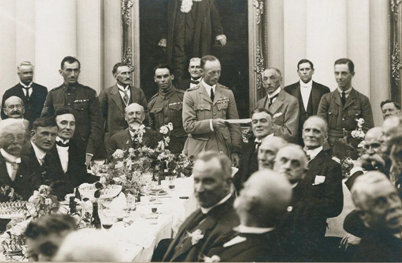 Presentation of a cheque for £10,000 to Ross Smith by prime minister William Hughes, 27 February 1920. Walter Shiers, James Bennett, and Keith Smith are standing in the background.
Those who work in the public service are daily flooded with articles, reports, white papers and keynotes referring to the complex times we live in and the even more complex public policies we must develop to address the challenges we face.
“Are our policy needs more complex than those considered during a peace conference to end the first world war? Are they more complex than a policy that kickstarted the Australian aviation industry in just 11 months?”
Is that true? Are our policy needs more complex than those considered during a peace conference to end the first world war? Are they more complex than a policy that kickstarted the Australian aviation industry in just 11 months?
Let innovation take flight
The Great Air Race ticks all the boxes of a well-rounded, contemporary public policy. It was problem-based, it was collaborative, it was developed in consultation with the community, it involved a systems approach, it encouraged the community to create and bear risks, and it created the space for innovation.
It was a simple policy, but it delivered on a complex outcome.
Today, like a century ago, we are transitioning to a new technological age, with new problems to solve. We are even seeing governments revisiting competition-based policies. But they are flawed.
Most calls for “innovative solutions” are attached to fresh applications of the hottest new tech – but that isn’t really a problem. To truly unleash the creativity of individuals and industry, governments must identify precise problems and reward the best solutions, regardless of the tech employed, devoid of vested interests and without trying to take on and control the risks.
In anticipation of the centenary of the Great Air Race, a rerun using renewable-powered electric aircrafts was in the works. Despite 30 teams registering, the organisers had “no option but to cancel the race”.
Why? The 25 governments along the route couldn’t agree on arrangements for safe passage. A hundred years on, with all the technological means at our disposal, we are killing opportunities for innovation before they are able to take flight.
— Luis Lafosse and Jen St Jack
Picture credits: State Library of South Australia; Shaun Bell on Unsplash
Make sure to share your own thoughts with the author by leaving a comment below

Log in or sign up to continue the conversation