
This article is written by David Durant, Senior Delivery Manager at Hackney Council in the UK.
If you work in government, chances are you get a lot of emails.
For many of us, we have come to take this aspect of life as a public servant for granted. But what if there was a smarter way to communicate? One that enabled us to talk more fluently, and include more people in our conversations? As you have probably guessed, this technology already exists. It’s online chat.
Governments continue to evolve away from siloed organisations defined by hierarchies and hard policy/delivery boundaries. More and more, there is a trend towards a more adaptable, fluid network-style structure.
For this new way of working to become the norm, there are a number of supporting digital services that need to be put in place.
One can hypothesise about the kind of services that are needed but it seems highly likely that the following four sets of user needs will need to be covered:
A way to facilitate and record decision-making in policy and delivery across multiple organisations that all contribute to a single project
A method of recording, cataloguing and searching institutional memory
A service to find the right people for any given task at hand
Mechanisms to facilitate communication between team members in widespread locations
Much has been written elsewhere on these topics; for example, in her excellent book Smart Citizens, Smarter State, Beth Simone Noveck of NYU goes into some detail about the advantages of a single cross-organisational “people directory” that records a civil servant’s contact details, skills, related interests and previous projects.
This essay will focus on the final point in the list above — mechanisms for communication — and particularly on using online chat as a way to enable civil servants to discover and easily join conversations with experienced colleagues, potentially based anywhere in the world.
Why encourage online chat as a tool for civil servants?
Civil servants continue to be overloaded with email. Online chat systems — of which the most famous is probably Slack — represent an alternative. They provide their users with a number of key features, such as enabling the creation of channels for a specific team, role or topic, to enable opt-in filtering of the messages a user receives.
Another advantage is that online chat provides excellent support for government-wide community building. For example to bring together people undertaking the same role in different organisations or for people coming together from different teams to work on the same policy area from different angles via service communities.
There are a number of reasons why cross-organisational online chat, while successful in certain areas, has not been more widely taken up by civil servants
Flows of conversation are much more natural than email, especially when multiple parties are involved. People are often used to this already as such services have become extremely popular in non-work contexts, with products such as WhatsApp becoming household names.
However, unlike WhatsApp, one of the advantages of work-based chat services is that people can join without knowing any of the users already involved and can immediately take advantage of the opportunity to ask questions and seek out people working on similar topics.
Online chat has very much supported the ability to work from home while still maintaining contact with colleagues, contributing to the overall work/life balance of many civil servants.
Finally, online chat systems are often integrated in a significant number of other cloud services, making it easier to monitor systems and collaborate on documents, to name just two of the many available options.
What’s preventing the uptake of cross-organisational online chat?
There are a number of reasons why cross-organisational online chat, while successful in certain areas, has not been more widely taken up by civil servants.
By far the main one is the lack of knowledge that a number of services already exist. In the UK to date there has been little in the way of internal departmental communication to staff about these services, with organisations instead focusing on their own internal-only versions, if such things exist. This is likely due to the semi-official nature of some of these services, which makes it difficult for some civil servants to feel empowered to either use or recommend them.
The reasons why official adoption has been lacking are complex in themselves. Some civil servants worry that conversations in online chat will be more informal than email and that this could reflect badly on organisations should journalists submit requests for open data, for example via Freedom of Information requests. A specific example of this in the private sector are the recent issues at online luggage company Away where comments on Slack by CEO Steph Korel have led to her resignation. That said, a good argument can be made that this is no different to any other communication mechanism and that organisations should trust their staff to act responsibly.
Speaking of views of such services by some people outside of government, some journalists have been surprised to discover that popular channels often include such water cooler topics as movies, video games, pets and other non-work related things. It is sometimes judged as being a frivolous waste of taxpayer money to support such things. But in reality, it creates bonds of community and helps bring staff together, improving staff retention and ensuring that people feel as if staff from other departments are humanised and accessible.
The UK cross-government Slack has approximately 2,000 weekly active members and has had over 1.5M messages posted since its creation in 2015
Cost models are sometimes also an issue. Free versions often exist but have limitations — for example that past messages cease to be accessible over time. Paid-for versions tend to be priced on a per-user model, perversely disincentivizing a push for further adoption of the product.
Sometimes departments have chosen to procure a single digital service that provides a number of functions including online chat. These are often incompatible so users of different systems cannot connect to each other. This would mean that to access such collaboration chats the user would frustratingly need to access at least two different systems.
However, in some cases even knowing the services exist is not enough, as the ability to access them is blocked at the departmental network firewall. This is also the case for many other cloud-based collaborative productivity systems, such as Google Docs and Trello. One Team Gov, about which more below, is planning to continue to look into this issue during 2020.
There is also the issue that the existing cross-government online chat services tend to have previously focused on staff working in the area of digital service development and therefore tend to have names that include the word “digital” in them. It is possible that this, plus the high technical proficiency of many of the existing users, could be off-putting to new members with different roles and backgrounds.
Finally, when looking forward to how we could build truly international platforms, the issues of time zones and languages become more important. There are a number of successful systems in the private sector that operate well across multiple time zones by encouraging a culture that supports members wherever they happen to be based. In addition, building on automatic translation technology, some services can now support users who don’t share a common language.
Four examples of successful cross-organisational online chat services
Currently, one of the most popular cloud-based products for online chat is Slack. Many individual government teams have their own internal-only Slack workspaces but here are three examples of successful cross-organisational collaboration that stand out.
The UK cross-government Slack
The UK cross-government Slack has approximately 2,000 weekly active members and has had over 1.5M messages posted since its creation in 2015.
Its purpose is to facilitate discussion across the whole of government. It has over 400 channels with many active topics, ranging from cybersecurity and service design to technology best practice and much more besides. Any existing member can add new members as long as they have a work email address that ends in “gov.uk”.
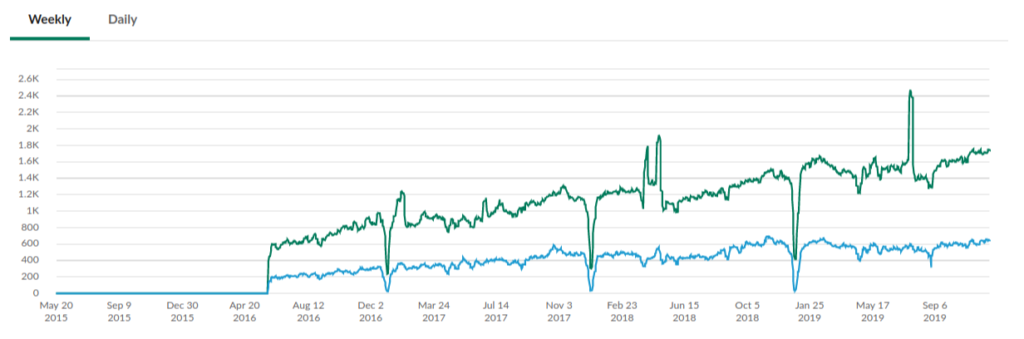
The weekly active users (green) and members who have posted (blue) for UK Government Digital’s slack.
The drop-offs coincide with holidays. The spikes in usage usually coincide with either a major news story or an event, such as a conference, where the service is mentioned to many new potential users.
The 18F Slack
18F is a digital services agency based within the United States' General Services Administration. Its Slack instance has a membership from across the whole of the US government estate. Unlike the UK cross-government Slack, it uses the paid-for version of Slack and is fully supported. Its comprehensive manual can be found here
The UK Local Gov Digital Slack
The UK Local Gov Digital Slack has approximately 250 weekly active members, with a significant increase occurring in the last 18 months as staff from considerably more local authorities have started to regularly take part in conversations.
It is run by a coalition of local government staff rather than a central government department. It has over 100 channels, which cover a very wide range of topics within the remit of local government. You can gain access by joining Local Gov Digital via this application form.
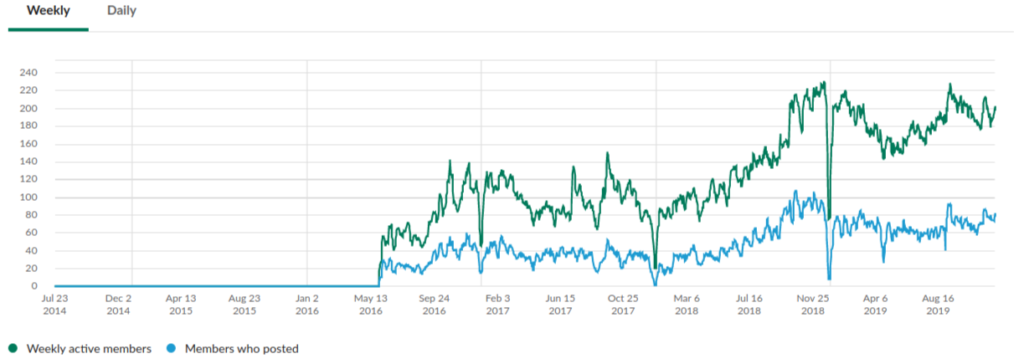
The One Team Gov Slack
One Team Gov is a global community, working together to radically reform the public sector through practical action.
They are driven by optimism and the desire to make things better, and are united by a set of core principles. The One Team Gov Slack is an excellent example of the power of such services to bring together people from across the world to collaborate on common issues. Members include individuals from the UK, Sweden, Australia, New Zealand, Canada and many other global locations.
Common topics include facilitating digital transformation, the environment, new ways of working and how to organise new-style meet-ups. The latter in turn has led to the delivery of a number of large international unconferences attended by senior civil servants. Anyone can join the One Team Gov Slack here.
What next for government online chat?
As more of everyday discussion moves online, the advantages of online chat, alongside other powerful digital services, will likely increase its uptake by individual users and government organisations. There are a number of ways in which this could be accelerated:
Official ownership and support of such channels. This is already in place in many cases, but some very successful examples still don’t have official sanction or any associated support budget.
Encouragement for others to join and participate. As mentioned above, in many cases such channels are still dominated by people working in digital teams. This should be opened up to support civil servants in non-digital roles. There are a number of ways to do this:
Via existing cross-organisational bodies such as LOTI (as an example in the UK local government space)
Being introduced as part of the standard induction and initial training of roles in government, such as the Policy Profession in the UK
Being made part of Continuing Professional Development for such roles so existing staff can also be introduced to the concept
The introduction and support of such services for already successful trans-national groups, such as Open Ownership and the Open Government Partnership to bring in even more diverse needs and viewpoints
Finally, there are examples of countries like Taiwan where “Join”, their national online civic participation platform, have started to drive true bottom-up democratic change by enabling citizens to directly interact with law-makers.
We are still in the very early stages of restructuring how government works on a national scale and still well short of fully understanding how real-time national cross-organisational and fully global discussions, facilitated by the internet, can aid government decision making.
The future of this area continues to be exciting. — David Durant
David Durant is a Senior Delivery Manager at Hackney Council in the UK. A former member of GDS, he has been quoted in a number of UK Parliamentary reports on digital technology in government, including the Speaker’s Digital Democracy Commission and the Science and Technology Committee Digital Government Inquiry.
(Picture credit: Unsplash)
Make sure to share your own thoughts with the author by leaving a comment below

Log in or sign up to continue the conversation